

I have seen no shortage of crypto projects that know how to make noise.
They arrive with huge promises, dramatic language, and the kind of branding that makes it sound like they are about to rebuild finance, redesign the internet, and save humanity before the day is over. It is exciting for a moment. But once the slogans fade, I keep coming back to one simple question: does this project solve a real problem that people and systems actually face every day?
That is where Sign stands out to me.
Not because it feels flashy. Honestly, it does not. It feels like infrastructure. Quiet, practical, deeply unglamorous infrastructure. And that is exactly why I take it seriously.
For me, one of crypto’s biggest weaknesses was never a lack of ambition. The space has always had ambition. The real weakness has been fragmentation. Every app, chain, protocol, and ecosystem builds its own rules, its own standards, and its own trust logic. So users end up proving the same things again and again. Credentials stay trapped in one environment. Approvals do not travel. Records lose meaning the moment you step into a different system.
That is not innovation. That is friction dressed up as progress.
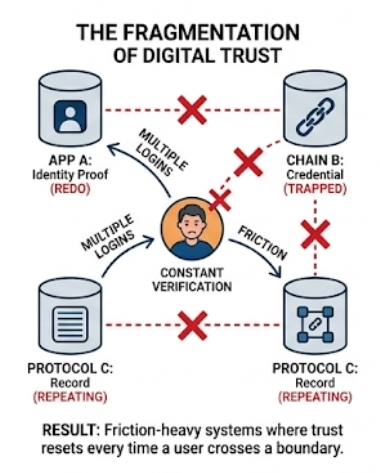
This is why I keep paying attention to Sign’s focus on attestations and portable trust. On the surface, it may sound boring. But in reality, this is one of the most important layers any digital ecosystem needs if it wants to grow up.
Because nothing truly scales when trust resets every time a user crosses a boundary.
A person should not have to verify the same fact in five different places just because five systems refuse to recognize each other. A credential should not become useless outside the first platform that issued it. A claim, an approval, or a proof should be able to move with context and still hold value. That is where Sign feels relevant. It is not just thinking about verification as a one-time event. It is thinking about trust as something that should be structured, reusable, and portable.
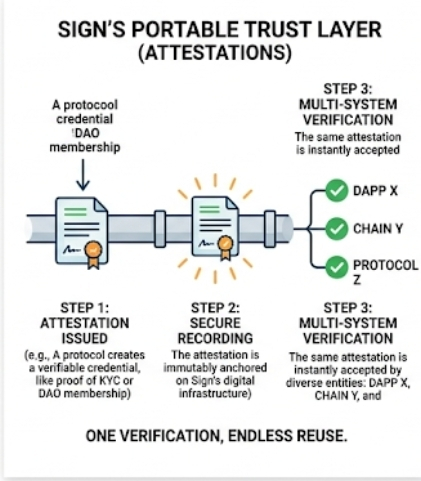
And that has a much bigger future than many people realize.
If crypto is serious about mass adoption, onchain identity, compliant finance, digital organizations, cross-chain ecosystems, and smarter internet coordination, then systems need a better way to carry trust across environments. In the future, I think the winners will not just be the projects that attract attention. They will be the ones that make digital systems less repetitive, less fragile, and less dependent on starting from zero every single time.
That is the lane where Sign feels important.
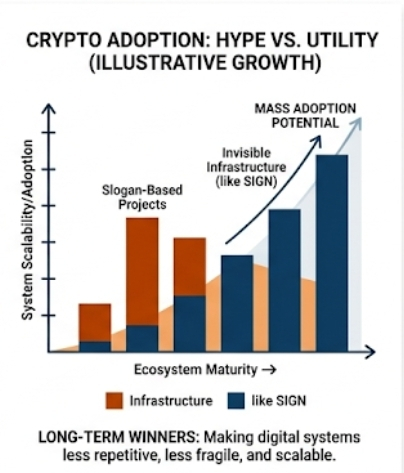
Of course, I am not naive about it. A real problem does not guarantee a winning outcome. Infrastructure only matters if people adopt it. Standards only matter if ecosystems agree to use them. Strong ideas still need timing, execution, and broad integration. Crypto has buried many good ideas simply because the market was too impatient to let them mature.
So I do not look at Sign and see a perfect answer.
I see a serious attempt to solve one of the most ignored problems in crypto: how to make trust less disposable.
That may never be the loudest mission in the market. It may not create the most viral excitement overnight. But I trust this kind of ambition more than the usual hype.
Because the future of crypto will not be built by slogans alone. It will also be built by the projects willing to fix the invisible layers that everything else depends on.
And that is exactly why Sign has my respect.