

I keep coming back to Midnight because it seems to be asking a more realistic question than a lot of blockchain projects used to ask. When I first started thinking about privacy on a blockchain I assumed it meant hiding everything, but that was always too simple. Midnight describes itself instead as a data protection blockchain that keeps sensitive information private while still letting the network verify that something true happened, and I think that distinction matters because the goal is not secrecy for its own sake. It is selective disclosure backed by zero-knowledge proofs so a person or company can prove a claim without laying out the underlying data for everyone to inspect. NIST describes zero-knowledge proofs in almost exactly that practical spirit by treating them as a way to prove a statement is true without revealing the extra information behind it.
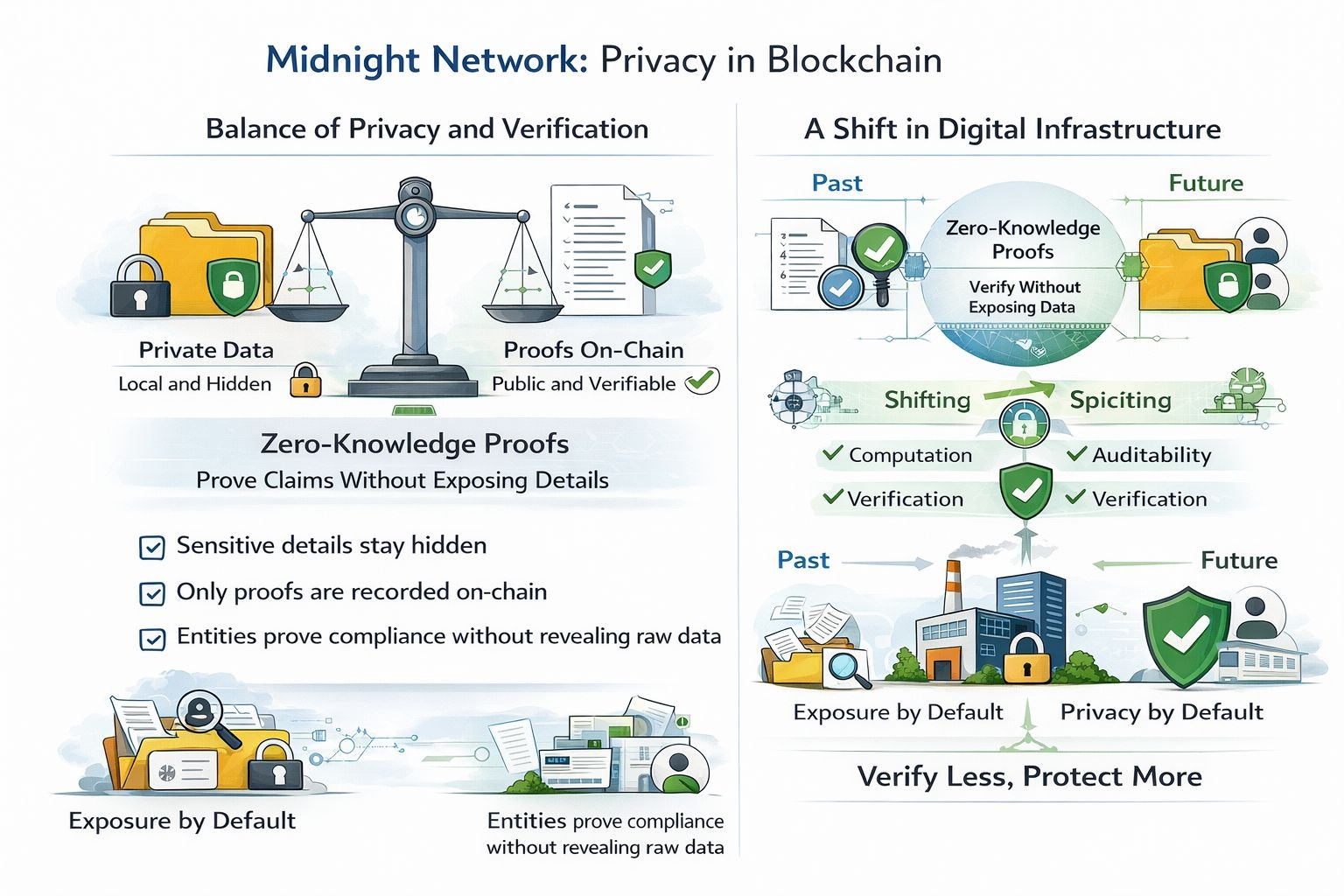
What I find useful is that Midnight does not pretend the public and private parts of a system should live in the same place because its own documentation says it keeps two parallel states. Midnight splits things into two sides. There is a public side on-chain for proofs, code, and information that is supposed to be visible, and there is a private side that stays with the user so sensitive data never has to be pushed out into the open. What that really means is the network can check that something was done properly without making people give up the details of their private lives or business activity. Midnight also says developers can write privacy-preserving contracts in Compact, which it presents as a TypeScript-like language, and that disclosure has to be declared explicitly rather than happening by accident. I used to think the hardest part of protected data would be the math, but more and more I think the harder part is designing systems where privacy is the default and exposure is the exception. Midnight is clearly trying to build around that principle.
Part of the reason this is getting attention now rather than five years ago is that the pressure around data has changed in a way that feels much more immediate. AI use inside firms has been rising fast and the OECD says reported firm-level AI adoption in its available-country data more than doubled from 2023 to 2025. At the same time regulation is no longer a distant possibility because the European Commission describes the EU AI Act as the first comprehensive legal framework on AI and the whole logic of that framework turns on risk, accountability, and trustworthy use. The OECD’s 2025 discussion of AI and privacy-enhancing technologies points to the same issue from a different direction. More organizations need ways to collaborate on data and models while still keeping exposure low and private information protected. Seen that way, Midnight is not only part of a blockchain story. This sits inside a wider change in expectations around digital infrastructure. Businesses still want the benefits of computation, oversight, and coordination, but they do not want to get those benefits by leaving sensitive information permanently visible to everyone.
The recent movement around Midnight also makes it easier to see why people are paying closer attention right now because the project seems to be moving from concept toward live use. Official updates say the network entered its Kūkolu phase in February 2026 with mainnet announced for late March and an initial federated operating model meant to provide stability for live production use before a later move toward fuller decentralization. That matters because it makes the project feel less like a theory paper and more like an attempt to cross the awkward line between research and operations. At the same time the timing shows why caution still matters since Midnight’s own forum reported a preprod reset and continuing testing ahead of launch as recently as March 21. What surprises me is that this uncertainty does not weaken the story so much as make it more believable because protected-data systems should be judged by whether they work under stress rather than by how cleanly they are announced.
When I try to picture where protected data is heading I do not see a world hidden behind closed doors. I see a calmer shift in how people think about digital infrastructure. Systems will still need to prove what happened, support oversight, settle transactions, and help people coordinate, but more and more there will be an expectation that they can do those things without revealing so much by default. Midnight is one attempt to build that kind of infrastructure in a way that is verifiable, programmable, and more careful about what becomes public. Whether it succeeds is still an open question, and that uncertainty feels like part of the honest center of the whole discussion because the OECD notes that privacy-enhancing technologies remain technically complex and hard to adopt widely. The future here probably belongs not to the loudest privacy claims but to the tools that make restraint usable, and that is why Midnight seems interesting to me now. It treats protected data not as an edge feature but as the normal condition serious digital systems will have to learn to respect.
@MidnightNetwork #Night #night $NIGHT
