

I keep coming back to the fact that trust is easy to talk about and much harder to build in a way that lasts under pressure. My first instinct used to be that digital trust was mostly a matter of security and that if you protected the system and locked down the data then the rest would sort itself out. The more I look at what Sign is trying to do the less complete that view seems. What Sign appears to be reaching for is something wider and more demanding which is a way to make important digital claims clear enough to read solid enough to verify and durable enough to hold across institutions that do not fully know one another and still have to work together. In its own documentation Sign describes S.I.G.N. as a sovereign grade framework for national systems of money identity and capital with Sign Protocol serving as the evidence layer beneath it. That wording matters to me because it shifts the idea away from another crypto product and toward infrastructure for proving what happened who approved it and which rules were in force at the time.
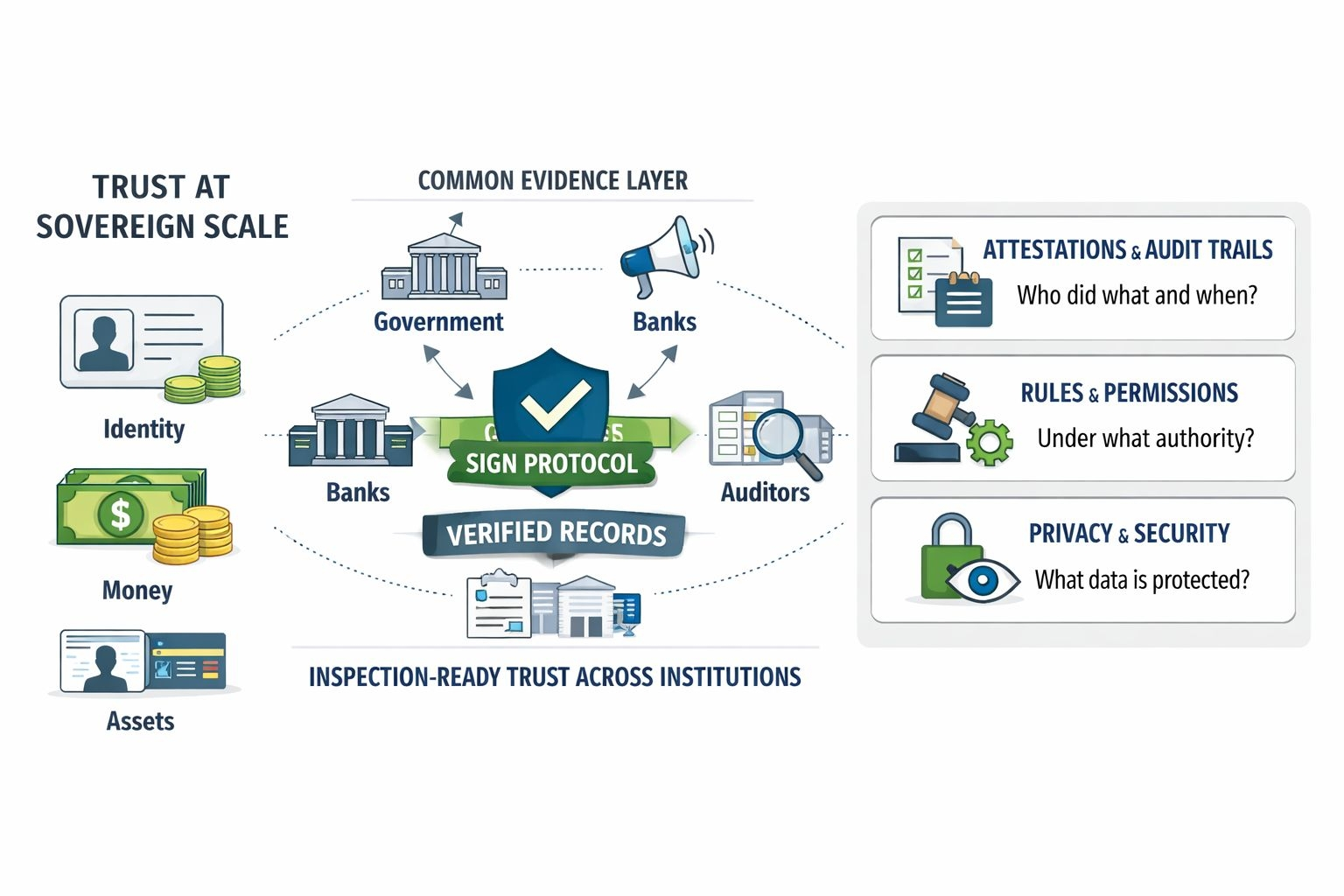
I find it helpful to look at the problem as a problem of shared memory rather than simple storage or transfer. The real challenge is not only moving value or keeping records in place. It is creating a record of events and permissions that agencies banks service providers and auditors can all rely on without being forced into blind trust. Sign’s materials describe this as inspection ready evidence and that phrase gets close to the heart of it. At sovereign scale trust cannot just mean that a system feels smooth to use or that a transaction appears to go through without friction. It has to hold up under oversight under dispute under policy change and under the kinds of edge cases that tend to define whether a public system is credible or not. A ministry may need proof that a benefit payment followed an approved rule. A regulated financial system may need evidence that an identity check took place without exposing more personal data than the situation requires. An institution may need to verify not just that a record exists but that it can be traced to a recognized authority and reviewed later in a way that still makes sense. That is why Sign spends so much time on attestations schemas audit trails and privacy controls. The part I find most interesting is that this turns trust into something less emotional and more inspectable. It becomes less like confidence and more like a fact pattern that can be examined.
That is also why this feels more relevant to me today than it once did. I used to assume these were separate conversations with very little overlap. Digital identity sat in one lane. Payment rails sat in another. Central bank digital currency debates moved on their own track. Document signing and verification belonged somewhere else again. Now those strands are moving closer together because governments and large institutions are facing a practical question that is hard to avoid. What does a country need if it wants identity payments permissions and records to work together without becoming a tangle of disconnected systems. The World Bank now treats digital identity e signatures digital payments and data sharing as core parts of digital public infrastructure rather than peripheral tools. The European Union has moved from broad discussion to implementation around its digital identity wallet and related interoperability work. The BIS has also been direct in saying that cross border payments remain slow expensive and fragmented while arguing that tokenisation could play a serious role in the next generation of financial systems. That tells me the pressure is no longer abstract. Institutions are trying to connect systems that were built apart from one another while still operating under legal political and administrative limits that do not disappear just because the technology changes.
What surprises me is that the big idea behind Sign is actually fairly restrained once the futuristic language falls away. It is not really an attempt to remove institutions or bypass politics or pretend that interoperability can be wished into existence. It is a more grounded attempt to make claims portable and verifiable enough that institutions can coordinate at scale without rebuilding trust from scratch every time they interact. That matters even more now because stablecoins and tokenised assets are no longer sitting at the edge of the conversation. Once money identity and capital begin to move in more programmable forms the weak point is not only settlement. It is evidence. Who is allowed to do what. Which rule applied at the moment an action took place. Can someone verify that later without having to depend on a single vendor’s database as the final source of truth. That is the idea behind Sign as I understand it. Trust at sovereign scale is not trust without institutions. It is trust that can move across them remain visible under scrutiny and still hold when the stakes stop being experimental and become public.
@SignOfficial #SignDigitalSovereignInfra $SIGN
