

When I first heard Midnight had a two-asset design, my reaction was basically a sigh. In crypto, “two tokens” usually means someone found a sophisticated way to justify a second narrative, a second valuation layer, or a second sale. After spending more time with Midnight, I ended up at a conclusion I did not expect: this separation actually has real logic behind it.
$NIGHT @MidnightNetwork #night 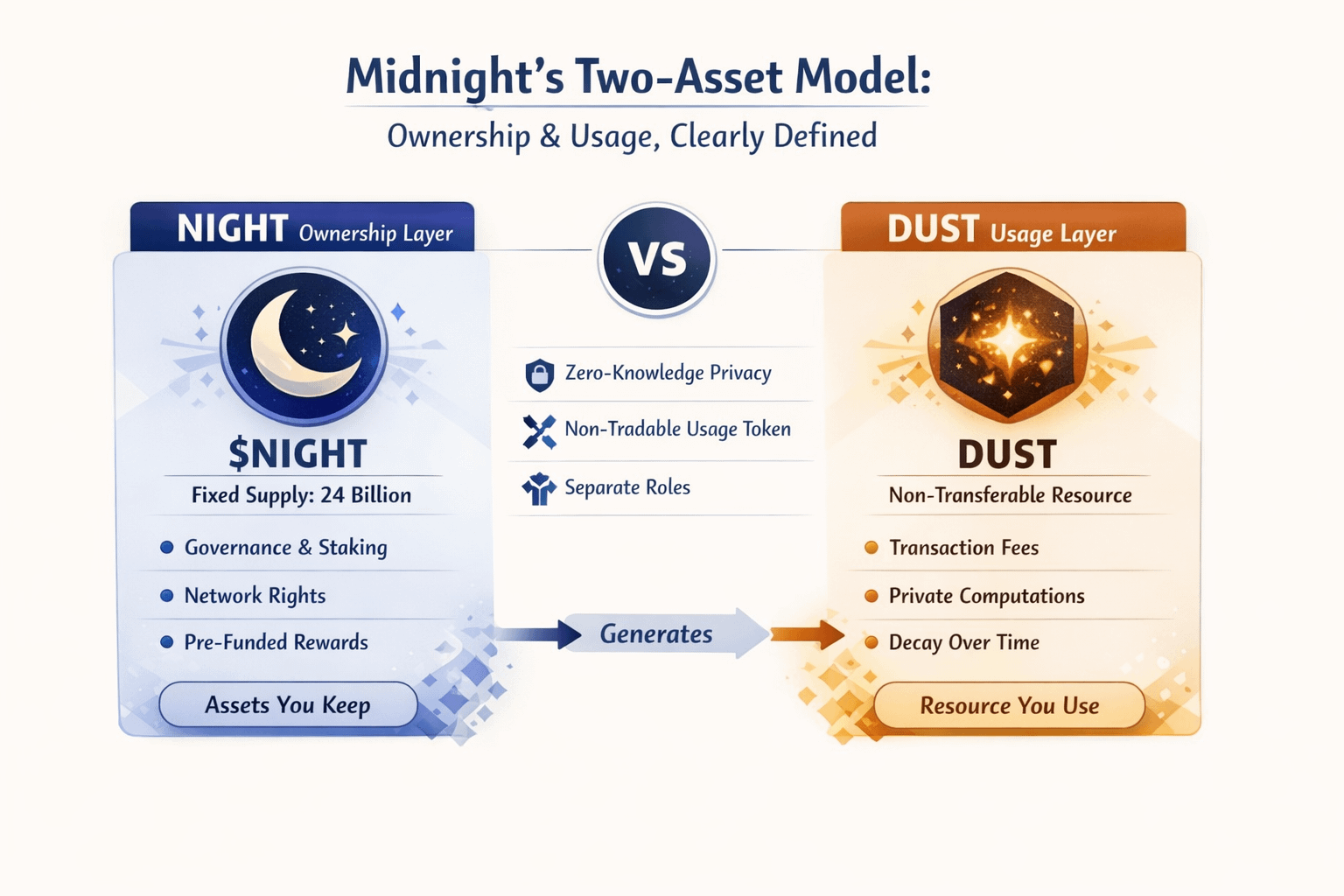 What Midnight is trying to solve is fairly clear.It starts from the idea that most blockchains are too transparent for serious real-world use. That transparency is useful for auditability, but it becomes a limitation when the data involved is sensitive.
Healthcare records, payroll flows, business contracts, procurement data, and compliance-heavy transactions are not the kind of information most organizations want permanently exposed on a public ledger.
Midnight’s answer is a privacy-first chain built around zero-knowledge proofs, where users can prove something is valid without revealing the underlying data itself. In theory, that gives you privacy by default with selective disclosure when needed.
That part is easy to understand.The more interesting part is the asset design underneath it.
NIGHT is the ownership layer.It is the fixed-supply asset of the network, capped at 24 billion, with no ongoing mint beyond what has already been allocated. It is used for governance and staking, and block producers are rewarded from a pre-funded reserve rather than from users directly paying fees in the base asset.
That matters because Midnight is not asking users to burn the ownership token every time they want to use the chain. NIGHT is not framed as transactional fuel. It is framed as the asset tied to participation, alignment, and network rights.
DUST is the usage layer.And this is where Midnight becomes more interesting than the usual two-token story. DUST is not designed like a normal tradable token.
It is better understood as a network resource generated by holding NIGHT and assigning that generation to a specific address.That’s the resource the network uses up when you make transactions or run private computations.
Three design choices make DUST stand out.First, DUST usage is shielded, so the fee layer itself is meant to inherit Midnight’s privacy model rather than exposing activity through transparent fee payments.
Second, DUST is non-transferable. You cannot trade it, flip it, or build a speculative side market around it. That removes a huge source of fee distortion that shows up on other chains when the same asset is asked to function as both a store of value and the thing everyone must constantly buy to transact.Third, DUST decays under certain conditions, especially when NIGHT is moved or redesignated.
That sounds harsh at first, but the logic is understandable: it prevents users from treating DUST like a permanent hoardable balance detached from the NIGHT position that generated it in the first place.
That separation is the part I think Midnight gets right.One of the biggest design problems in crypto is that ownership and usage are usually fused into the same asset.
That looks elegant on paper, but in practice it creates constant tension. If demand for the token rises, the cost of using the network often rises with it.
If speculation explodes, regular users get priced into volatility they never asked for. Midnight is trying to break that link.NIGHT is what you keep. DUST is what you actually use.That is a cleaner model than the standard “everyone shares one volatile asset for everything” design.
It also gives the network a better shot at predictable operating costs. If DUST is generated from a NIGHT position rather than bought on an open market every time, the usage side becomes more modelable.
That matters a lot for teams thinking in terms of ongoing application costs rather than token upside. A company can plan around resource generation more easily than around fee markets driven by speculation and congestion auctions.
That said, I do not think the design is frictionless.
The first concern is calibration. If DUST decay is too aggressive, casual users may feel punished for normal account behavior.
If it is too lenient, the anti-hoarding logic loses force. Getting that balance right is not a cosmetic detail. It is one of the main things that will shape whether the system feels usable or overly engineered.
The second concern is onboarding. Midnight’s model is intellectually cleaner than most gas systems, but not necessarily simpler at first contact. New users and developers need to understand why they hold one asset and spend another, how DUST generation works, and what causes it to decay.
That may be good mechanism design, but it is still extra cognitive load.
The third concern is execution. A design can make perfect sense conceptually and still become awkward under real usage.
Midnight has a thoughtful structure here, but the real test is whether this model stays intuitive and reliable once applications, users, and transaction demand hit production scale.
So my read is fairly simple: Midnight’s two-asset model does not feel like artificial complexity for the sake of storytelling. It feels like an attempt to solve a real structural problem in crypto.
NIGHT and DUST exist separately because ownership and usage are actually different functions, and most chains still force one asset to do both badly. The idea is strong. Now it has to prove it can work cleanly in practice
@MidnightNetwork $NIGHT #night
