
I’m starting to notice a pattern in crypto that most people overlook the loudest projects rarely fix the deepest problems They capture attention they ride momentum but underneath the same structural gaps remain I’ve been watching SIGN with that in mind and what stands out isn’t hype or velocity It’s intent The kind that doesn’t rush because it’s working on something the market hasn’t fully learned to value yet
For a long time we’ve operated in an ecosystem built on assumptions disguised as signals Wallet activity gets treated like identity Participation gets mistaken for contribution And token distributions arguably one of the most important mechanisms in this space are often reduced to educated guesses You can feel the fragility in it The constant tension between rewarding real users and filtering out noise It’s inefficient and more importantly it’s unsustainable
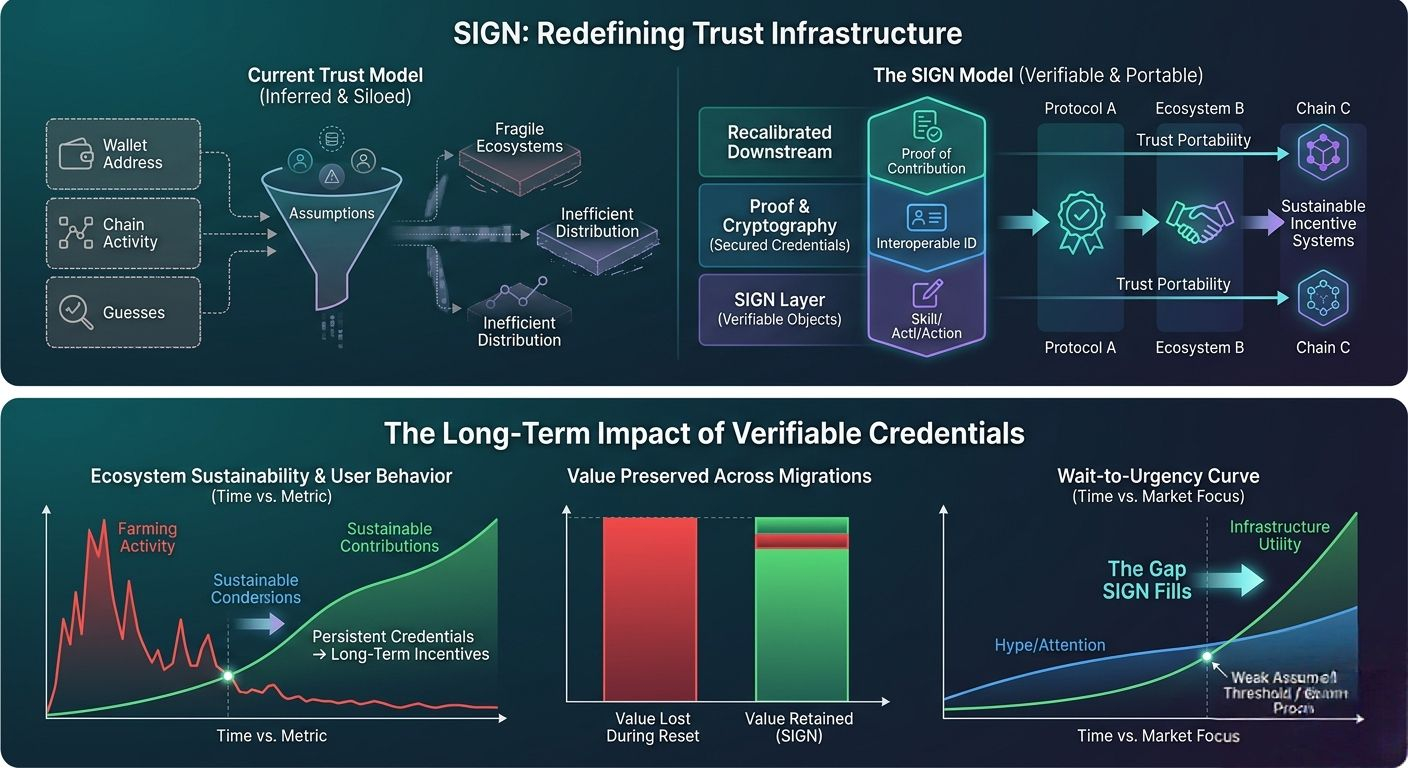
SIGN approaches this from a completely different angle Instead of trying to refine the guesswork it removes the need for it Credentials become verifiable objects issued with intent proven with cryptography and carried across systems without losing their meaning That shift changes the nature of trust itself It’s no longer inferred from patterns it’s established through proof
And once proof enters the system everything downstream starts to recalibrate
Distribution becomes sharper Not perfect but grounded Eligibility transforms from speculation into something measurable The endless cycle of farming and countermeasures begins to lose its grip because identity is no longer so easily abstracted What you’ve done starts to matter more than how you’ve appeared to behave
There’s a behavioral layer to this that’s easy to miss but hard to ignore once you see it When contributions are persistent and verifiable users begin to think longer term Actions aren’t just one off attempts to capture value they’re part of an accumulating record That changes incentives in a way most token models have tried and failed to engineer
Then there’s the idea of continuity Right now every protocol feels like a reset You move from one ecosystem to another and start from zero as if your history doesn’t exist SIGN quietly challenges that assumption It creates a shared layer where credentials can move retain context and inform new interactions Not just data portability but trust portability
That’s where the real shift begins to take shape
Because when trust becomes interoperable ecosystems stop behaving like isolated economies They start connecting in ways that reduce friction preserve value and reward consistency It’s a subtle transformation but one that compounds over time The kind of change that doesn’t look dramatic in the moment but feels obvious in hindsight
What makes this even more compelling is how misaligned it is with current market behavior Most capital still flows toward narratives that are easy to understand and quick to price Infrastructure like SIGN sits in the background building quietly waiting for the moment when its absence becomes more obvious than its presence
And that moment tends to come faster than expected
Because as systems grow more complex the cost of weak assumptions increases Distribution errors become more expensive Reputation becomes more fragile Identity becomes more exploitable At some point the industry is forced to confront the gap between what it assumes and what it can actually prove
SIGN lives in that gap
Not as a patch but as a redefinition of the layer itself And if there’s one thing I’ve learned watching this space evolve it’s that the projects shaping the foundation rarely look urgent until suddenly they are.