

I’m watching SIGN in a quiet way, like I’m trying to understand something without forcing it to explain itself too quickly. It doesn’t feel like a typical idea you can just read once and move on from. It sits with me. I keep noticing how often, in everyday life, we are asked to prove who we are—again and again—in small, almost tiring ways. And how normal that has started to feel.
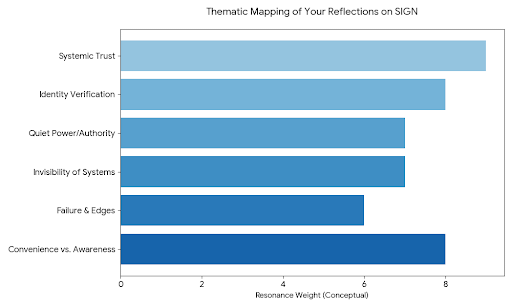
At first, there’s something comforting in the thought that maybe we wouldn’t have to repeat ourselves so much. That something could quietly hold onto the parts of us that matter—our work, our identity, our place—and let them be recognized without effort every single time. It feels simple when I think about it like that. Almost relieving. But the more I sit with it, the more I start to wonder what it really means to hand that responsibility over to something else.
I’ve been thinking about trust a lot. Not the big, obvious kind, but the quiet kind we rely on without noticing. The kind that lives in systems, in processes, in things we assume will work when we need them. SIGN seems to exist somewhere inside that space. It’s not loud, not demanding attention, but it touches something important—this idea of being believed without having to constantly explain yourself. And that matters more than we usually admit.
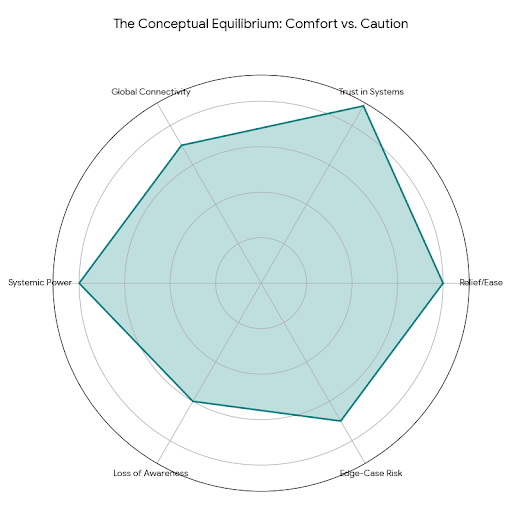
Still, there’s a part of me that hesitates. Maybe it’s because anything that decides what is “valid” or “real” carries a kind of quiet power. Even if it’s built with good intentions, even if it makes things easier, there’s always that question in the background—who decides, and what happens when something doesn’t fit neatly into those decisions? I don’t have a clear answer to that, and maybe that’s why I keep thinking about it.
What stays with me most is how invisible something like this is meant to be. If it works well, no one really notices it. It just becomes part of the background, like so many other systems we rely on every day. And maybe that’s where it becomes most important—because the less we see something, the less we question it. We just trust it to keep working, to keep recognizing, to keep things moving.
But what about the moments when it doesn’t? When something goes wrong, or doesn’t match, or gets lost in the process? Those moments feel just as important, maybe even more. They remind us that behind every smooth experience, there are edges we don’t always see. And those edges matter, especially for the people who end up there.
There’s also something quietly complicated about making things easier. Because while ease can feel like progress, it can also change how we relate to the process itself. When everything becomes fast and automatic, we stop noticing what used to take effort. We stop questioning it. And maybe that’s natural. Or maybe it means we give up a small part of awareness without realizing it.
I don’t think SIGN is just about systems or technology. It feels more like it’s about how we are recognized in a world that is becoming more connected, but also more distant in some ways. It sits somewhere between convenience and control, between trust and uncertainty. And I’m not sure it needs to be one thing or the other.
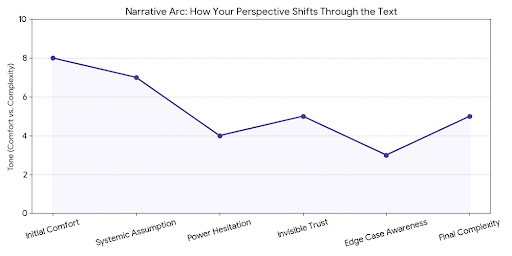
I’m still thinking about it, honestly. Still noticing small things, small questions that don’t fully settle. It doesn’t feel finished in my mind. It feels like something I’m still watching, still trying to understand in pieces. And maybe that’s okay—maybe some things aren’t meant to feel complete right away, but to stay with you, quietly shifting, long after you stop trying to define them.