
I didn’t expect identity to feel this fragile
I used to think “proving who you are” was a solved problem. You log in, you verify, you pass a check, done. But the more I watched how crypto actually works, the more I noticed how breakable the whole thing is. Identity isn’t just a name anymore. It’s access, reputation, sometimes your money. And the systems behind it are messy… different rules, different platforms, different standards, different countries. One app trusts you. Another app treats you like a stranger. So you keep proving yourself again and again, like your history never happened.
That’s where Sign started to make sense to me.
What pulled me in: Sign is trying to “lock in proof,” not vibes
When I look at @SignOfficial, I don’t see it as another “identity project” trying to sound important. I see it as an attempt to turn proof into something reusable. Like… if a fact is already verified once, why are we re-checking it everywhere like we have no memory?
In simple terms, Sign is trying to create a system where a verified claim can travel with you. Not screenshots. Not links. Not “trust me bro.” Something structured, signed, and verifiable. That’s the difference that keeps standing out to me: it’s not just data — it’s proof with an issuer attached, and a format other systems can read.
Token distribution is where “weak identity” turns into chaos
This is the part I think most people underestimate. Token distribution sounds easy until you try to do it at scale. Who gets what? Why them? Who qualifies? Who’s faking activity? Who’s using ten wallets? Who’s exploiting the gaps?
If the identity layer is weak, distributions either become rigid (and then they miss real users), or they become loose (and then they get farmed). And if you add regulations on top—different rules per region—it becomes even harder. That’s why I keep saying: tokens are not the hard part. Verification is the hard part.
And honestly, this is where Sign’s “evidence” approach feels more realistic. If eligibility is tied to something provable (instead of just vibes and spreadsheets), then distribution becomes less guessy. Not perfect. But stronger.
How I think about Sign Protocol as a builder tool
If I’m thinking like a developer for a second, I actually like the “hybrid” direction. Because I’ve seen what happens when teams push everything on-chain: cost explodes, UX slows down, and the app becomes unusable for normal people. So the idea of signing and structuring evidence off-chain, then keeping it verifiable, feels practical.
What I’d do (and what I think Sign is pushing toward) is:
• keep proof strong and consistent
• don’t force every tiny update to be an on-chain write
• use schemas so data isn’t random and messy
• use indexing so apps can query fast without rebuilding custom plumbing
To me, that’s the “grown-up” approach. Not everything needs to be stored publicly forever. But anything important should be provable when someone challenges it.
Schemas are boring… but they quietly decide what “truth” is
I didn’t care about schemas at first. Then I realized schemas are basically rules for what counts as a valid claim. They decide what a credential even means. That matters because if every project invents its own format, we’re back to the same problem: fragmentation.
I like the idea that identity, action, and metadata can be separated into clean pieces. It makes things easier to audit, easier to reuse, and harder to twist later. That’s the kind of design that doesn’t look exciting on a chart, but it makes the system survive.
My real question isn’t tech… it’s adoption
This is where I stay honest with myself. I can like the architecture and still admit the hard part: trust doesn’t scale just because the code exists. Trust becomes real when people keep using the same proof layer again and again… across apps, across ecosystems, without friction.
If Sign becomes that default layer—where proof follows you instead of restarting every time—then it’s not just another protocol. It becomes infrastructure. But if apps don’t integrate it, or if issuers don’t stay credible, then it stays “a good idea” more than a habit.
My takeaway
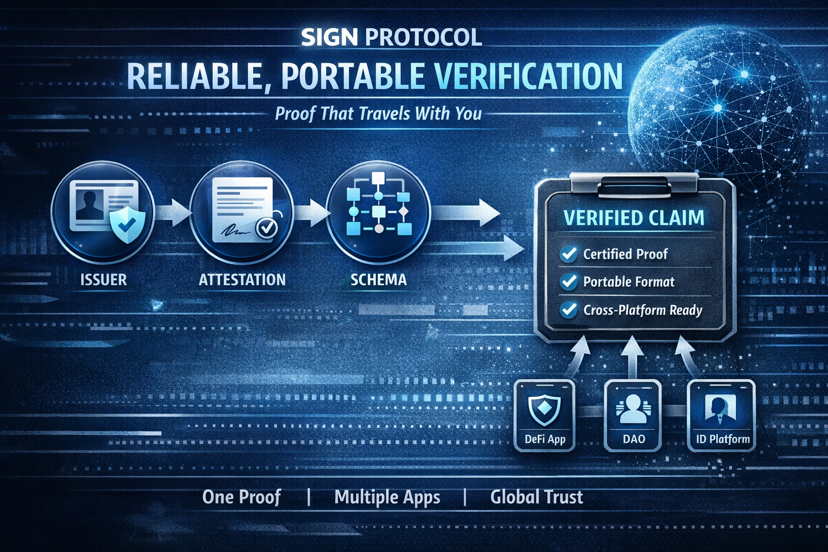 What I keep coming back to is simple: @SignOfficial is trying to make verification feel less repetitive and more permanent. Not permanent as in “you’re trapped,” but permanent as in “your proof doesn’t disappear the moment you change platforms.”
And if someone cracks that—secure, usable, scalable proof that works across borders and systems—that’s not just a Web3 feature. That’s the backbone of the next digital era.