

Honestly I have been looking at some of the 2026 gaming and virtual asset plans for the region and the more I look at them the more I realize we are all part of an experiment with no safety net. Most people are excited about the Digital Cities" or the billion-dollar gaming hubs being built in Riyadh but I keep thinking about a really important technical question: if the server crashes do you actually own anything?
When I was studying engineering we were taught that if a system cannot be checked by someone it is not a system. It is just a controlled database. For me SIGN is starting to look like the way to turn these "digital promises" into actual assets that we control.
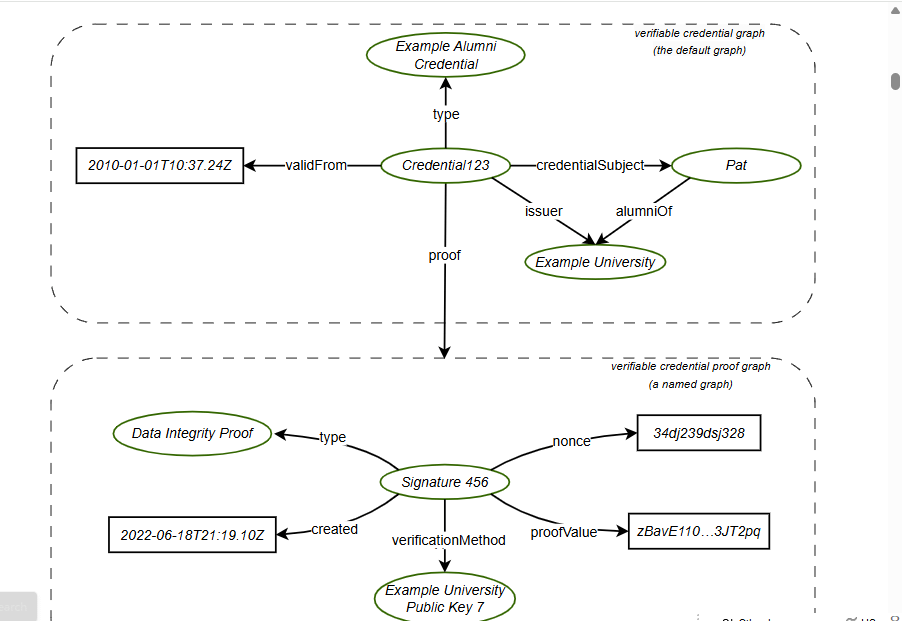
Why "Attestation" is the thing standing between us and a big problem
I look at digital real estate and high-value in-game assets for example. On the surface people think it is about having a cool item in a virtual world.. What SIGN atually does is create a cryptographic proof that exists outside the games internal code. That means your ownership is not a row in someones private spreadsheet. It is a condition backed by a ledger of signatures and rules. I see this as the "Sovereign Layer" that the Middle East needs if it wants to be the capital of the digital economy. If you cannot prove you own something across borders without asking for permission do you really own it?
There is a situation right now where everyone wants "decentralization" but nobody wants the complexity that comes with it. ges the model by making the verification process invisible. Every time an asset moves or a contract is updated it generates an attestation. It is quiet it is in the background. It is why SIGN robably going to be the most important part of the system that nobody actually sees while they are using it. But the reality is obvious. This SIGN only works if the initial data is clean. If the source of the identity is a mess the whole chain is a mess.
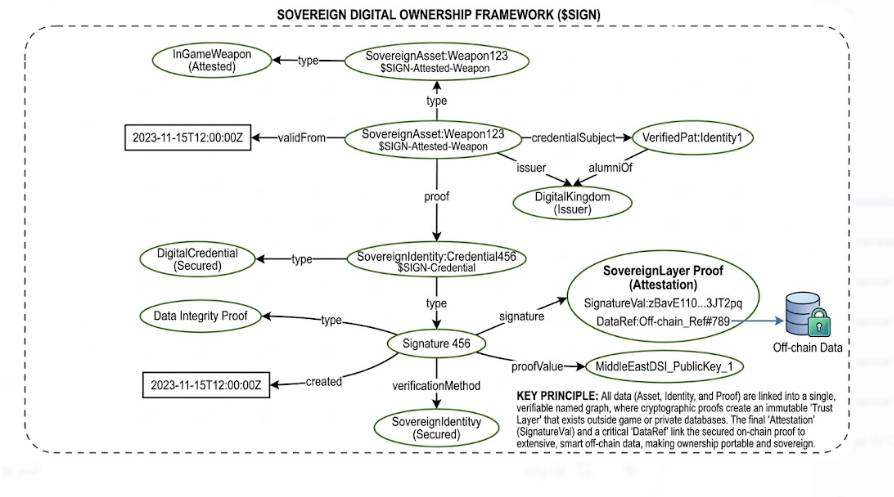
I think the "Talent Visa" programs are where this feels the most practical now. We have many builders moving to the GCC but the paperwork is a nightmare. SIGN to turn these credentials into proofs. Of verifying my degree for the tenth time I carry the attestation. It is efficient. I keep wondering about the "Issuer Trust." If the institution is not on the blockchain the whole portable identity dream hits a wall.
I see the data architecture as the key to success here. SIGN try to put every byte on the blockchain because that would be too expensive. It layers it. Proofs, on the blockchain, data somewhere smarter. It is a choice that most people ignore because it is not flashy. So when you look at the picture SIGN solving a "crypto problem”. It is trying to standardize how an entire digital society proves its history. It is very ambitious.. It raises a deeper question I cannot shake: in a world where everything is attested and verifiable do we lose the ability to reinvent ourselves or is that just the price of absolute truth?
