
@SignOfficial #SignDigitalSovereignInfra $SIGN
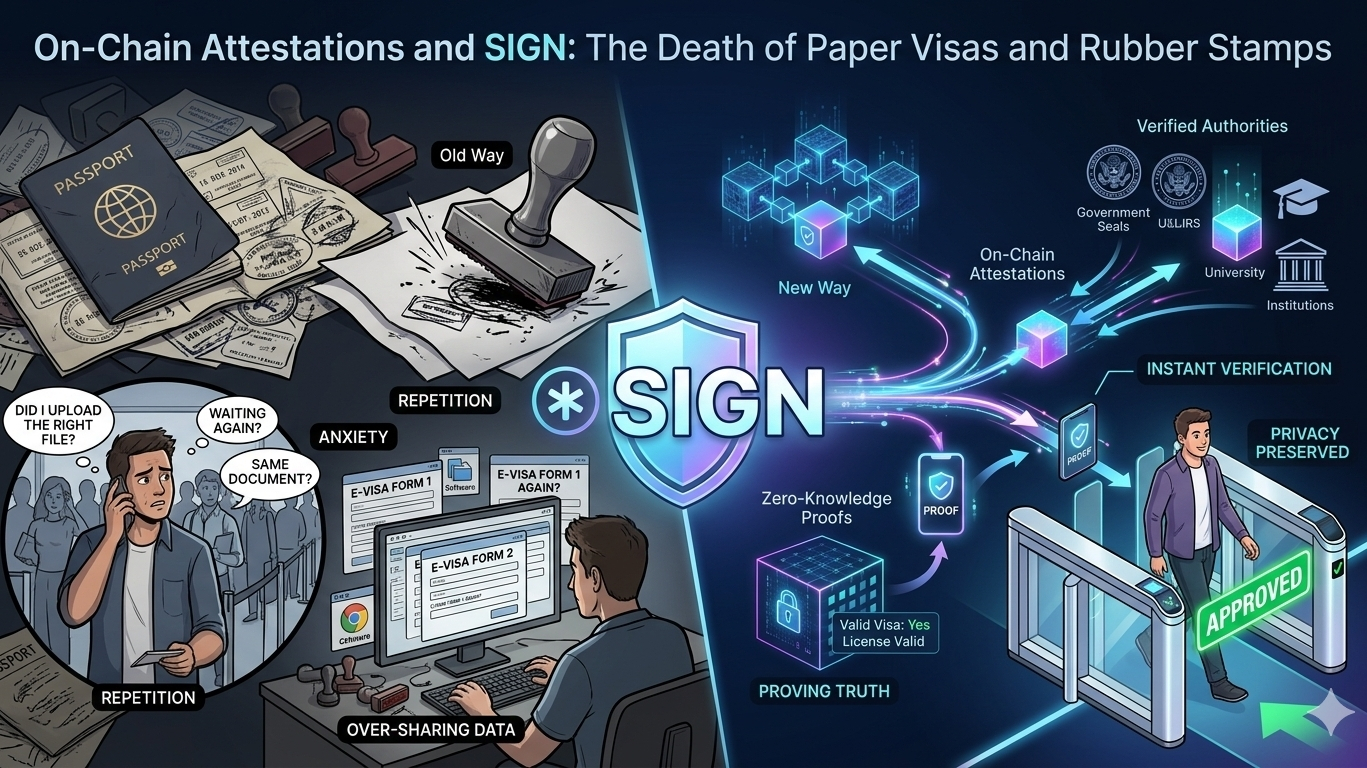
I can still feel it—the tension in that immigration line, passport in hand, stomach twisting while I silently replayed every detail. Did I upload the right file? Did I miss a tiny requirement? What if they ask for something else at the last moment? And then the officer flips through my passport, pauses just long enough for my heart to skip, and suddenly the journey I thought was set feels fragile.
All of it comes down to a stamp.
The sound of it hitting the page—heavy, decisive—used to feel like permission granted. But thinking back now, that stamp was never really about trust. It was a system constantly checking me, over and over, as if my word wasn’t enough.
I went through an e-visa application not too long ago. Everything was digital: forms, uploads, confirmations. Smooth interface, clean design. I thought, finally, progress.
But the reality hit fast.
I got asked for the same document twice, then again in a slightly different format. Different offices, same verification. Nothing had sped up—it just hid the repetition behind a prettier interface.
That’s when I realized something obvious but unsettling. We hadn’t fixed the process. We’d just digitized the inefficiency.
Each authority still acted like it was seeing me for the first time. No shared truth. No continuity. Every checkpoint exposed more of my personal information than necessary.
Now imagine that multiplied across airports, border control, licensing authorities. Every single checkpoint silently asking the same question: “Can we trust this?” That’s the friction that slows everything down.
So I started thinking differently.
What if I didn’t need to hand over everything just to prove one fact?
What if I could show that I meet a requirement without revealing every detail about myself?
No extra data. No over-sharing. Just proof.
That’s exactly where SIGN flips the whole system.
SIGN doesn’t sit on top of the old model. It doesn’t patch it. It replaces the logic entirely.
Instead of shuffling documents endlessly, SIGN introduces on-chain attestations. These are verified claims issued directly by trusted authorities—governments, institutions, licensing bodies. Once they exist on-chain, they’re tamper-proof. They can’t be faked, altered, or silently manipulated.
And here’s what blew me away: I don’t need to show the attestation itself. Using zero-knowledge proofs, I can prove that I hold a valid visa, meet entry requirements, or am licensed for a specific activity—without exposing the underlying personal data.
I’m not handing over documents anymore. I’m proving truth.
This is the moment where everything changes—and SIGN sits right at the center.
At a border, instead of flipping pages or manually verifying files, the system simply checks the proof linked to my attestation on SIGN. Instantly. No duplication. No delays. No guessing.
For e-visas, it’s even more obvious. I don’t worry about whether one office saw my application or whether systems synced. My eligibility exists as a verifiable attestation on SIGN. I arrive, present proof, and move forward. No files. No friction.
Licenses work the same way. Driving, professional certifications, operational permits—all instantly verifiable through SIGN, without unnecessary exposure. Verification becomes seamless, precise, and personal.
What surprised me most was how different it feels.
There’s no anxiety about missing documents. No fear that some office holds more of my personal data than it should. I know exactly what I’m proving—and importantly, what I’m not.
The authorities don’t need to store every detail about me anymore. They just verify what matters through SIGN. That’s it.
The relationship changes. Trust isn’t about handing over everything. It’s about proving what’s required—nothing more, nothing less. Privacy stops being a worry; it’s built into the system.
When I look back, it’s obvious.
Paper visas, rubber stamps, even today’s digital portals—they all operate on the assumption that trust requires full visibility. That to verify, someone has to see everything.
SIGN proves that assumption wrong.
Verification can happen without exposure. Trust can exist without surveillance. Systems can be faster, safer, and more human-friendly all at once. Once you see it, the old ways feel cumbersome and unnecessary.
---
Now, when I think about that stamp, the pause, the uncertainty—it feels like an artifact of the past.
Not because it didn’t work.
But because SIGN shows a better way.
A quieter, smarter way.
Where I don’t have to prove who I am over and over.
I just prove what’s true—once.
And that changes everything.