
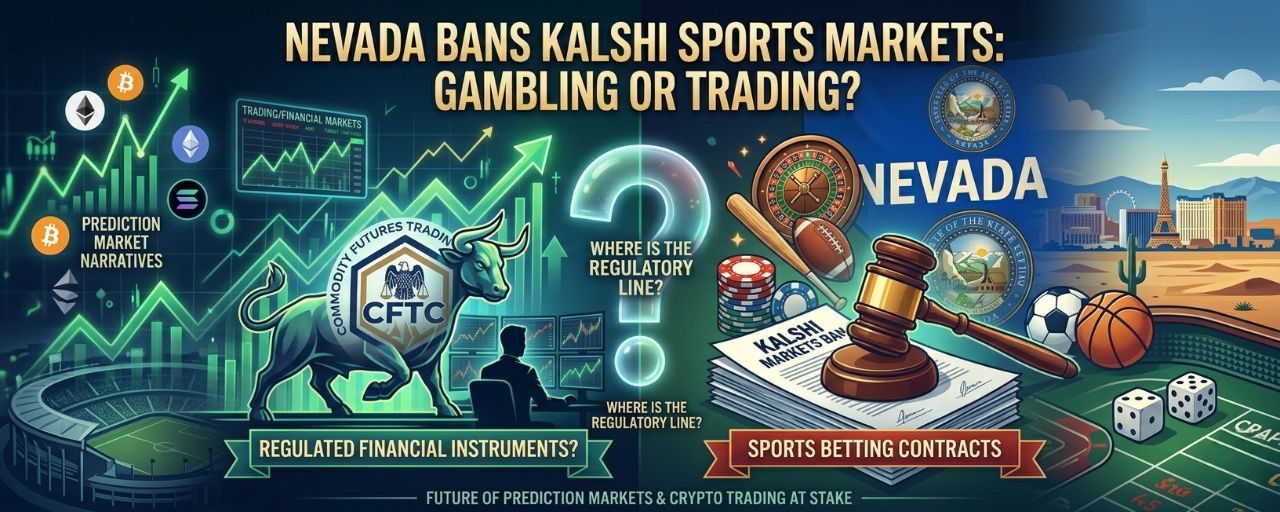

A Nevada court has extended its ban on sports-related contracts offered by Kalshi, a move that could have broader implications for prediction markets and even parts of the crypto trading ecosystem.
At first glance, this may look like a localized regulatory dispute. In reality, it touches a much bigger question: where is the line between trading and gambling?
What Happened
The Nevada Gaming Control Board argues that Kalshi’s event based contracts function as unlicensed sports betting. These contracts allow users to trade on outcomes like game results, turning real-world events into tradable positions.
The court initially issued a temporary restriction. Now, that ban has been extended, preventing Kalshi from offering new sports-related markets in Nevada while the case continues.
Kalshi’s Position
Kalshi isn’t backing down.
The platform maintains that it operates under federal oversight from the Commodity Futures Trading Commission and that its products are financial instruments, not bets.
From its perspective, users are not gambling. They are trading probabilities, similar to derivatives markets.
Why This Matters for Traders
This case goes beyond one platform.
Prediction markets sit in a gray zone that looks increasingly similar to:
Crypto derivatives
Perpetual futures
Event-based trading narratives
That overlap is exactly why this ruling matters.
If regulators classify these products as gambling, it could:
Limit how event based markets are structured
Increase scrutiny on similar financial products
Create stricter boundaries around what qualifies as “trading”
The Bigger Regulatory Signal
Nevada is one of the most mature betting markets in the US. Its stance is clear: if it looks like sports betting, it should be regulated like sports betting.
But at the federal level, the argument is different.
The involvement of the Commodity Futures Trading Commission brings this into a broader conversation, one that also overlaps with crypto regulation. The same questions around classification, jurisdiction, and product design are already playing out in digital asset markets.
What Comes Next
This case could shape how prediction markets evolve:
If states win, expect a fragmented system with strict local rules
If federal authority prevails, prediction markets could expand more freely
Either way, regulatory clarity is coming closer
Bottom Line
This isn’t just about Kalshi.
It’s about how regulators define the future of trading itself.
As the gap between traditional finance, prediction markets, and crypto continues to narrow, cases like this will play a key role in deciding what’s allowed and what isn’t.
For traders, the takeaway is simple:
Regulation is evolving and anything that looks like a market will eventually be treated like one.