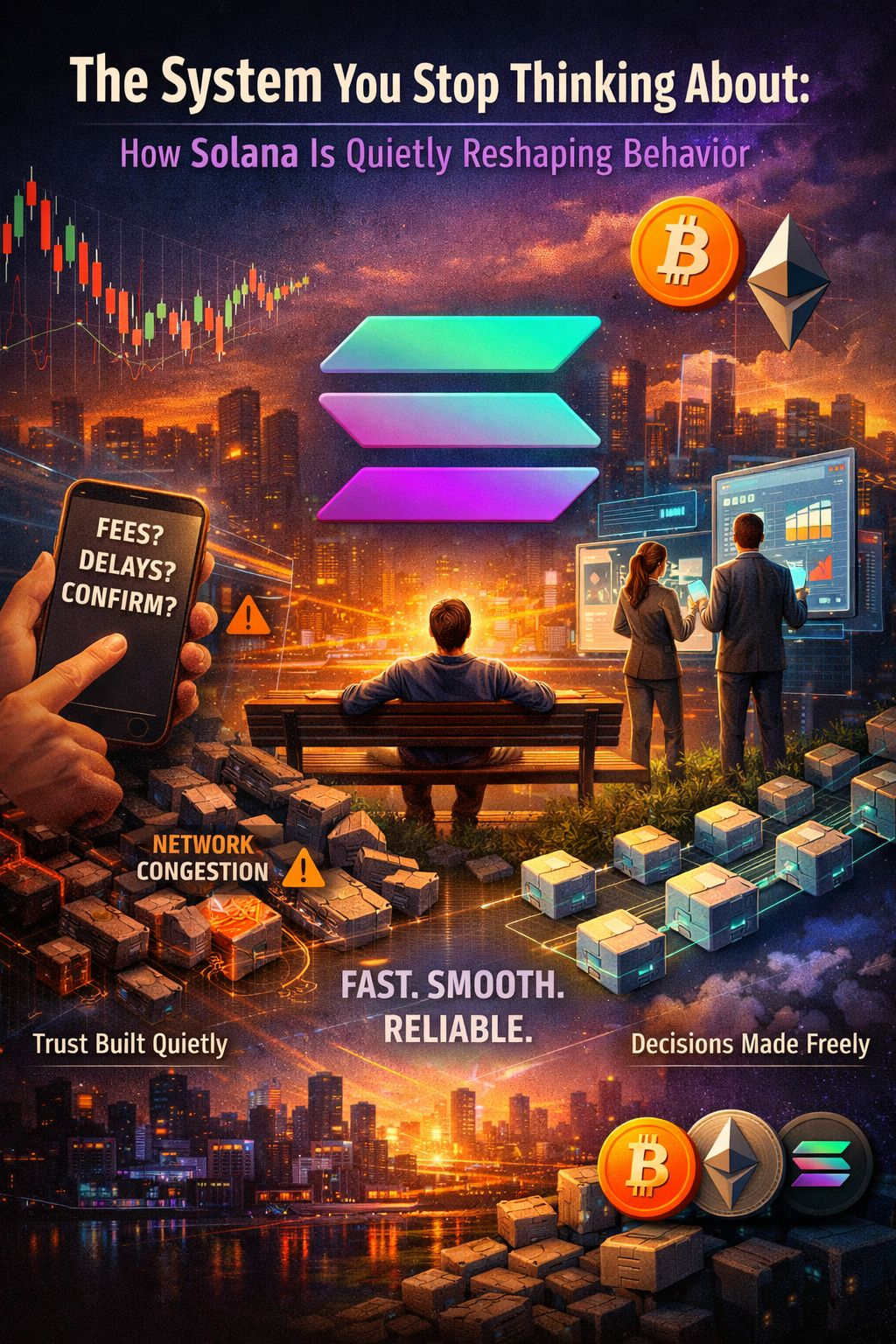
It took longer than expected to realize that the real friction in crypto isn’t just volatility—it’s awareness.
Every action comes with a checklist: fees, delays, confirmation risk, network congestion. You’re not just making decisions—you’re negotiating with the system. Over time, that changes behavior. It makes users hesitate when they shouldn’t, and act impulsively when they shouldn’t.
Watching Solana in live conditions reveals a different pattern. Not dramatically smoother—but less intrusive.
You act, and it resolves quickly enough that you don’t build anxiety around it.
That small shift matters.
Users experiment more.
They adjust faster.
They commit less emotional weight to each decision.
It doesn’t make them smarter—it just removes unnecessary friction.
Early users didn’t trust the system—they challenged it.
They pushed it to failure, sometimes recklessly, forcing it to prove itself under pressure. That phase exposed weaknesses, but it also built something more valuable: shared memory.
The people who stayed understood what broke, what improved, and what survived.
Later users entered a different environment. They didn’t test—they expected.
And that expectation changed everything.
The system was no longer something to evaluate.
It became something to rely on.
What stands out is the restraint beneath the surface.
Fast systems often rush expansion. But here, delays sometimes signal discipline. At high speed, small flaws scale instantly. Waiting isn’t always hesitation—it’s control.
Risk isn’t managed through authority—it’s embedded in design.
Good developers don’t just plan for success. They design for failure:
Does the system degrade gradually?
Or does it collapse suddenly?
That distinction defines real user experience—not ideal scenarios.
Trust builds quietly.
Not through announcements.
Not through incentives.
But through repetition.
A transaction works.
Then it works again.
Then again.
Eventually, you stop questioning it.
That’s where real confidence begins—and why even small disruptions feel amplified later.
You can tell the difference between hype and durability by watching behavior:
Are users staying because it’s easier—or because they’re incentivized?
Do applications integrate cleanly—or rely on workarounds?
The strongest systems fade into the background.
They don’t need constant explanation.
The token—Solana—plays a role, but not always visibly.
Over time, it becomes less about price movement and more about alignment:
validators
developers
users
Holding it starts to reflect belief in function, not just attention.
What’s most interesting is how quietly a system becomes infrastructure.
There’s no clear moment.
It just happens.
People stop asking if it works—and start assuming it will.
That’s when everything changes.
Reliability stops being a goal.
It becomes a requirement.
At the same time, the tension never disappears.
Speed.
Decentralization.
Resilience.
They don’t naturally align.
The question isn’t whether those trade-offs exist—it’s whether they’re managed honestly.
So far, they are.
If this continues, the outcome won’t be loud.
It will be subtle.
The system becomes something people use without thinking.
Not invisible—just predictable.
And in the long run, predictability is what builds permanence.
Bitcoin$BTC
Ethereum$ETH
Solana$SOL