To be honest, At first, I assumed that would be the obvious center of it. A social casual game, open world, farming, exploration, creation. Fine. That sounds pleasant enough. Maybe a little familiar. Maybe too familiar. I think that was my first reaction, actually. Not dislike. Just a kind of quiet skepticism. I have seen enough projects describe themselves in soft, inviting language that I have become careful around it. Sometimes the mood is doing all the work. Sometimes the world sounds warmer than it really is.
So I looked at Pixels that way at first. As another game trying to package comfort.
But after sitting with it for a while, the thing that started to feel more important was not comfort on its own. It was the structure underneath that comfort. The way a world like this tries to hold attention without forcing it. That is harder than people think.
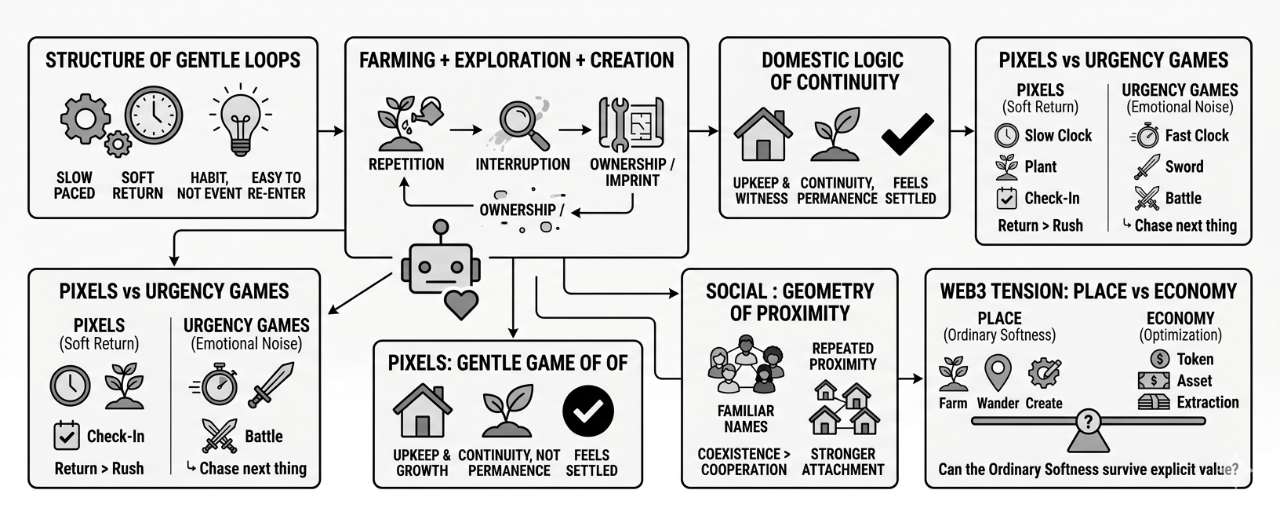
A lot of games are built around urgency. Timers, battles, scarcity, pressure, ranking, speed. Even when they are fun, they often carry a certain emotional noise. They want to keep your nervous system active. They want you reacting. They want you chasing the next thing. Pixels seems to work in a different register. It is slower. Softer. More about returning than rushing. And I think that changes the whole meaning of the experience.
Because once a game is built around return instead of urgency, it starts acting less like an event and more like a habit.
That may sound small, but it is not small at all. Habits are where digital products either become part of someone’s life or disappear. You can usually tell when a game understands this. It stops trying to impress you every second. It starts focusing on whether the world feels easy to re-enter. Whether progress feels steady enough to matter but light enough not to exhaust you. Whether there is enough variety to keep the rhythm from turning flat.
That is where things get interesting.
Pixels is described as a world of farming, exploration, and creation, and I think those three parts fit together in a more revealing way than people first assume. Farming gives repetition. Exploration gives interruption. Creation gives ownership, or at least a sense of imprint. Repetition alone can become dull. Exploration alone can become thin. Creation alone can become decorative. But together they create a loop with a little more life in it. You do familiar things, then you wander, then you shape something, then you return to the familiar things again.
That pattern matters because people do not stay in online spaces for mechanics alone. They stay because the mechanics begin to organize their time in a way that feels oddly natural.
I think that is part of why these slower social worlds can end up feeling more sticky than louder games. They ask less from you at any one moment, but more from your long-term pattern of attention. And that is a very different kind of relationship. Instead of a peak experience, the goal becomes something gentler. A world you check in on. A place where your absence is not punished too harshly, but your presence still means something.
There is something almost domestic about that.
Not in a dismissive way. I mean it seriously. Domestic spaces are built around upkeep, repetition, and small visible changes over time. That is what farming games have always understood. The appeal is not just growth. It is witnessing growth that happened because you kept showing up. Pixels seems to sit inside that logic. The pleasure is not only in doing something, but in coming back later and seeing that your earlier action stayed there in some form.
That probably sounds obvious, but I think people often skip over how emotionally effective that can be. In a lot of online spaces, nothing feels settled. Everything resets, disappears, gets buried, or gets replaced by the next wave of activity. A slower world gives a different feeling. It suggests continuity. Not permanence exactly, but continuity. And for many players, that matters more than spectacle.
The social part becomes more interesting once you look at it through that lens too.
A social game does not become social just because players can interact. Plenty of multiplayer worlds still feel lonely. What makes a place feel social is repeated proximity. Familiar names. Small recognitions. Shared rhythms. Seeing someone else harvesting near you, building near you, passing through the same space often enough that they stop feeling anonymous. It becomes obvious after a while that community is often made from low-intensity repetition rather than dramatic collaboration.
That is one reason open worlds built around lighter routines can sometimes produce stronger background attachment than more intense games. They give people room to coexist before they ask them to coordinate. That is a subtle difference, but it matters. Coexistence is easier than cooperation, and in many online worlds it is the thing that comes first.
I also think Pixels makes more sense when you stop asking whether it is deep in the traditional sense.
That question can be misleading. Not every game is trying to be deep through complexity. Some are trying to be durable through rhythm. Those are not the same thing. A complicated system can still be emotionally empty. A simple loop can still feel alive if the pacing, presence, and return structure are right. The question changes from “how much is there to do?” to “does doing these things keep feeling like a place I want to revisit?”
That is a harder question, honestly.
And because Pixels exists in Web3, another layer gets added whether the game wants it or not. Ownership, assets, tokens, network infrastructure. These things are never neutral once they become visible. They change how people read the world. Some players will see a farm. Some will see an economy. Some will move back and forth between those two views depending on the day. I do not think that tension can be removed. It just has to be managed.
This is where I become cautious.
Because casual spaces are fragile. They lose something the moment optimization becomes the dominant mood. The minute every action starts getting evaluated too aggressively for output, efficiency, or economic meaning, the atmosphere changes. What felt gentle starts to feel instrumental. What felt social starts to feel transactional. And once that shift happens, it is difficult to fully reverse. The world may still look the same, but it is being inhabited differently.
That risk exists in many online games already, of course. It is not unique to Web3. But Web3 can intensify it because it makes value more explicit. It makes players more aware that time, items, and activity might map onto something outside the game. That can create commitment, but it can also create a strange stiffness. People begin calculating more than they are inhabiting.
So with Pixels, I do not think the interesting question is whether the Web3 layer makes it better in some simple way. I think the better question is whether the game can protect the ordinary softness of its world while carrying that extra layer in the background. Whether the infrastructure supports the mood instead of overtaking it. Whether people still talk about the game as a place, not only as a system.
You can usually tell when a world is holding together. People talk about where they were, what they noticed, who they kept seeing, what changed since the last time they logged in. They describe it like somewhere they have been. When that disappears, the language changes. Then it becomes all strategy, extraction, timing, and numbers.
Pixels seems most interesting to me right in that fragile space between those two possibilities.
Not because it solves anything perfectly. I do not think games like this ever do. But because it is trying to build around routine instead of intensity, and around return instead of spectacle. That is a different kind of bet. A quieter one.
And sometimes the quieter bets reveal more about how people actually want to spend their time.
@Pixels #pixel $PIXEL

Artículo
What keeps pulling me back to Pixels is not really the farming part.
Aviso legal: Contiene opiniones de terceros. Esto no constituye asesoramiento financiero. Es posible que incluya contenido patrocinado. Consultar Términos y condiciones.