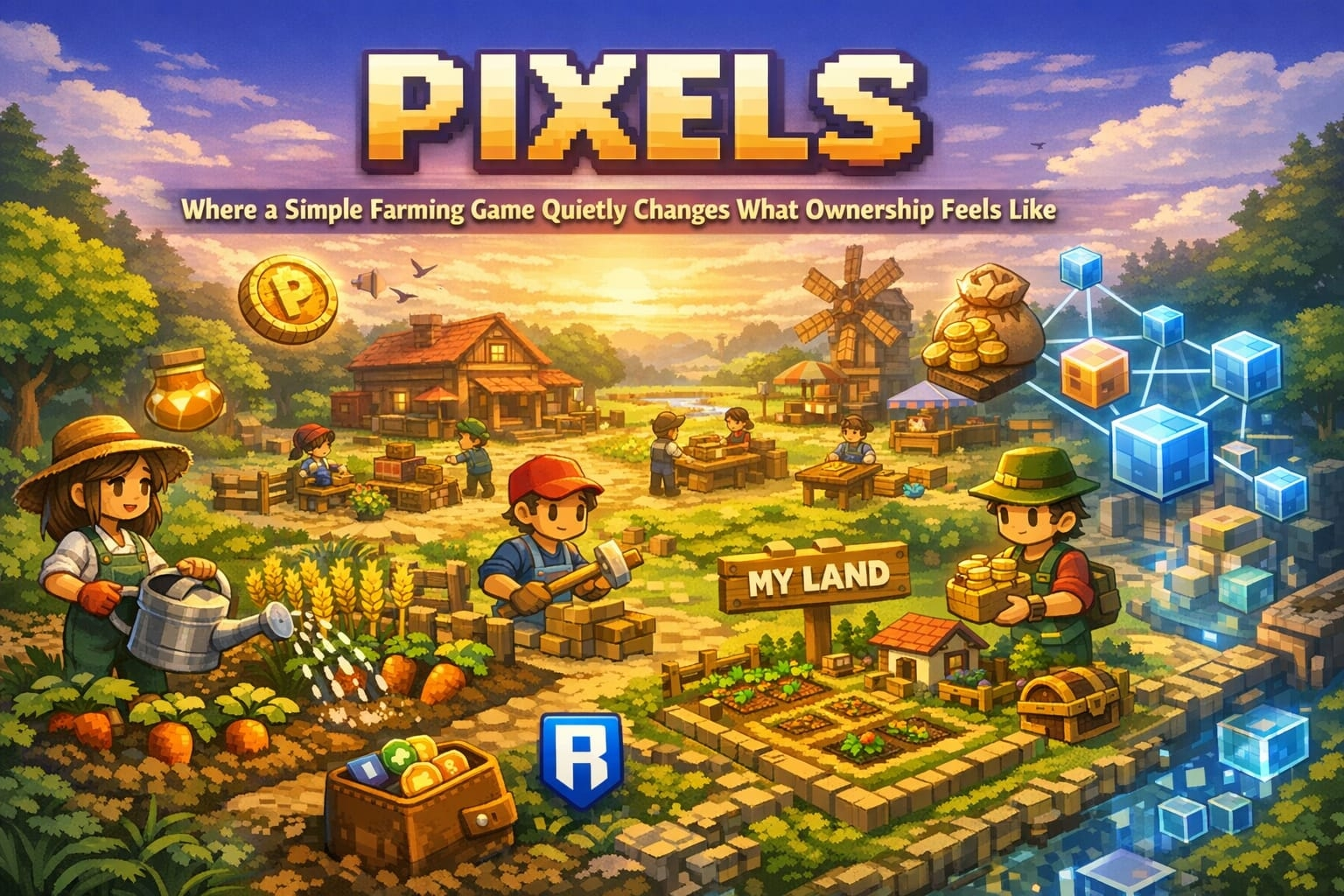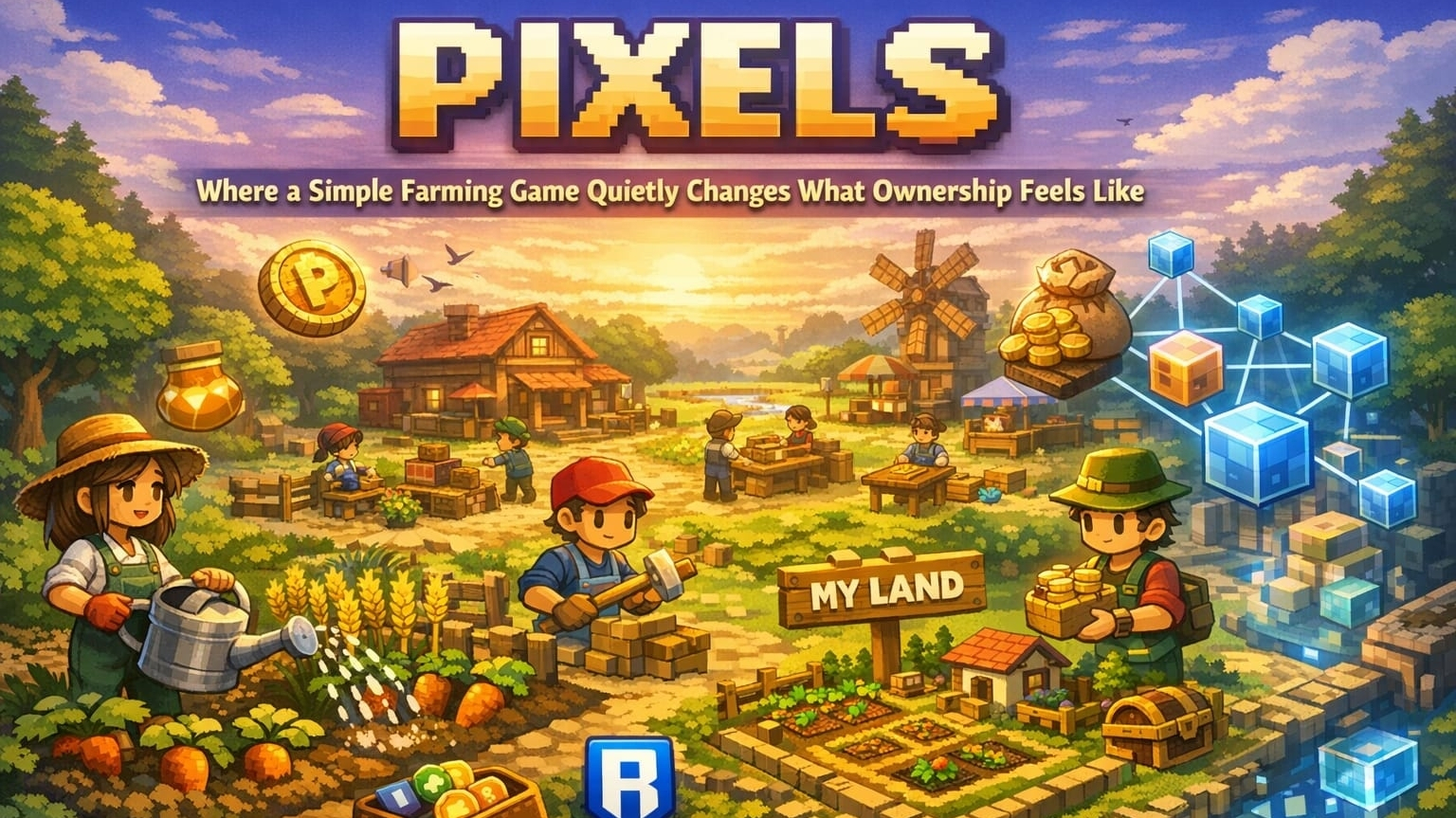

The first time you open Pixels, it doesn’t feel like anything special. No dramatic intro, no overwhelming interface, no sense that you’ve just stepped into some next-gen blockchain experience. You plant a few crops, walk around, maybe notice other players moving nearby. It’s calm. Familiar. Almost… ordinary.
And that’s exactly why it works.
Because the shift doesn’t happen right away. It creeps in slowly. At some point—maybe after your third harvest, or when you start paying attention to what you’re collecting—you realize something feels different. Not visually. Not mechanically. Just… in how you’re thinking.
You’re not just playing anymore. You’re participating in something where your time might actually matter a bit more than usual.
Pixels, at its core, is a social farming game. You grow crops, gather materials, craft items, and interact with other players in a shared world. If you’ve ever played something like Stardew Valley or Harvest Moon, you’ll recognize the rhythm instantly. There’s comfort in that. No steep learning curve, no pressure to understand complex systems right away.
But underneath that simplicity is where things start to get interesting.
The game runs on the Ronin Network, which—if you’ve been around Web3 for a while—you probably associate with Axie Infinity. But here’s the thing: most players won’t even think about that while playing. And honestly, that’s a good sign.
What you do notice is how smooth everything feels. Actions happen quickly. There’s no constant hesitation about fees or transactions. You don’t find yourself asking, “Is this worth it?” every time you click something. That friction—something that’s held back a lot of blockchain games—is mostly gone here.
And when that friction disappears, something else happens. You stop thinking about the tech. You just play.
The gameplay loop itself is simple enough to explain in a sentence: plant, water, harvest, repeat. That’s it. No hidden complexity at the beginning. No systems stacked on top of systems.
But after a while, you start noticing patterns. Certain resources are more valuable than others. Some areas are better for gathering specific materials. Players begin to specialize—not because the game tells them to, but because it naturally makes sense.
You’ll see someone who clearly focuses on farming, another who’s always crafting, someone else trading constantly. It’s not forced. It just emerges.
And that’s where Pixels starts to feel less like a static game and more like a small, living system.
The world itself isn’t massive or overwhelming, but it doesn’t feel empty either. You run into people. Sometimes you interact, sometimes you don’t. There’s no pressure to engage, which makes the interactions that do happen feel more natural.
You might trade with someone once, then run into them again later. Maybe you start recognizing names. It’s subtle, but it builds a quiet sense of familiarity.
That kind of social layer is easy to overlook at first. Then one day you notice you’re not really playing alone anymore.
Crafting adds another layer, though it doesn’t demand your attention immediately. Early on, it feels optional. Something you’ll figure out later.
Then later comes, and suddenly it matters.
You start turning raw materials into items that other players actually want. And once there’s demand, behavior shifts. Some players stay casual, crafting only when needed. Others go deeper, paying attention to what sells, what doesn’t, what’s worth the time.
It’s interesting to watch. Or even to fall into yourself, without really planning to.
You log in, gather resources, craft a few items, sell them, log out. It becomes a rhythm. Not quite work, not entirely play. Somewhere in between.
Then there’s land ownership, which is where things start to feel a bit more serious.
Owning land in Pixels isn’t just cosmetic. It gives you a space that’s yours—something you can shape, use, and build around. You can farm on it, organize it, even create value for other players.
And because this ties into an actual economy, it changes how you see it.
It’s no longer just “my farm in a game.” It becomes something with a bit more weight. Not heavy, not stressful—but noticeable.
It brings back a feeling older online games used to have, where your space or setup actually meant something. The difference here is that it’s connected to real ownership in a way traditional games never were.
That’s where the PIXEL token comes in.
At a basic level, it’s the in-game currency. You use it for upgrades, purchases, progression. Nothing unusual there.
But it also exists outside the game. It has real-world value. And that alone changes how people behave, even if they don’t admit it.
You’ll start to notice different types of players. Some are just enjoying the game, playing at their own pace. Others are optimizing everything—trying to be as efficient as possible. And then there are those somewhere in the middle, experimenting, figuring things out as they go.
That mix creates an interesting dynamic. Sometimes a bit unpredictable, sometimes even messy—but rarely boring.
This is also where Pixels separates itself from earlier Web3 games. Instead of pushing a “play-to-earn” model, it leans more toward “play-and-earn.”
It might sound like a small difference, but it’s actually important.
Play-to-earn, in many cases, turned games into systems people felt obligated to grind. The focus shifted away from enjoyment and toward income. And eventually, that imbalance became a problem.
Pixels feels like it’s trying to avoid that. You can earn, yes—but it’s not constantly emphasized. You’re not pushed into thinking about profit every second.
And because of that, the experience feels lighter. More like a game again.
That said, it’s not perfect. There are still challenges.
The economy is player-driven, which means it’s not always stable. Prices change. Demand shifts. Something valuable today might not be tomorrow.
That can be frustrating. Especially if you’re trying to be strategic.
Token values can fluctuate too, sometimes unpredictably. And then there’s the broader issue of regulation in Web3, which is still evolving and, frankly, a bit unclear depending on where you are.
So yes, there are risks. That part hasn’t gone away.
But even with those challenges, there’s something about Pixels that feels… grounded.
It doesn’t overpromise. It doesn’t try to be revolutionary in a loud, attention-grabbing way. It takes a familiar concept and quietly changes one important detail—ownership—and then lets everything else grow from there.
And that approach seems to work.
If you’re new to the game, the best advice is probably the simplest: don’t rush.
Just play. Walk around. Try things. Talk to people if you feel like it.
There’s a natural temptation to jump straight into optimization or earning strategies, especially in a Web3 environment. But that can wait.
The game makes more sense once you’ve spent some time just experiencing it without pressure.
You start to see how everything connects. How small actions build into something larger. How the world reacts to what players are doing.
And at that point, it stops feeling like “just a farming game.”
It becomes something a little harder to define.
Not revolutionary. Not perfect. But definitely moving in a direction that feels more sustainable—and maybe more human—than a lot of what came before.
And honestly, if that’s where Web3 gaming is heading, that’s probably a good sign.