
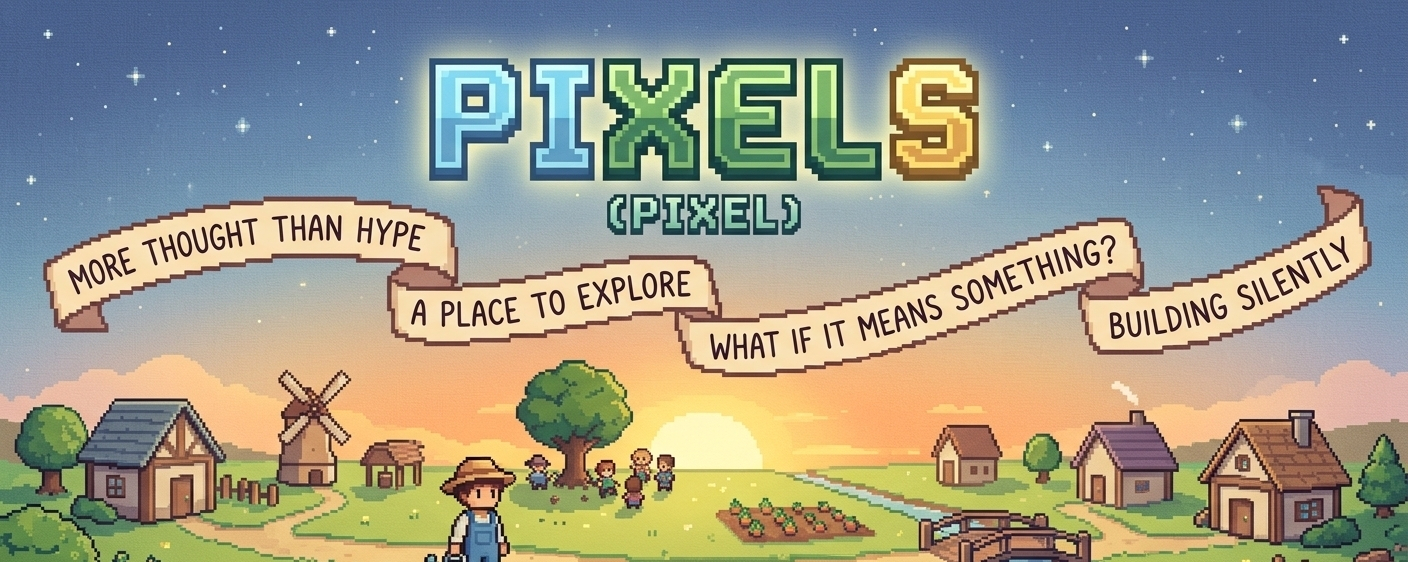

I’ve been trying to figure out why I keep coming back to Pixels. Not in the obsessive way that some games pull you in, but in a quieter, more curious way. It’s the kind of return that feels less like addiction and more like unfinished thinking. Every time I log in, I’m not just playing I’m observing, questioning, and, honestly, second guessing what I’m seeing.
At first glance, it looks almost too simple to take seriously. Farming, gathering, wandering around a pixelated world it doesn’t scream innovation. If anything, it feels like something I’ve seen before, maybe a dozen times. That’s usually where my skepticism kicks in, because crypto has a habit of wrapping familiar ideas in new language and calling it a breakthrough. But the more time I spend inside Pixels, the harder it becomes to dismiss it outright.
What caught my attention wasn’t the gameplay itself, but the structure underneath it. The fact that it’s built on Ronin already says something. Ronin isn’t just another chain trying to attract developers it carries the weight of having already hosted a major Web3 gaming ecosystem. That history matters, not because it guarantees success, but because it changes the expectations. You’re not starting from zero; you’re building in an environment that has already seen both hype and collapse.
And that context shapes how I look at Pixels. It’s not just a game trying to prove that Web3 gaming can work. It feels more like a quiet response to everything that didn’t work before.
I remember when “play-to-earn” was everywhere. The idea sounded compelling at the time—play games, earn tokens, create digital economies where players actually benefit. But the reality didn’t match the narrative. Most of those systems weren’t really games; they were financial loops disguised as gameplay. The moment new users stopped entering the system, everything started to unravel. It wasn’t sustainable because it wasn’t built around genuine engagement it was built around extraction.
Pixels seems aware of that history, even if it doesn’t explicitly say it. The farming, the exploration, the slow progression it all feels intentionally grounded. There’s no immediate pressure to optimize earnings, no aggressive push to turn every action into profit. And that, ironically, is what makes me pay more attention.
Because the real question here isn’t “Can you earn?” It’s “Would you still play if you couldn’t?”
That’s where most Web3 games fail. They rely too heavily on incentives and not enough on intrinsic motivation. Once the rewards fade, so does the player base. So when I look at Pixels, I’m not just asking what it offers I’m asking what it withholds. And in a strange way, that restraint might be its most interesting feature.
The core idea farming, crafting, exploring feels almost deliberately unambitious. But maybe that’s the point. Instead of trying to reinvent gaming, it leans into something familiar and focuses on how that experience integrates with a decentralized system. It’s less about creating a new genre and more about quietly testing whether existing gameplay loops can coexist with blockchain mechanics without collapsing under their own weight.
Still, I can’t ignore the underlying tension. Because at the end of the day, it is a Web3 game. There are tokens, assets, economies all the usual components. And those systems always introduce a layer of complexity that traditional games don’t have to deal with. Ownership sounds great in theory, but it also changes player behavior. When items have real value, people don’t just play they strategize, speculate, sometimes even exploit.
So I find myself watching how Pixels handles that balance. How do you create a world that feels like a game while also functioning as an economy? How do you prevent it from turning into another optimization problem where players are just chasing the most efficient path to profit?
I don’t think there’s an easy answer, and I’m not convinced Pixels has fully solved it. But it does feel like it’s asking the right questions.
One thing that stands out is how social the experience is meant to be. Not in the forced, “join this guild for rewards” kind of way, but in a more organic sense. The world feels shared, not segmented. You see other players moving around, doing their own thing, and it creates this subtle awareness that you’re part of something larger. It’s not groundbreaking, but in the context of Web3, it’s surprisingly rare.
A lot of crypto projects talk about community, but what they really mean is coordination people aligning around a token or a goal. That’s different from actual social interaction. Pixels, at least from what I’ve seen, leans more toward the latter. And that distinction matters more than we usually admit.
Because if Web3 gaming is going to work, it can’t just be about ownership or earnings. It has to recreate the reasons people play games in the first place curiosity, creativity, connection. Without those, everything else feels hollow.
At the same time, I can’t shake a certain level of doubt. Not about Pixels specifically, but about the space as a whole. I’ve seen too many projects start with thoughtful design and slowly drift toward short-term incentives. It’s almost like there’s a gravitational pull in crypto that pushes everything toward monetization, whether it makes sense or not.
So I keep wondering can Pixels resist that pull?
Can it stay grounded in gameplay, or will it eventually lean into the same patterns we’ve seen before? Will the economy remain a background layer, or will it start to dominate the experience?
These aren’t criticisms as much as they are open questions. And maybe that’s why I find the project interesting. It doesn’t feel finished. It feels like something that’s still figuring itself out, still negotiating the balance between game and system.
And in a way, that uncertainty makes it more real.
Because if I’m being honest, the crypto industry has a tendency to present everything as already solved. Every project claims to have the answer, the innovation, the breakthrough. But the reality is much messier. Most of these systems are experiments, whether they admit it or not.
Pixels doesn’t loudly declare itself as a revolution. It just exists, quietly building, quietly iterating. And that approach, while less exciting on the surface, might actually be more sustainable in the long run.
I’ve started to think of it less as a game and more as a test environment. Not in a technical sense, but in a behavioral one. What happens when you combine familiar gameplay with decentralized ownership? How do players react? What patterns emerge?
Those are the kinds of questions that can’t be answered through whitepapers or roadmaps. They require time, observation, and a willingness to accept that things might not go as planned.
And that brings me back to why I keep returning.
It’s not because I think Pixels is the future of gaming. I’m not ready to make that claim, and honestly, I’m not sure any project deserves that label yet. It’s because it feels like a small step in a direction that’s still being defined.
There’s something oddly refreshing about a project that doesn’t try to overwhelm you with complexity or promise the world. It just gives you a space to explore, to interact, to see how things unfold. And maybe that’s enough, at least for now.
Of course, there are still challenges ahead. Scalability, player retention, economic balance none of these are trivial problems. And the broader market conditions will always play a role. If interest in Web3 fades, even the most well-designed projects can struggle.
But I don’t think the value of Pixels lies in whether it becomes massively successful. It lies in what it represents a shift away from purely speculative design toward something that at least attempts to prioritize experience.
Whether that shift will hold is still uncertain.
For now, I’m just watching. Playing a bit, thinking a lot, and trying to understand what this world is actually trying to become. And maybe that’s the most honest place to be not fully convinced, not fully dismissive, just somewhere in between.
Because if there’s one thing I’ve learned from spending time in crypto, it’s that the most interesting projects aren’t the ones that promise the most. They’re the ones that leave you with questions you can’t quite answer yet.
And Pixels, for all its simplicity, does exactly that.
