
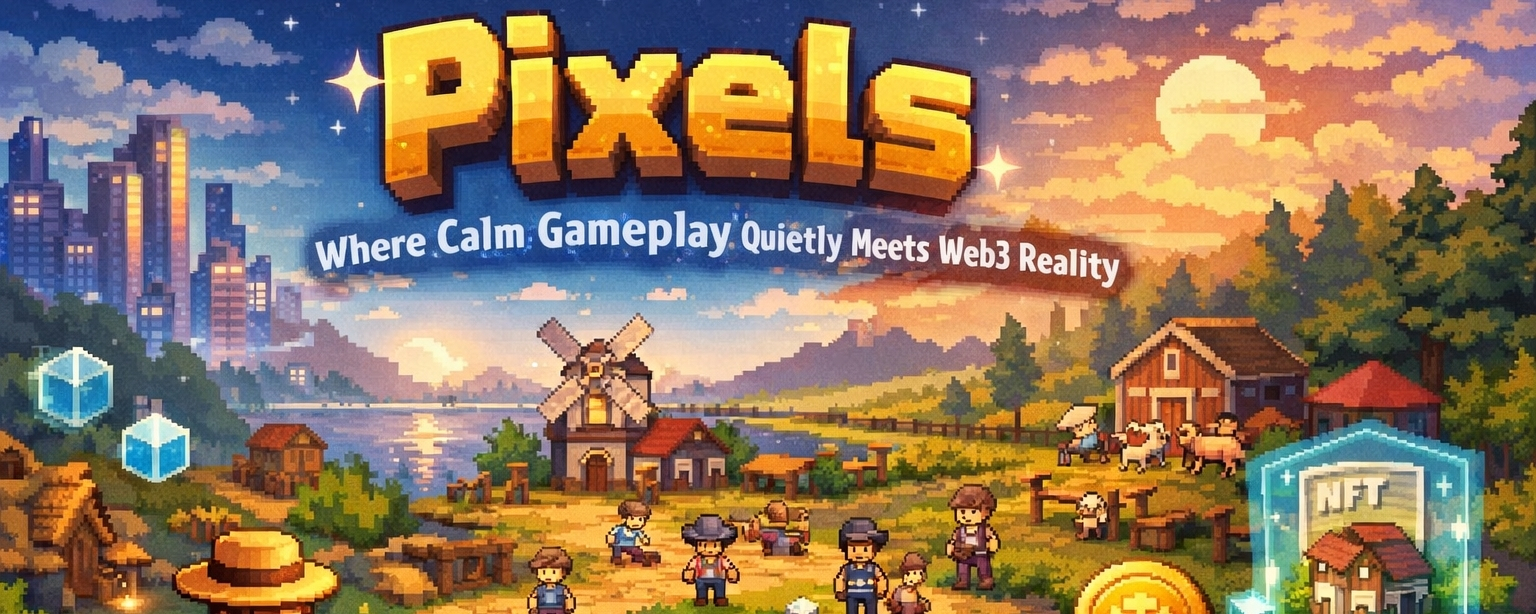
@Pixels I remember the first time I came across Pixels. At a glance, it looked simple—almost too simple. A farming game, some exploration, a bit of crafting. It gave me the same feeling I used to get from older, slower-paced games where nothing felt rushed and progress came from small, steady steps. But then I noticed it was built on Web3, and that’s usually where things start to feel complicated. So I paused for a moment, unsure of what to expect.
The idea of mixing a “casual” game with blockchain elements didn’t immediately make sense to me. Casual games, at least in my experience, are about relaxing. You play them to unwind, not to think about wallets, tokens, or digital ownership. Web3, on the other hand, often brings a layer of seriousness—markets, assets, speculation. Putting the two together felt like trying to blend two very different moods into one experience.
But the more I spent time looking into Pixels, the more I realized it doesn’t really force that complexity on you right away. It kind of sits quietly in the background. On the surface, you’re just planting crops, walking around, meeting other players, and slowly building something of your own. It feels familiar, almost comforting. That familiarity is probably what makes it approachable, especially for people who aren’t deeply into crypto.
What stood out to me most was how social the game feels. It’s not just about farming or collecting resources—it’s about being in a shared space. You see other players moving around, doing their own thing, and it creates this subtle sense of community. It’s not loud or overwhelming. It’s more like being in a small town where everyone is doing their own work, but you’re still aware of each other.
I think that’s where Pixels starts to feel a bit different from traditional games. There’s this underlying idea that what you’re doing might actually matter beyond just the game itself. When you grow something, craft something, or own a piece of land, there’s a suggestion—quiet, but noticeable—that it could have value outside the game. Not in an exaggerated way, but in a more grounded, almost experimental sense.
At the same time, I can’t help but feel slightly cautious about that part. I’ve seen how quickly things in the Web3 space can shift. What feels valuable today might not feel the same tomorrow. And when a game introduces ownership and tokens, it inevitably invites a different kind of mindset. Some players might start focusing more on profit than on the experience itself. That can change the atmosphere in subtle ways.
Still, Pixels doesn’t seem to lean too heavily into that pressure. At least from what I’ve observed, it tries to keep things balanced. You can engage with the economic side if you want, but you don’t have to. You can just play it like a normal game, and that option matters more than it might seem. It keeps the experience grounded.
Another thing I appreciate is how the progression feels. It’s not overly fast, and it doesn’t try to impress you with constant rewards. Instead, it moves at a slower pace. You plant something, you wait, you come back. There’s a rhythm to it. It reminds me of how some of the most enjoyable games aren’t the ones that constantly stimulate you, but the ones that give you space to breathe.
I also found myself thinking about how this kind of game might evolve over time. If more players join, if the world expands, if new systems are added—what happens then? Does it stay calm and casual, or does it slowly become something more complex? It’s hard to say. Growth can be a good thing, but it can also change the original feel of a game.
There’s also the question of accessibility. Right now, Pixels seems to be trying to lower the barrier for entry, which is important. Web3 games often struggle with that. If something is too technical, people lose interest before they even get started. Pixels seems aware of this, and it feels like it’s trying to ease people in rather than overwhelm them.
I think what I find most interesting is not just the game itself, but what it represents. It feels like an experiment—an attempt to see if blockchain elements can exist quietly within a game without taking over the entire experience. Not everything needs to be about tokens and markets. Sometimes, it’s enough for those systems to exist in the background, supporting the world rather than dominating it.
And maybe that’s the direction things need to go. Instead of making Web3 the main attraction, games like Pixels seem to treat it as a layer—something that adds depth without demanding attention. Whether that approach will work long-term is still uncertain, but it’s at least a step toward something more balanced.
As I think about it now, Pixels doesn’t feel like a game that’s trying too hard to impress. It’s not loud, it’s not overly ambitious in a flashy way. It just exists, quietly doing its thing. And sometimes, that’s exactly what makes something worth paying attention to.
In a space that’s often driven by big promises and rapid hype cycles, there’s something refreshing about a game that moves at its own pace. It doesn’t try to convince you of anything. It just lets you explore, build, and figure things out for yourself.
I wouldn’t say it’s perfect, and I wouldn’t assume it will stay the same forever. But for now, it feels like a small, thoughtful step in a direction that many projects talk about but rarely achieve. And maybe that’s enough—to simply exist as something that feels real, even in a space that often doesn’t.
