
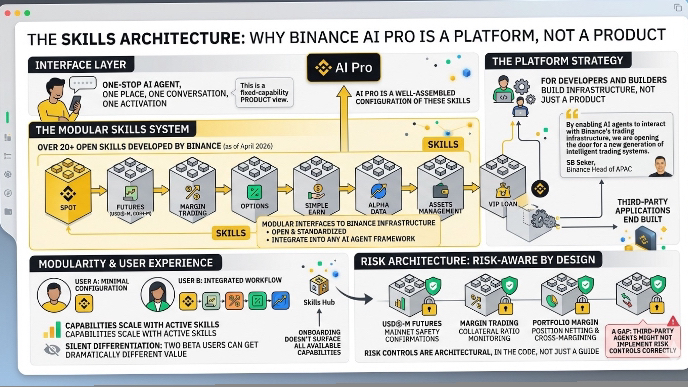
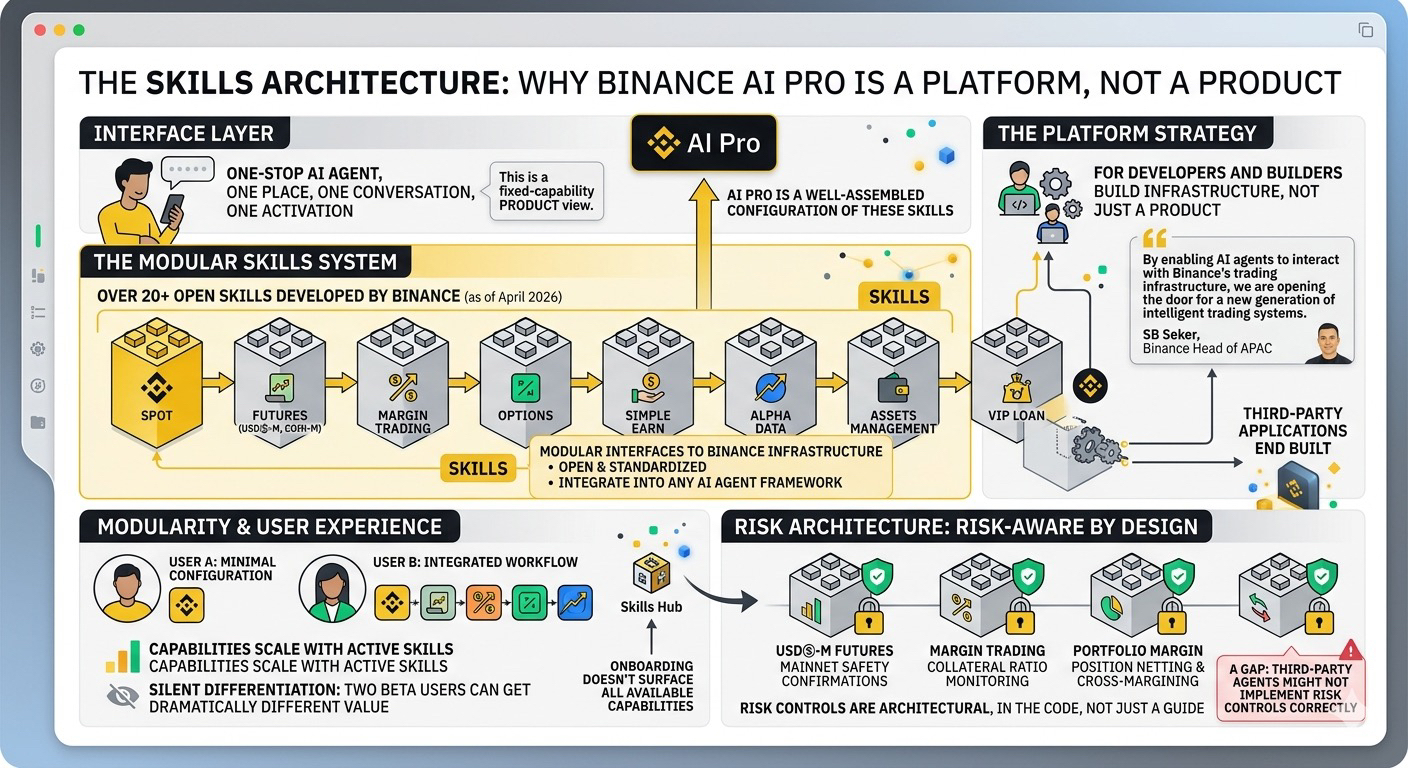
 The product description calls Binance AI Pro a "one-stop AI Agent." That framing is accurate for the interface layer: one place, one conversation thread, one activation. But underneath the interface, the architecture is something different. It's a modular skills platform, and understanding that distinction changes how you evaluate what the product is and what it can become.
The AI Skills system is the part of AI Pro most people miss. By the time of this writing, Binance has launched 13 AI Agent Skills that can be equipped on any AI agent, including AI Pro. The initial 7 covered core capabilities. The March 18, 2026 expansion added 4 more covering USDⓈ-M Futures, Margin Trading, Binance Alpha data, and Assets Management. A further 13 new skills added in April extended coverage to Simple Earn, VIP Loan, Options, Portfolio Margin, COIN-M Futures, Tokenized Securities, and more.
Each skill is a modular interface to a specific part of Binance's infrastructure. They're open, standardized, and can integrate into any AI agent framework with minimal configuration. Binance publishes them on the Skills Hub and in a public GitHub repository.
That's a platform, not a product. A product gives you fixed capabilities. A platform gives you components. AI Pro is, in practice, a well-assembled default configuration of those components delivered as a consumer-facing interface.
what modularity means for the user experience
The practical implication of modular skills: your AI Pro capabilities scale with which skills are active in your configuration. A user who has only the Spot skill active is using a different product from a user who has Spot, Futures, Margin, Options, and Alpha all active in an integrated workflow.
This creates a silent differentiation that the product page doesn't surface clearly. Two users paying $9.99/month for the same beta access might be getting dramatically different value depending on how much of the skills ecosystem they've discovered and configured.
The onboarding doesn't walk you through skills selection in a way that surfaces all available capabilities. You can activate and start using AI Pro without knowing the Options skill exists, without knowing you can query Binance Alpha token data, without knowing Simple Earn monitoring is available. The skills are there. Whether you find them is a different question.
the open and modular design choice
Binance made a specific architectural choice: build the skills to be open and integrable into any AI agent framework, not just AI Pro. This means the skills are designed for developers, not just for end users. Any developer building an AI agent can equip it with Binance-grade trading capabilities using the same skills that power AI Pro.
This is a platform strategy. Binance isn't just building AI Pro for retail users. It's building infrastructure that third parties can build on. AI Pro is the consumer product. The skills ecosystem is the platform that developers and builders access separately.
SB Seker, Binance's Head of APAC, framed it directly: "By enabling AI agents to interact with Binance's trading infrastructure, we are opening the door for a new generation of intelligent trading systems." That statement is aimed at builders, not at retail users. It's describing the platform layer.
The interesting question is what gets built on top of that platform. Retail users get AI Pro. Builders get the skills. What builders create with those skills, and whether any of those creations eventually come back to retail users as products, is the multi-year story that the March to April 2026 skills expansion is the beginning of.
the risk architecture embedded in the skills
The skills are not just capability modules. They're risk architecture. Each skill that touches real execution has specific risk controls baked into it. The USDⓈ-M Futures skill has mainnet safety confirmations. The Margin Trading skill has collateral ratio monitoring. The COIN-M Futures skill supports testnet. The Portfolio Margin skill has position netting and cross-margining designed to improve capital efficiency without requiring manual management.
These controls are not bolted on. They're designed as part of the skill specification. The phrase Binance uses is "risk-aware by design," which is exactly the right way to describe it: the risk management is architectural, not procedural. It's in the code, not in a user guide.
This is the right approach for an AI execution layer. When the AI is doing the execution, the risk controls can't rely on the user remembering to apply them. They have to be embedded in the system. The alternative — AI execution plus manual risk management — is worse than either AI execution plus automated risk controls or manual execution plus manual risk controls.
the gap the modular design creates
Here's the uncomfortable implication of an open, modular skills architecture: the barrier to building a badly configured AI agent using these skills is low. The skills are open and designed for minimal configuration. A developer who understands how to integrate them but doesn't understand the risk controls can build an AI agent that uses Binance-grade execution without Binance-grade risk management.
AI Pro as a consumer product includes the risk controls by default. The skills as an open platform are available for configuration by anyone. The documentation includes the risk controls in the specification, but documentation is not enforcement. A third-party AI agent built on these skills might or might not implement the safety confirmations and collateral monitoring correctly.
This is a design tension in every open platform: openness for builders versus protection for end users. Binance's solution is to build the controls into the skill specifications and trust that builders implement them. Whether that trust is warranted at scale is a question that will be answered as more third-party applications are built on the skills platform.
the platform vs product distinction matters
If you think of AI Pro as a product, you evaluate it on what it does by default. If you think of it as a platform interface on top of a skills ecosystem, you evaluate it on what it can do when fully configured and what it enables builders to create.
Both evaluations are valid. The product layer is what most beta users are experiencing. The platform layer is what will determine AI Pro's long-term relevance. The skills expansion pace — from 7 to 11 to 13 to a growing total in a matter of weeks — suggests the platform layer is moving faster than the product layer.
Watch the skills, not just the product.
@Binance Vietnam $XAU $BTC $ETH #BinanceAIPro
Giao dịch luôn tiềm ẩn rủi ro. Các đề xuất do AI tạo ra không phải là lời khuyên tài chính. Hiệu quả hoạt động trong quá khứ không phản ánh kết quả trong tương lai. Vui lòng kiểm tra tình trạng sản phẩm có sẵn tại khu vực của bạn.