
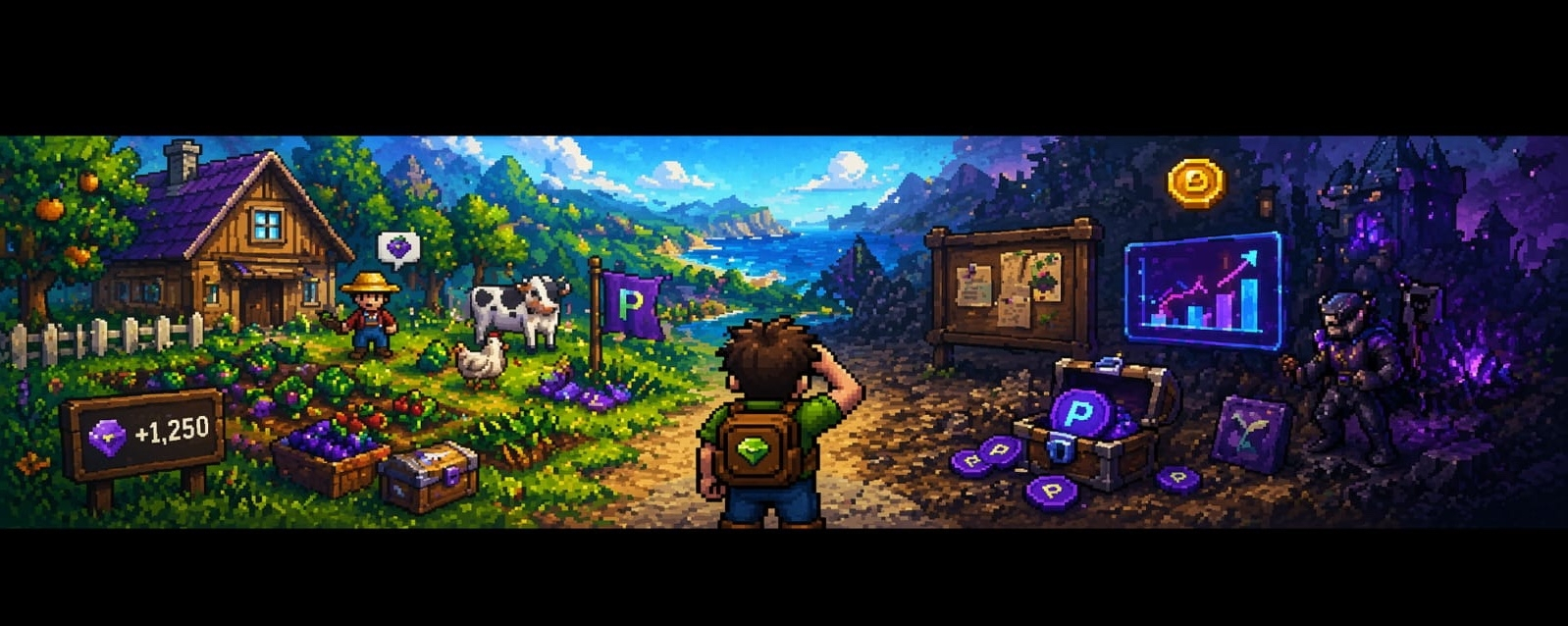
I’ve been watching Pixels closely for a while now, not just as someone scrolling through updates, but as someone trying to understand where the real value actually comes from in these so-called “play-to-earn” ecosystems. And if I’m being completely honest, the version of Pixels we’re seeing in 2026 is very different from what pulled people in at the start. The shift isn’t loud, but it’s real—and if you’re arriving late, you’re stepping into a completely different game than the one early users experienced.
When Pixels first started gaining traction, the appeal was obvious. You could log in, complete basic tasks, interact with the world, and start earning almost immediately. It felt frictionless. There was a sense that time spent in the game directly translated into value, and for a lot of people, that was enough. The barrier to entry was low, and the feedback loop was fast. That combination created momentum, and momentum created growth. Within a relatively short period, Pixels scaled to millions of users, driven largely by this simple promise: play, and you earn.
But what I’ve come to realize is that those early rewards were never meant to define the long-term system. They were incentives—carefully designed to bootstrap activity, not sustain it. In simple terms, they were subsidies. And like every system built on subsidies, there comes a point where the math starts to matter more than the narrative. That’s where we are now.
In 2026, the earning landscape inside Pixels feels noticeably tighter. It’s not that rewards have disappeared, but the ease of extracting value has changed. Where early users could rely on basic participation, newer players are facing a more competitive and, in many ways, more selective environment. The same actions that once generated consistent returns now produce less, and the margin between effort and reward has narrowed. That’s not accidental—it’s structural.
One thing I’ve noticed is how the in-game economy has matured, but not necessarily in a way that benefits late entrants. With more players competing for the same reward pools, and with emissions becoming more controlled, the system has naturally become less forgiving. If millions of users are all trying to extract value, the system has to either inflate endlessly or tighten distribution. Pixels, like most projects that survive beyond the hype phase, is choosing the latter.
And this is where the illusion starts to break for many people. The idea that you can enter late and replicate early gains simply doesn’t hold anymore. Early users weren’t just “lucky”—they were participating in a different economic phase. They were there when rewards were high relative to participation, when inefficiencies existed, and when the system was actively overpaying to grow. That window doesn’t stay open forever.
I’ve also started to question what kind of behavior the system actually rewards now. In the beginning, it felt like playing the game was enough. Now, it feels more like optimization is required. Players who understand mechanics deeply, who manage resources efficiently, or who already hold valuable assets have a clear advantage. The gap between casual participation and strategic play has widened, and that gap matters more than most people expect.
Another thing that stands out to me is how the perception of activity can be misleading. On the surface, Pixels still looks busy. There are players, trades, events, and updates. But activity alone doesn’t equal value creation. A system can be full of users and still struggle with retention quality, reward sustainability, or economic balance. The real question isn’t how many people are playing—it’s how many are staying because the system makes sense without constant incentives.
The dual-token structure, with $BERRY as the in-game currency and $PIXEL as the premium layer, adds another layer of complexity. Early on, this structure helped separate utility from speculation, but over time, managing inflation and maintaining demand becomes increasingly difficult. If too much value is extracted without enough being reinvested into the system, pressure builds. And that pressure often shows up in subtle ways—reduced rewards, higher costs, or shifting mechanics that favor long-term holders over new participants.
From my perspective, the most important shift is psychological. The expectation of “easy earnings” is fading, but many people are still entering with that mindset. That mismatch creates frustration. When reality doesn’t meet expectation, people assume something is wrong with the project, when in fact, the system is simply evolving into something more sustainable—or at least trying to.
I don’t think Pixels is failing. If anything, this phase is necessary. Any system that survives has to move from aggressive growth to controlled balance. But that transition always comes at a cost, and that cost is usually paid by late entrants who expected the early experience.
So when I look at Pixels in 2026, I don’t see a broken ecosystem. I see one that is recalibrating. Rewards are no longer handed out to attract users—they’re distributed to retain the right kind of behavior. The game isn’t about showing up anymore; it’s about understanding how the system actually works.
And that’s the part most people miss.
If you’re coming in now, you’re not early. You’re stepping into a system that has already gone through its easiest phase. The question isn’t whether you can earn—it’s whether you can adapt.