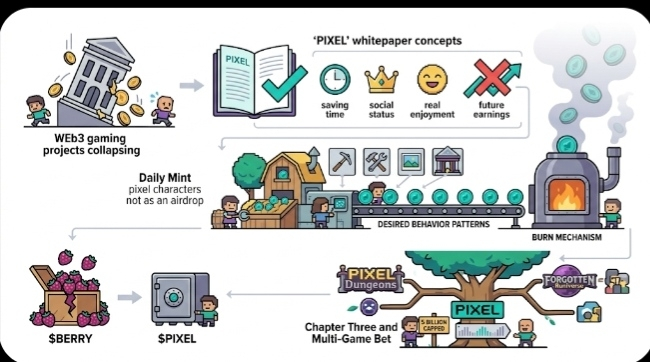
I have watched enough Web3 gaming projects collapse under their own weight. The pattern is always the same: launch with hype, hand out tokens like candy, watch players farm and dump, then wonder why the economy turned into a ghost town. So when I started looking into Pixels, I expected more of the same. A farming simulator. Cute graphics. Another token to grind and sell.
But then I read the whitepaper. And something caught my attention that most casual players probably skip right over.
The Question Nobody Asks
The Pixels team published a framework for $PIXEL that is almost uncomfortable in its honesty . They ask four questions about why someone would spend this token. Three of them are fine: does it save me time, does it buy me social status, does it provide real enjoyment. The fourth question, the one they deliberately exclude, is the most telling.They do not ask whether pixel increases future earnings.
Read that again. The team behind a gaming token explicitly states that their premium currency should not be viewed as an investment vehicle. That is heresy in this space. Most projects want you to believe their token will only go up. Pixels is telling you the opposite spend it on things that make the game better, not because you expect a financial return.
This changes the entire mental model for holding PIXEL.
The Daily Mint Is Not a Giveaway
Supply mechanics are where most people get lazy. They see 100,000 new $PIXEL minted every day and assume inflation will crush the value . But the distribution method matters more than the raw number.
Those tokens do not get airdropped to passive holders. They go to players who complete specific tasks, find rare items, or create user-generated content that actually benefits the ecosystem . The whitepaper calls this desired behavior patterns. In plain English, you have to work for them. And not just grinding the same quest repeatedly. The game rewards actions that make the world more engaging for everyone else.
I appreciate the distinction. It separates the farmers from the builders. If you want a share of that daily mint, you need to contribute something beyond clicking buttons.
The Burn Mechanism That Actually Functions
Premium items in the in-game store cost PIXEL. The store does not buy anything back.That means every purchase removes tokens from circulation permanently. But here is the detail that matters the team has stated they will likely burn a large portion of the proceeds each day .
This is not a one time event. They are helping tighten the supply for everyone else. The system aligns individual enjoyment with collective scarcity.
Why the Berry Removal Was Necessary
The project recently eliminated the BERRY system and consolidated everything into a single token model . On the surface, that sounds like a simplification. But the strategic reasoning runs deeper.
BERRY was inflationary by design. It worked for daily transactions but created endless sell pressure. By removing it, the team forced all economic activity through PIXEL.
The risk is obviousif PIXEL becomes too expensive for casual actions new players get priced out. But the team has addressed this by keeping core gameplay loops free. You do not need PIXEL to farm, explore or complete basic quests . The token only touches premium layers.
Chapter Three and the Multi-Game Bet
The roadmap for 2026 includes something called multi-game staking . The idea is straightforward pixel stake across different titles within the Pixels universe, earn yields from each one. The project already has five to six games in development, including Pixel Dungeons and Forgotten Runiverse .
This transforms $PIXEL from a single game currency into an ecosystem wide asset. If even two of those new titles gain traction, the demand base expands significantly. And because the supply remains capped at 5 billion, with a structured vesting schedule stretching over years, the economic pressure points shift .
The Uncomfortable Truth
I am not here to tell you pixel will make you rich. The team explicitly does not want that expectation. But I will say this: most gaming tokens fail because they prioritize extraction over enjoyment. Pixels has built a system where spending feels like progression not loss . The daily mint rewards contribution not passive holding. The burn mechanism is continuous, not performative.
The project account @Pixels is running an experiment. Can a Web3 game survive by being genuinely fun first, with the token as an amplifier rather than the main attraction? Based on the structural decisions in the whitepaper, I think they have a better shot than most.
#pixel