
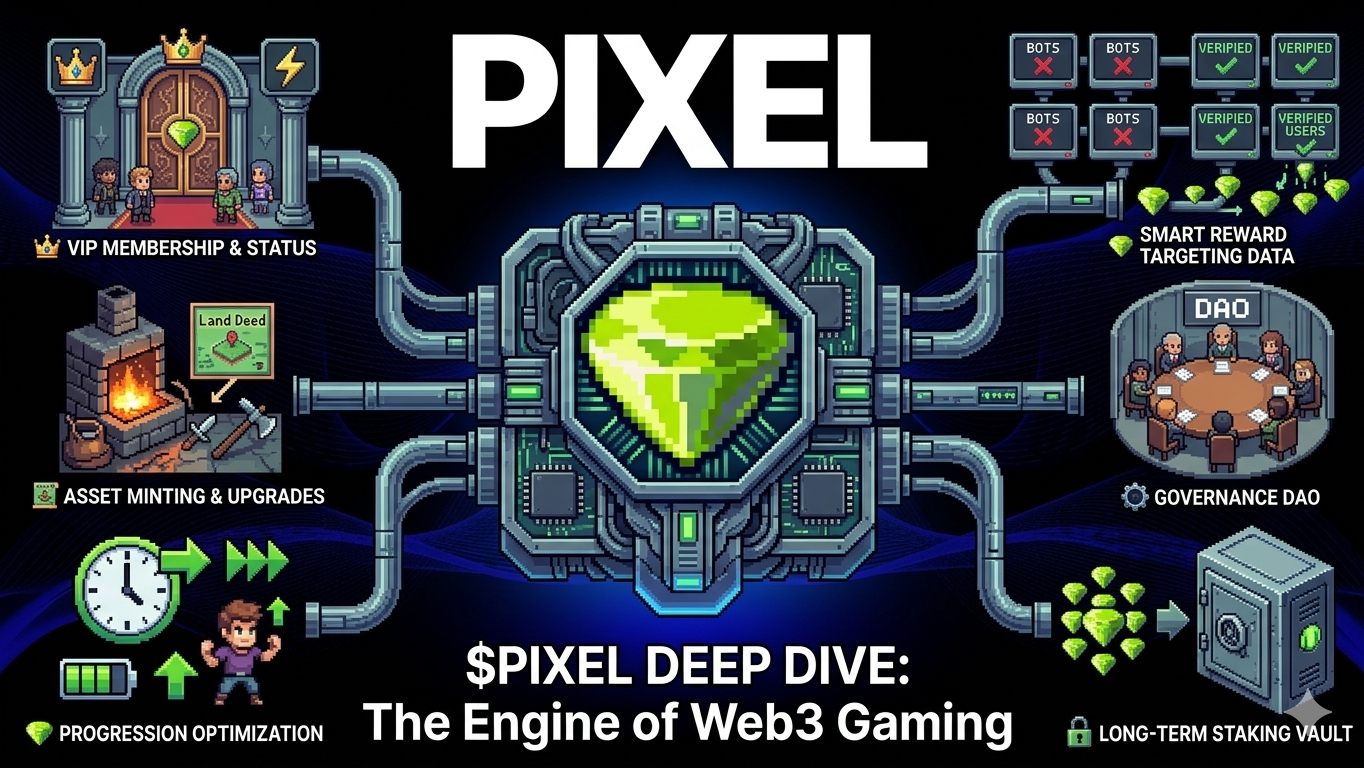
The architectural foundation of any resilient decentralized application is its economic engine. During the first iteration of Web3 gaming, developers focused heavily on the visual interface of tokenomics but severely neglected the underlying mechanics. We witnessed an era where inflationary soft currencies were paraded as sustainable rewards, leading to the inevitable collapse of countless GameFi projects. Pixels, however, has engineered a fundamentally different machine. The $PIXEL token is not an afterthought, a temporary incentive, or a simple reward mechanism; it is the highly calibrated core utility layer that powers progression, social status, and governance within a thriving digital nation.
To truly understand the trajectory of the Pixels ecosystem, we must examine the engine itself. This deep dive dissects the mechanics of $PIXEL, exploring how it avoids the pitfalls of the past and sets a new structural standard for the future of digital asset integration.
The Evolution: From Soft Faucets to Hard Currency
The genius of the PIXEL token cannot be fully appreciated without acknowledging the ecosystem's economic history. In its early stages, Pixels operated heavily on a dual-token model utilizing a softer currency designed for high-velocity in-game microtransactions. While this fueled rapid initial growth, the team recognized that relying on an uncapped, easily farmed asset to sustain long-term value was a critical vulnerability. It created an environment susceptible to extreme inflationary pressure and bot-farm exploitation.
The introduction of PIXEL represents a structural hardening of the economy. $PIXEL is designated as the ecosystem's premium, hard currency. It is inherently limited in supply, vastly superior in utility, and fiercely protected against superficial farming. By cleanly separating the "daily gameplay chores" from the "premium ecosystem value," Pixels established an economic firewall. The day-to-day resource gathering continues uninterrupted, but the high-level growth and capitalization of the ecosystem are anchored securely to $PIXEL.
The Architecture of Utility: The Sinks
A premium token is entirely worthless if the platform lacks compelling avenues for its expenditure. In the language of tokenomics, these avenues are called "sinks." Pixels has designed its sinks not as mandatory taxes or tedious roadblocks, but as powerful enhancements to the user experience.
The litepaper outlines several core "power sectors" that drive the intrinsic demand for $PIXEL:
VIP Memberships and Social Capital: In any persistent digital world, status is a primary motivator. PIXEL acts as the direct gatekeeper to the VIP Membership system. Purchasing a subscription (managed through on-chain NFTs) unlocks exclusive perks, expanded energy limits (the vital fuel for progression), and access to restricted VIP social hubs. This creates a massive voluntary sink where players actively exchange tokens to elevate their daily experience and social standing among their peers.
Asset Minting and Economic Upgrades: The continuous expansion of a digital economy requires the creation of new assets. Whether a user intends to mint unique NFTs, acquire specialized land upgrades, or unlock advanced crafting blueprints, PIXEL is the required fuel. This mechanism guarantees that as the overall player base scales and the demand for digital property increases, the underlying demand for the token scales linearly alongside it.
Accelerating Progression Dynamics: While Pixels firmly upholds its "Fun First" mandate, it remains a game of resource management and time allocation. #pixel grants players the ability to accelerate build times, replenish energy reservoirs, and bypass tedious waiting periods. This introduces a sophisticated layer of "Pay-to-Optimize." It allows users with greater capital resources to maximize their efficiency without destroying the core competitive balance for casual participants.
Smart Reward Targeting: The Data-Driven EnginePerhaps the most revolutionary aspect of the @Pixels economy is how the tokens are distributed. Traditional Play-to-Earn protocols operated on a flat, primitive Proof of Work model: if a wallet completes task X, it automatically receives reward Y. This indiscriminate distribution is a magnet for sybil attacks and automated bot extraction.
Pixels discards this archaic model in favor of Smart Reward Targeting, an infrastructure that operates with the precision of a high-end algorithmic ad network.
Instead of blindingly emitting tokens into the void, the system leverages large-scale data analysis and machine learning to evaluate the quality of the interaction. It analyzes account reputation, the longevity of the user, social engagement metrics, and whether the player's actions genuinely contribute to the ecosystem's intrinsic value. PIXEL rewards are then distributed surgically to these verified, high-value users.
By utilizing authenticated data to drive token emissions, the engine prevents the bleeding of liquidity to mercenary actors. It ensures that the rewards act as a potent amplifier for genuine community building rather than a subsidy for bot developers.
Decentralized Infrastructure and Designing Trust
As a brand and product designer, the most critical element I evaluate in a Web3 protocol is trust. In a truly decentralized environment, transactions must be transparent, secure, Peer-peer, No intermediaries. If the user interface is beautiful but the underlying economic contract is opaque or easily manipulated by a centralized authority, trust instantly evaporates.
Pixels designs this trust directly into the token's architecture. The roadmap for PIXEL extends far beyond mere in-game utility; it is the foundation for the Pixels DAO (Decentralized Autonomous Organization). Eventually, $PIXEL holders will transition from being mere users to active stakeholders. The token will grant the community the power to govern treasury allocations, direct future game integrations, and vote on essential ecosystem parameters.
This composability ensures that the token possesses "meta-utility." It is not just the money of the realm; it is the law of the realm. When a token represents verifiable ownership and governance over a secure, peer-to-peer network, it removes the speculative fog that plagues standard crypto projects. The community buys and holds PIXEL not solely because they hope the chart goes up, but because they intend to use it to shape the environment they inhabit.
Staking: Aligning the 10-Year Horizon
To complement the immediate utility sinks, the ecosystem relies heavily on staking to align the long-term incentives of all participants. The staking mechanics are engineered to bridge the gap between casual players, organized guilds, and the core development team.
By locking PIXEL into the protocol, users secure the network and signal long-term commitment. In return, they gain enhanced influence, better reward multipliers, and deeper integration into the platform's publishing flywheel. This system transforms short-term token flippers into long-term infrastructure partners, ensuring that the liquidity required to run the engine remains stable, deep, and committed to a multi-year vision.
The Blueprint for Digital Nations
The $PIXEL token is a masterclass in economic calibration. It successfully balances the complex, often conflicting needs of the hardcore competitive gamer, the casual social explorer, and the long-term infrastructure stakeholder.
By focusing relentlessly on high-utility sinks, implementing data-driven reward distribution, and ensuring the architecture remains transparent and secure, the Pixels team has constructed an engine that doesn't just run, it continuously learns and adapts. PIXEL proves that the next generation of Web3 gaming does not need to rely on unsustainable Ponzi-lite mechanics. It can, and must, be a legitimate, functioning economy where value is seamlessly exchanged for entertainment, status, and community.
The engine is primed, the data loops are active, and the foundation is solidified. As we move forward in this series, we will examine how this sophisticated economic engine is packaged and presented to the user.