
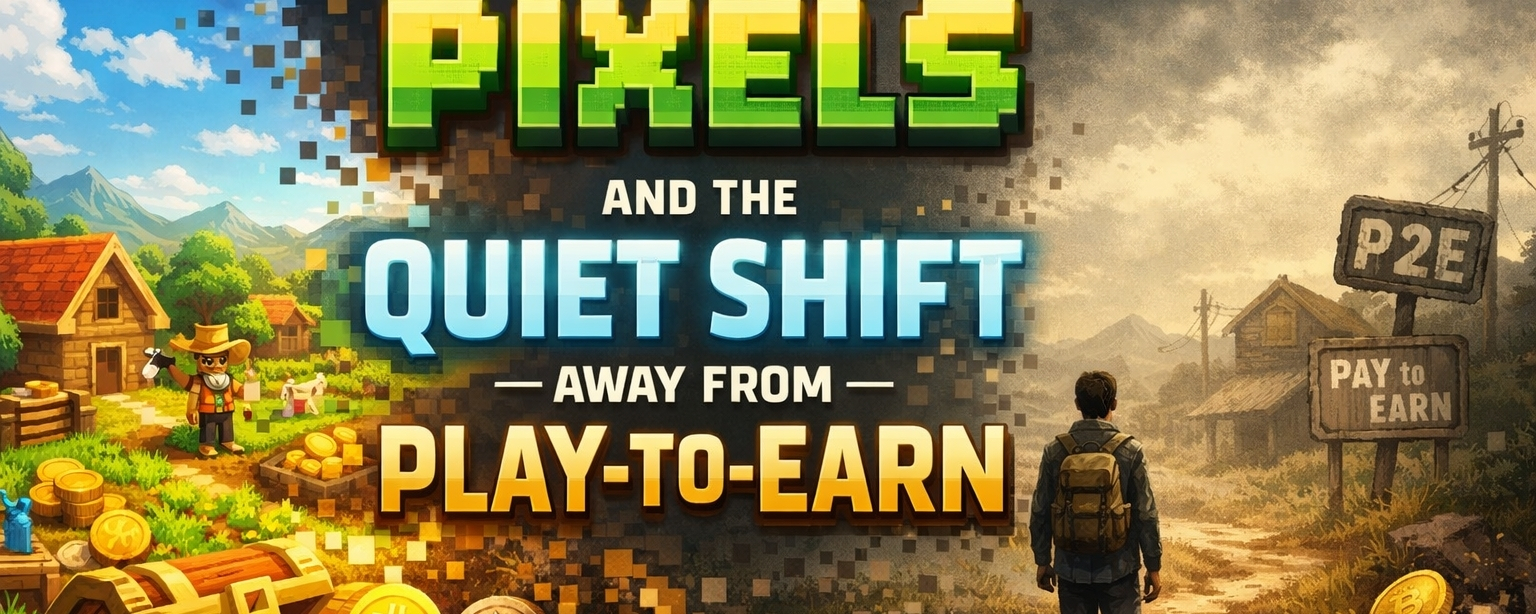

There’s something a little strange about how quickly we got used to the idea that games on the blockchain should feel like work. Somewhere along the way, “playing” became tied to earning, optimizing, extracting. So when I first came across Pixels, it didn’t immediately register as anything unusual. Farming, gathering, wandering around a pixelated world it sounded familiar, almost too safe.
But the longer I sat with it, the more it started to feel like it was quietly pushing against a pattern that had become normal in Web3.
What stands out isn’t just that Pixels is built on the Ronin Network, or that it has tokens and on-chain elements. It’s that most of the time, you don’t really think about those things while you’re in it. You plant crops, you explore, you talk to other players, and the blockchain part sort of fades into the background. That’s a subtle shift, but it matters. For a while, Web3 games almost insisted that you stay aware of the system underneath wallets, transactions, assets, rewards. Here, the system is still there, but it’s less intrusive.
It makes me wonder whether that’s closer to what blockchain infrastructure was supposed to feel like all along. Not invisible exactly, but not constantly demanding your attention either.
There’s also something interesting about the pace. Pixels doesn’t rush you. The loops are simple and a bit repetitive, but not in a way that feels aggressive. It’s closer to the rhythm of older farming games, where progress is slow and sometimes a little mundane. In most crypto environments, slowness is almost treated like a flaw. Everything is expected to move fast prices, narratives, user growth. Here, slowness feels intentional, even necessary.
At the same time, that raises a question. If the experience becomes too relaxed, does the Web3 layer still justify itself? Ownership of in-game assets, token economies, decentralized infrastructure these are meaningful ideas, but they only really matter if they add something to the experience. Otherwise, they risk becoming decorative. Pixels walks a thin line here. It integrates these elements, but it doesn’t always make it obvious why they need to exist beyond enabling trade or persistence.
That’s not necessarily a criticism, just an observation. Maybe the value isn’t in constantly feeling the presence of blockchain, but in knowing it’s there if you need it. Like owning something quietly, without being reminded of it every second.
The social aspect adds another layer. Because the world is shared, there’s a kind of soft coordination between players. Not structured competition, not even strict collaboration just a sense that other people are around, doing their own thing in parallel. It’s less intense than most multiplayer environments, and that again feels deliberate. Web3 often leans heavily into markets and incentives to drive interaction. Pixels seems to rely more on presence and routine, which is harder to measure but maybe more sustainable in its own way.
Still, I can’t help but think about how fragile that balance might be. As more players arrive, as the economy grows, as expectations shift, does the game start to tilt back toward optimization and efficiency? Do players begin to treat it less like a world and more like a system to be mastered?
That tension isn’t unique to Pixels. It’s something that sits at the center of almost every Web3 project. The moment real value is introduced, behavior changes. People start looking for edges, shortcuts, advantages. It’s natural, but it can quietly reshape the experience into something more transactional.
What Pixels seems to be exploring whether intentionally or not is whether a blockchain-based system can support a space that doesn’t immediately collapse into that pattern. A place where value exists, but doesn’t dominate. Where infrastructure matters, but doesn’t define the moment-to-moment experience.
I don’t think it fully answers that question yet. Maybe it’s too early for that. But it does feel like a different kind of attempt, one that’s less concerned with proving that Web3 can scale or monetize, and more interested in whether it can simply exist alongside something as ordinary as a farming game.
And in a space that often feels like it’s chasing the next big thing, there’s something oddly compelling about that kind of restraint. Not because it guarantees anything, but because it leaves room for things to unfold a bit more slowly, a bit more naturally.
I keep coming back to that feeling that maybe the most interesting part of Pixels isn’t what it does, but what it chooses not to emphasize. And whether that choice can hold as everything around it keeps accelerating.
