
What stands out to me about Pixels is that it never felt like one of those projects trying too hard to convince people it was the future. It felt different for a simpler reason. It felt playable.
That may sound obvious, but in Web3 gaming, it really is not.
I have spent enough time watching this space to notice a pattern. A lot of projects come in with huge promises, polished language, token narratives, ownership narratives, and big ideas about how they are going to change gaming forever. Then you actually look at the product, and the experience feels thin. Sometimes it feels like the game exists to support the token, not the other way around. From my point of view, Pixels became important because it moved in the opposite direction. It gave people something that felt familiar, social, light, and alive, and that mattered more than most of the industry expected.
What I keep coming back to is this: Pixels did not make noise by sounding revolutionary. It got attention by understanding what makes people stay.
I am watching this closely across gaming in general, not just Web3, and the projects that last usually understand one basic truth. People do not return every day because of abstract technology. They return because the experience fits into their lives. They come back because the world feels easy to enter, because there is something to do, because progress feels visible, because other people are there, and because the game gives them a rhythm. Pixels seems to understand that extremely well.
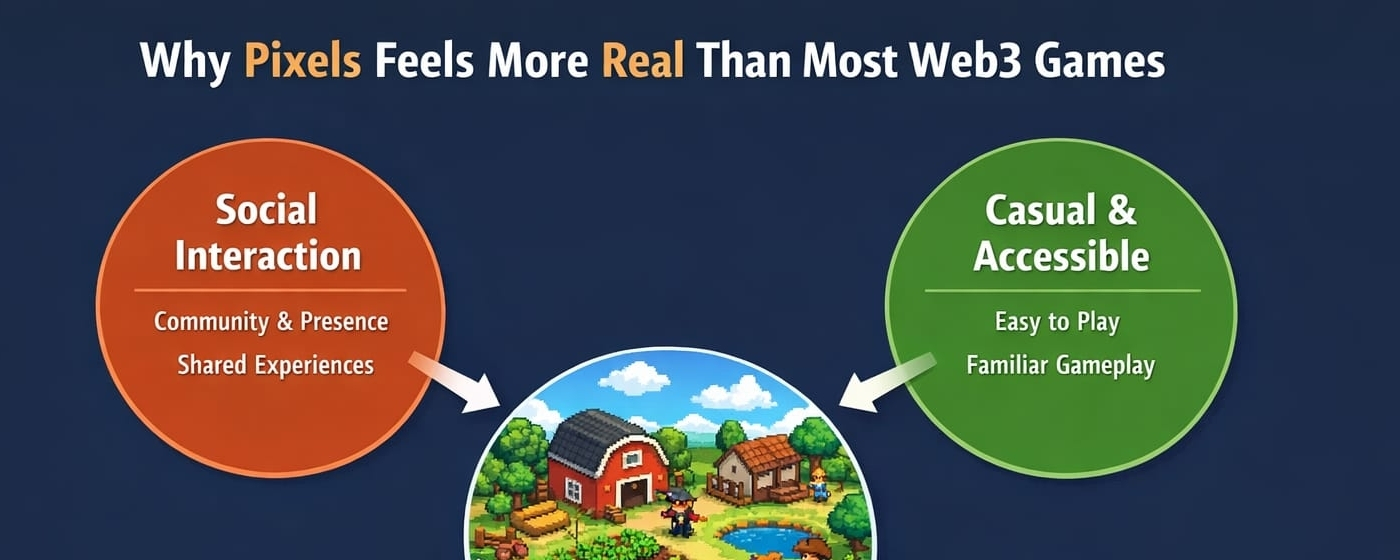
That is why it is so often described as a strong example of social, casual, and scalable Web3 design. Not because it invented everything from scratch. Not because it is perfect. But because it got the priorities right.
The social part matters more than many people realize.
When I look at Pixels, I do not just see farming loops, gathering loops, crafting, quests, and exploration. I see a world built around presence. That is an important distinction. A lot of games give players tasks. Fewer games give players a sense that they are somewhere. Pixels has that feeling. It is not just about doing an activity. It is about being in an environment where identity, routine, and interaction start to matter.
That, to me, is where many Web3 games missed the point. Ownership alone does not create attachment. A wallet holding an asset is not the same thing as a player feeling connected to a world. Real attachment comes from habits. It comes from shared space. It comes from the simple but powerful feeling that other people are here too, building, progressing, watching, participating.
I pay attention to that very closely because social energy is often the difference between a game that looks promising and a game that actually survives.
Pixels also benefited from leaning into casual design, and I think this is another area where people often misunderstand what they are seeing. Casual does not mean weak. It does not mean shallow. In many cases, it means disciplined. It means the game respects the player’s time. It means the systems are readable. It means someone can enter the world without feeling like they need a manual, a strategy thread, or a crypto education just to understand why the product exists.
That is harder to build than people think.
A lot of products become complicated because the builders confuse complexity with depth. Pixels feels like it made a smarter choice. It used loops people already understand. Farming. Crafting. Gathering. Progression. Exploration. These are not random choices. These are familiar and proven behaviors. They lower resistance. They give the player an easy starting point. Then, once the player is comfortable, the deeper layers start to matter more.
From my point of view, that sequence is one of the biggest reasons Pixels became important. It does not ask people to understand Web3 first and enjoy the game later. It invites them into the game first. That is the correct order.
I have noticed that when blockchain products place too much emphasis on the technology at the front, they create distance instead of excitement. The user becomes aware of the system before they become attached to the experience. That usually leads to friction. Pixels seems to avoid a lot of that by keeping the play experience visible and the infrastructure more quietly in the background.
That is how it should be.
Technology should support the experience, not interrupt it.
Another thing I think Pixels understood very well is the power of routine. Many people assume successful games are built around huge moments, dramatic updates, constant excitement, or intense competition. Sometimes that helps, but from what I have seen, sticky products are more often built around repeatable behavior. People come back because the loop feels natural. The game becomes part of their day.
That matters a lot.
Farming and resource-based progression can look simple from the outside, but they create something very valuable: rhythm. They give the player a reason to check in. They make progression feel steady instead of abstract. They remove the pressure of needing every session to feel massive. In a strange way, that is exactly why these systems can become powerful. They are sustainable. They create low-friction engagement, and when that is connected to a social world, the whole thing becomes much stronger.
I believe Pixels gained credibility because it was built around these repeatable behaviors instead of relying only on speculation. That is a major difference. Many Web3 games chased spikes of attention. Pixels, from my point of view, seemed much more aligned with building habits.
Habits are stronger than hype.
That is true in games, products, media, and probably most things people use regularly.
When people call Pixels scalable, I think they are noticing more than just infrastructure. Of course the technical side matters. A game needs a network and ecosystem that can support real user activity without making every interaction feel expensive, slow, or annoying. That part matters. But I think behavioral scalability matters just as much, and maybe even more.
Can new people understand the game quickly?
Can the experience support different types of players?
Can the world remain readable as more users arrive?
Can the game keep its identity while growing?
These questions are often ignored, but they are critical. Plenty of products can technically handle more traffic. Far fewer can absorb growth without losing clarity. Once more users enter, many systems become noisy, confusing, or culturally empty. Onboarding gets worse. Retention gets weaker. Veterans feel disconnected from newcomers. The whole thing starts to feel less human.
Pixels, in my view, has often been seen as scalable because its design language is simple in the best possible way. You can understand the basic logic of the world quickly. You do not need to be deeply ideological about blockchain to see the appeal. You can just enter, play, explore, gather, build, and interact. That lowers the barrier, and lowering the barrier is one of the hardest things to do well in Web3.
I am watching this closely because it points to a broader truth. The products that scale best are often the ones that feel easiest to enter, not the ones that sound the most advanced.
There is also something important about how Pixels made Web3 feel less intrusive. I think this is one of its biggest strengths, even if people do not always say it directly.
The weakest blockchain products force the user to constantly feel the machinery. You are always aware of the chain, the wallet, the assets, the marketplace, the token, the infrastructure. It becomes exhausting. Instead of feeling like a world, the product feels like a mechanism. The user is never allowed to forget that they are inside a system.
Pixels seems more effective because it lets the experience stay in front. The world comes first. The activity comes first. The feeling of progress comes first. The social presence comes first. Then the Web3 layer supports those things underneath.
That is a much better design philosophy.
I believe the future winners in this space will follow that model. Not because the technology is unimportant, but because people do not build emotional connection to infrastructure. They build emotional connection to experiences. Infrastructure becomes valuable only when it strengthens something people already care about.
That is exactly why Pixels became symbolic for so many people. It represented a correction.
For a long time, Web3 gaming seemed trapped in the wrong conversation. Too much focus on tokenomics. Too much attention on extraction. Too much obsession with ownership as if ownership by itself creates meaning. What Pixels helped show is that none of those things matter if the world itself does not feel worth entering.
That lesson sounds simple, but the market needed it.
I have noticed that the projects people remember are usually the ones that respect the player’s emotional reality. They understand that people want ease before complexity, identity before monetization, and community before abstraction. Pixels feels closer to that understanding than many of the projects that came before it.
And the community side is not a minor detail. It is central.
A lot of companies talk about community like it is a marketing asset. Something external. Something you build on social media and then point toward the product. But in stronger games, community is not separate from the experience. It is inside the design. It is part of why the game has energy in the first place.
That is what I think Pixels did well. It created a structure where people were not just consuming content or speculating on outcomes. They were participating in a space together. That changes everything. Once a game starts generating routines, shared culture, visible progress, and social presence, it becomes much harder to dismiss it as just another product cycle.
From my point of view, this is one of the clearest reasons Pixels gets treated as a leading example. People were not only talking about it. They were showing up.
And in gaming, behavior tells the truth much better than narrative does.
If people continue to return, there is usually a reason. If they build habits, there is usually a reason. If a world starts feeling alive, there is always a reason.
Pixels became meaningful because it gave the space something concrete. It helped prove that a Web3 game does not need to feel like a financial instrument with graphics attached. It can feel soft, social, understandable, and still matter at scale.
That is a bigger achievement than many people admit.
I think there are real lessons here for anyone building in this category. The first is that familiarity is powerful. Builders do not always need to create entirely new behavior. Sometimes the smarter move is to take patterns people already love and execute them with more care. The second is that onboarding must feel light. If the first session feels heavy, most users are gone. The third is that community cannot be decorative. It has to live inside the product logic. And the fourth is that Web3 should stay in service to the user experience, not dominate it.
These sound obvious once you say them clearly. But the reason they matter is because so many teams ignored them.
What stands out to me about Pixels is not that it solved every problem in Web3 gaming. It did not. No project does. What matters is that it moved the conversation back toward fundamentals. It reminded people that a game has to be enjoyable before it is monetizable. A world has to feel alive before ownership feels meaningful. And a product has to earn people’s time before it starts asking for their belief.
That is why I think Pixels is so often seen as a leading example of social, casual, and scalable Web3 game design.
It respected the player more than the narrative.
That is the core of it.
It did not begin by demanding ideological commitment. It began by offering a world. It did not rely only on financial excitement. It built around rhythm, interaction, and return. It did not treat community like a slogan. It treated community like gravity.
I believe that is why it mattered then, and why it still matters now.
Because in the end, the future of Web3 gaming will not belong to the projects that explain ownership the loudest. It will belong to the projects that build worlds people genuinely want to spend time inside. Pixels became important because it showed that this idea is not just theoretical. It can actually work.
And from my point of view, that is exactly why so many people keep pointing back to it.
