
I’m watching this space the way you watch something you’ve already seen too many times to be surprised, just still curious enough not to look away. Not excited, not impressed—just paying attention. Because after years in crypto, you start noticing that most things don’t really begin when they’re announced. They begin when the same ideas start repeating again with different names attached.
You hear the same language over and over. Ownership. Community. Play-to-earn, then play-and-own, then whatever the next version of that sentence is. The packaging gets cleaner each time, but the feeling underneath doesn’t really change. It’s always the same promise dressed slightly better: this time, people will stay, this time it will feel real, this time it won’t collapse into speculation first and everything else later.
And most of the time, it still does.
That’s why when I first saw Pixels (PIXEL), I didn’t react much. Another Web3 game. Ronin network. Farming, exploration, crafting, social interaction. On paper, it sits right inside a category that already feels over-visited. I’ve learned not to get pulled in by categories anymore, because categories in crypto are mostly just recycled attempts at solving the same problem with slightly different visuals.
But I didn’t fully dismiss it either. That’s the part experience changes in you—you stop making quick judgments, because you’ve been wrong both ways before. You’ve ignored things that later mattered, and you’ve paid attention to things that disappeared in a month.
So I just kept observing.
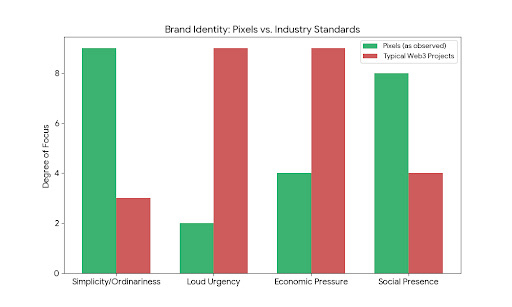
What started to stand out about Pixels wasn’t any single feature. It was how unforced it felt compared to most crypto games. There wasn’t this loud urgency in its identity, like it was trying to convince you it had already won. It felt more like a system built around small, repeatable actions—farming, collecting, building, talking. Simple things. Almost ordinary things.
And that ordinariness is interesting, because crypto doesn’t usually trust ordinary. It tends to inflate everything into “revolutionary ecosystems” or “next-generation economies,” even when what’s actually being built is just a game loop with tokens attached.
Pixels, at least from the outside, doesn’t push that too hard. But I’ve been around long enough to know that calm surfaces can still hide unstable systems. In fact, they often do.
Because the real question with any Web3 game isn’t what it looks like on day one. It’s what happens after the first wave of curiosity fades. When people stop logging in because it’s new, and start asking whether it’s actually worth their time without external incentives pushing them forward.
That’s where most of these projects break—not in the beginning, but in the repetition. When the loop stops feeling like discovery and starts feeling like routine.
And Pixels, like everything else in this space, eventually has to live in that reality too.
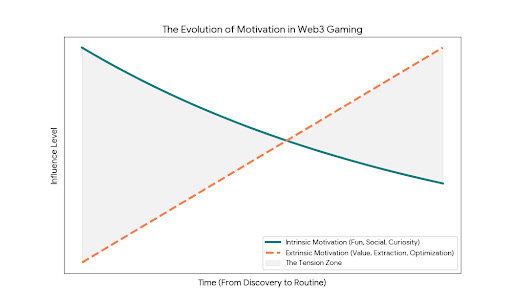
What makes Web3 gaming such a difficult problem isn’t just the technology. It’s the clash between two very different kinds of motivation. Games, at their core, survive on intrinsic reasons: curiosity, creativity, relaxation, social connection. Crypto systems introduce extrinsic motivation: ownership, value, extraction, return. When those two align, things feel exciting. When they drift apart, you start noticing friction.
And they always drift apart eventually.
Pixels seems to be trying to keep things grounded in the simpler side of gaming—small tasks, familiar mechanics, social presence. That might actually be its quiet strength, or it might just be a temporary design phase before economic pressure starts shaping behavior more aggressively. It’s hard to tell yet, and honestly, it’s too early to pretend certainty.
Because the moment tokens and markets sit next to gameplay, everything becomes slightly unstable. Players are no longer just players. They become participants in two systems at once, often without fully separating the two in their own behavior. One system asks them to enjoy the process. The other quietly asks them to optimize it.
That tension never fully disappears. It just changes shape depending on attention, liquidity, and time.
So when I look at Pixels now, I don’t really see a product I’m supposed to evaluate. I see another attempt—genuine or not, successful or not—to make that tension livable. To see if a world built around repetition can still feel worth returning to when the excitement wears off.
And I don’t have a clean answer for that. I don’t think anyone really does yet, even if they speak like they do.
Maybe Pixels will figure out a version of that balance. Maybe it will drift into the same patterns everything else does once incentives take over and behavior starts optimizing itself. Both outcomes feel equally possible from where I’m standing.
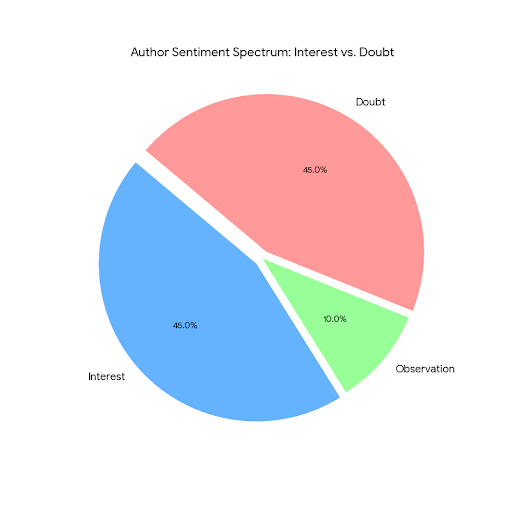
So I just stay in the same place I usually end up in with these things—somewhere between interest and doubt. Not buying the story, not rejecting it either. Just watching how it behaves over time, because that’s the only part that ever really tells you what something is.
And for now, that’s all Pixels is to me. Not a breakthrough, not a failure—just another system entering the same long experiment, and I’m still here, still watching, still waiting to see what it becomes when the early noise finally settles.