
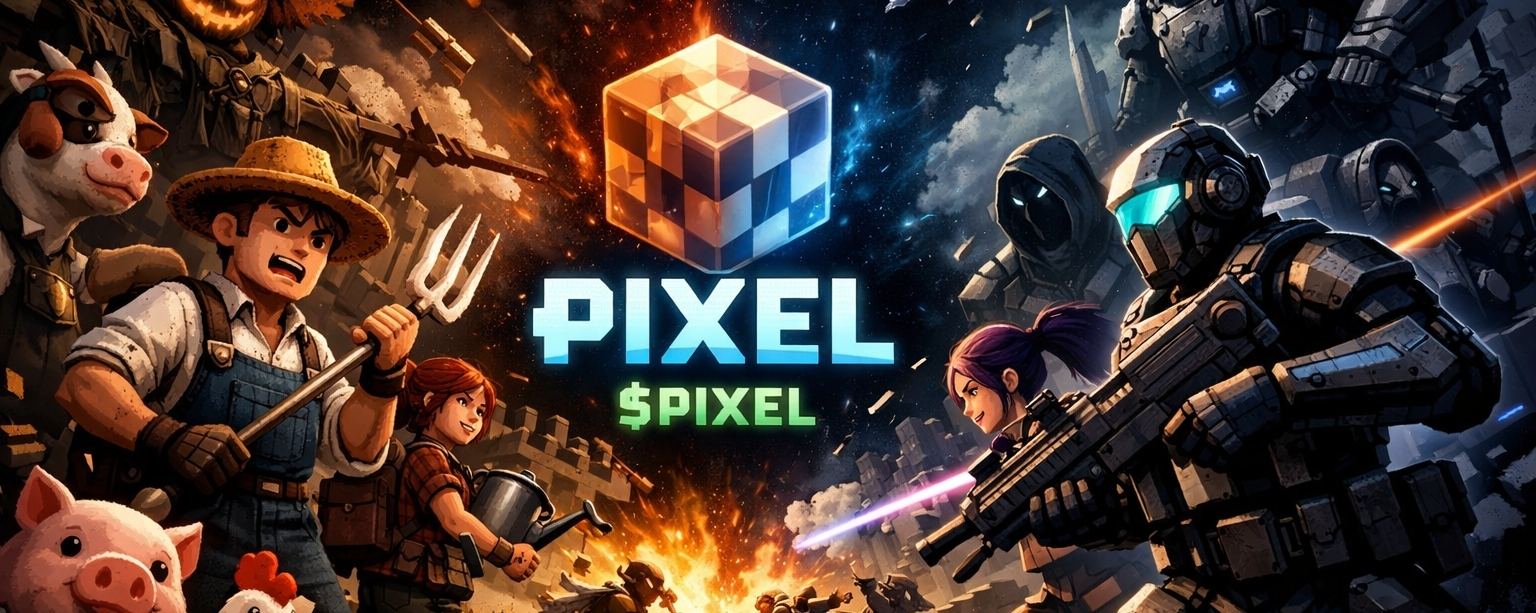
I didn’t expect to take Pixels seriously.
At first glance, it looked like one of those projects you’ve seen a dozen times already. Bright pixel art. Farming. Quests. Land. A token economy wrapped around a casual-looking game. In crypto, that combination usually leads to the same place. Early excitement, a rush of farming activity, a lot of noise about community, then the slow realization that most people were never there for the game in the first place.
So that was my assumption. Pixels would run the same playbook, attract the same crowd, and eventually hit the same wall.
But after spending more time looking at it, that read started to feel too shallow.
What Pixels is doing makes more sense when you stop looking at it like a farming game and start looking at it like a live battleground for attention. That is the part that caught me off guard. Underneath the crops, resource loops, and social mechanics, this is really a story about one game learning how to survive in a market where players are no longer trapped inside closed systems. They can move whenever they want. And they do.
That changes everything.
In traditional gaming, players often stay where they are because leaving comes with friction. Their friends are there. Their progression is there. Their purchases are there. Their platform keeps them in place even when the game itself starts to lose energy. Crypto gaming doesn’t have that luxury. The walls are thinner. The switching cost is lower. Users can drift fast, and when they do, they do it without sentiment.
That is why Pixels matters more than it first appears to.
It is not because it reinvented gaming. It didn’t. It is not because farming mechanics are suddenly groundbreaking. They are not. It matters because it seems to understand a very uncomfortable truth that a lot of Web3 games still avoid facing: if the actual game is not good enough to hold people, no token system can save it for long.
And for a while, crypto gaming kept pretending otherwise.
Too many projects built their identity around extraction. The game was treated like packaging. Something decorative. Something there to make the emissions look sustainable for a few extra months. People didn’t log in because they were invested in the world. They logged in because the numbers made sense for that week. Once the numbers stopped making sense, the whole structure fell apart.
Pixels feels different because it seems built around the idea that players need reasons to come back that are not purely financial.
That doesn’t mean the token is irrelevant. It obviously matters. But it feels more like one layer inside a wider loop instead of the entire point of the experience. That distinction is important. When a game becomes nothing more than a delivery mechanism for rewards, the relationship between player and world stays shallow. People optimize it, drain it, and leave. But when the world has rhythm, identity, social presence, progression, and enough texture to make daily play feel familiar, something stronger starts to form.
Not loyalty, exactly.
More like habit with emotional residue.
That is harder to build than people think.
Pixels made smart choices here. It is easy to enter. The browser-based format removes a lot of the friction that usually kills curiosity before it has time to grow. The visual style is simple, but in a useful way. It feels readable. Immediate. You do not need to decode the game before you begin interacting with it. In crypto, that is an underrated advantage. A lot of projects want players to absorb three layers of infrastructure before they get to have any actual fun. Most users never make it that far.
Pixels seems to have understood that early. Let people in first. Give them something intuitive to do. Let familiarity carry the first session. Complexity can come later.
That is not laziness. That is design discipline.
And once people are inside, the interesting part begins. Because what keeps a game alive is not the first impression. It is return behavior. It is whether players come back after the novelty fades. It is whether routine forms. Whether social interaction deepens. Whether optimization turns into investment. Whether the world starts feeling like a place instead of a product.
That is where Pixels became more interesting to me.
Not because it looked sophisticated on paper, but because it seems to have grasped that crypto gaming is no longer just competing on hype cycles. It is competing game against game, loop against loop, world against world. Every live title is pulling on the same user base. Every new release is testing whether your players were actually committed or just temporarily parked.
This is what I mean when I say it feels like straight PVP between games.
Not in the obvious sense. Not sword fights and leaderboards. I mean structurally. Every project is in open competition for time, attention, and repetition. If another game offers a better daily loop, a cleaner economy, a stronger social layer, or even just better timing, users rotate. Fast. There is no real protection from that. No hidden moat. No guaranteed retention just because you were early.
That environment is brutal.
It is also healthy.
Because it forces projects to make something people want to keep touching. Not something people can tolerate while rewards are high. Something they actually want to return to. There is a difference, and most failed GameFi projects died because they never understood it.
Pixels, at the very least, seems closer to understanding it than most.
What also stands out is that it does not feel trapped in the narrow ambition of being just one self-contained game with one short cycle of attention. There is a broader instinct there, a sense that the real opportunity might be in building an ecosystem where utility, identity, and player movement can stretch across more than a single experience. That matters because one game eventually gets predictable. Every loop does. But a connected ecosystem gives a project more ways to stay relevant without constantly squeezing the same mechanics harder.
That is a much more durable direction than the old model of forcing one token to carry an entire world on its back.
Of course, none of this makes Pixels untouchable.
Crypto players are still unstable as a group. Markets still distort behavior. Token-based economies still carry pressure from every angle. A game can build real engagement and still lose momentum if it mishandles balance, pacing, or incentives. Success here is never permanent. The audience is too fluid for that. And maybe that is the right way to see it. Not as a flaw, but as the real test.
Can the game keep earning its place?
That question hangs over every project in the space now, and honestly, it should.
I went into Pixels expecting another polished excuse for short-term extraction. Something dressed up just enough to feel playable while the real action happened around the token. Instead, what I found was a project that seems to understand the market it is actually in. Not the fantasy version of crypto gaming. The real one. Fast-moving users. Shallow loyalty. Constant substitution. Endless competition.
And in that environment, the projects that survive will not be the ones with the loudest token narratives.
They will be the ones that build worlds people do not want to leave.
