
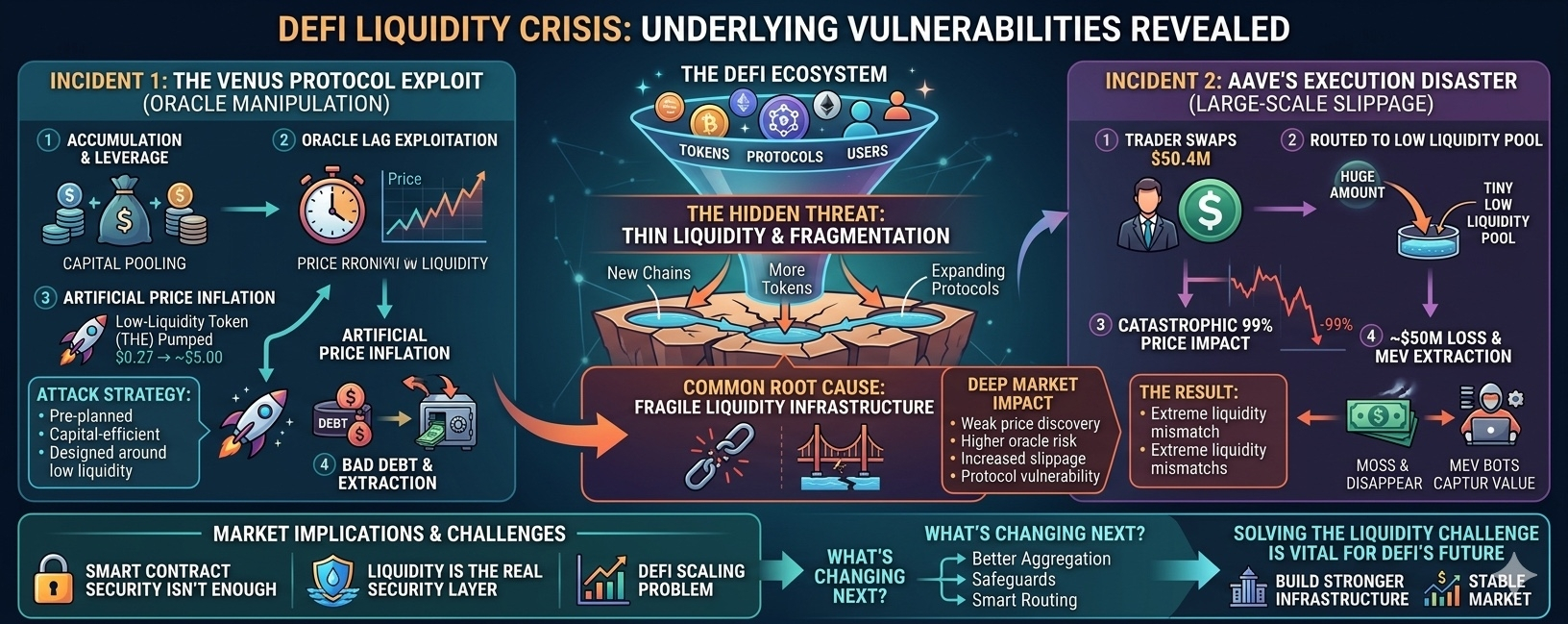
“This market brief covers two liquidity-driven incidents that hit DeFi within the same week… Same underlying problem: DeFi’s liquidity is dangerously thin.”
Introduction: A Warning Signal for DeFi Markets
Within just a few days, two major incidents shook the foundations of decentralized finance:
■ A calculated exploit on Venus Protocol
■ A catastrophic execution loss on Aave
At first glance, they seem unrelated — one a hack, the other a trading mistake.
But the reality is more concerning:
👉 Both events expose the same structural weakness — fragile liquidity infrastructure in DeFi
Incident 1: The Venus Protocol Exploit
The attack targeted a low-liquidity token (THE), using a classic oracle manipulation strategy.
What Happened?
■ ~$2.15M in bad debt left in the protocol
■ ~$3.7M in assets extracted
■ Complex funding routed via Tornado Cash
■ Collateral leveraged through Aave
The Attack Strategy (Simplified)
The attacker executed a highly structured plan:
Accumulate massive token supply over 9 months
Inflate collateral via a donation attack
Loop strategy:
Deposit THE
Borrow assets
Buy more THE
Exploit oracle lag (TWAP updates)
Trigger liquidation at peak inflated price
■ Price pumped: $0.27 → ~$5.00
■ Price collapsed: ~$0.24
Critical Insight
This was not a random exploit — it was:
✔ Pre-planned
✔ Capital-efficient
✔ Designed around low liquidity conditions
👉 The attacker didn’t break the system — they used its weaknesses
Incident 2: Aave’s $50M Execution Disaster
Just days earlier, a different kind of failure occurred.
What Happened?
■ A trader swapped $50.4M via CoW Protocol
■ Trade routed into SushiSwap
■ Pool liquidity: only ~$73,000
The Result
■ 99% price impact
■ Only ~$36,000 value received
■ ~$50M effectively lost
■ MEV bots extracted ~$34M
Key Takeaway
No exploit. No hack.
👉 Just extreme liquidity mismatch
This is arguably one of the largest execution failures in DeFi history.
Connecting the Dots: One Root Cause
Despite different triggers, both events share the same underlying issue:
⚠️ Thin Liquidity
In Venus:
■ Low liquidity enabled price manipulation
In Aave:
■ Low liquidity caused catastrophic slippage
The Structural Problem: Liquidity Fragmentation
DeFi is growing — but not efficiently.
■ More chains
■ More tokens
■ More protocols
👉 But liquidity is being spread thinner
Why This Is Dangerous
✔ Weak price discovery
✔ Increased oracle manipulation risk
✔ Higher slippage for large trades
✔ Easier exploitation of protocols
This creates a fragile ecosystem where:
👉 Even established platforms are vulnerable
Historical Context: Not the First Time
The Venus exploit closely resembles the Mango Markets exploit:
■ Oracle manipulation
■ Artificial price inflation
■ Massive extraction via leverage
👉 Lesson not learned = risk repeated
Who Actually Won?
Surprisingly, the attacker may not have profited much.
■ Borrowed: ~$9.92M
■ Extracted: ~$5.07M
Possible explanation:
👉 Profits came from off-chain short positions
Who Lost?
■ Venus Protocol → $2.15M bad debt
■ Aave user → ~$50M execution loss
■ DeFi credibility → Significant damage
Market Implications: Why Investors Should Care
These events highlight deeper risks:
1. Smart Contracts Aren’t the Only Risk
Even “secure” protocols fail under liquidity stress.
2. Liquidity = Real Security Layer
Without deep liquidity:
■ Prices can be manipulated
■ Trades can fail catastrophically
3. DeFi Scaling Problem
Permissionless systems cannot scale safely without:
✔ Better liquidity aggregation
✔ Stronger safeguards
✔ Smarter execution routing
What’s Changing Next?
Response from protocols has already begun:
■ Aave introducing “Aave Shield”
■ Limiting high price-impact trades
■ Increased focus on risk management
Final Take: A Reality Check for DeFi
These incidents are not isolated failures — they are systemic warnings.
DeFi has achieved:
✔ Transparency
✔ Accessibility
✔ Composability
But it still lacks:
❌ Robust liquidity depth
❌ Unified infrastructure
❌ Protection against extreme edge cases
Conclusion
The biggest threat to DeFi right now isn’t hackers —
It’s liquidity weakness hiding in plain sight.
Until this is solved:
👉 Exploits will continue
👉 Losses will repeat
👉 Confidence will remain fragile