
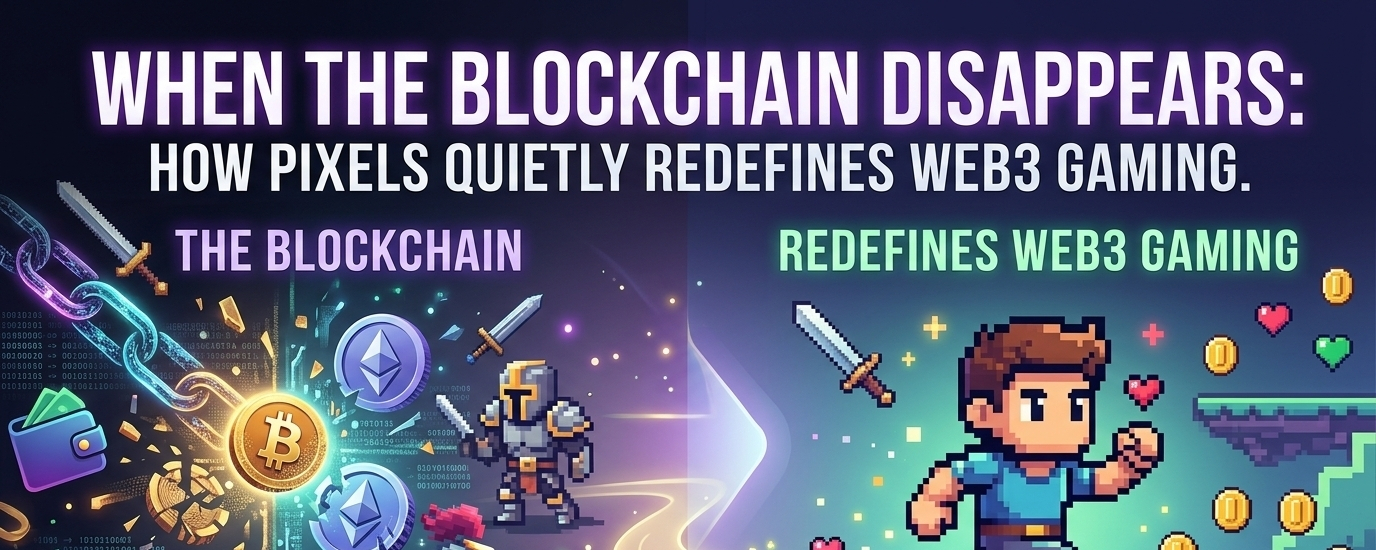

I didn’t expect a farming game to make me think about infrastructure.
That sounds a bit off at first, but spending time in Pixels has this strange way of shifting your attention away from the usual noise in crypto. There are no aggressive promises, no dashboards pushing numbers in your face every second. You plant crops, wander around, maybe chat with someone, and log off. It feels almost too simple for a space that usually thrives on complexity.
And maybe that’s exactly why it’s interesting.
Underneath that calm surface sits the Ronin Network, which isn’t new to gaming but carries its own history. It was built to handle the scale and friction that games like Axie Infinity struggled with on mainnet. Faster transactions, lower costs, smoother onboarding—these aren’t flashy ideas, but they’re the kind of things that quietly decide whether a game feels like a game or like a chore.
What Pixels seems to do, intentionally or not, is lean on that infrastructure without making it the center of attention. You don’t feel like you’re “using a blockchain” in the way early Web3 apps made you painfully aware of every transaction. Instead, it fades into the background, closer to how the internet itself works when it’s doing its job properly.
That raises an odd question: if the tech disappears from the user experience, does it still matter how decentralized it is?
It’s a slightly uncomfortable thought. A lot of the early ideals around Web3 were built on visibility—owning your assets, verifying transactions, understanding what’s happening under the hood. But most players in Pixels probably aren’t thinking about validators or token standards while harvesting carrots. They’re just playing.
There’s a trade-off here that feels more real than theoretical. On one side, you get accessibility and ease, something that Web3 has historically struggled with. On the other, you risk turning blockchain into just another backend layer that users don’t question, which starts to resemble the very systems it was meant to rethink.
I’m not sure that’s entirely a bad thing, though.
In traditional games, ownership is often abstract. You spend hours collecting items that ultimately belong to a server you don’t control. In Pixels, even if players aren’t actively thinking about it, there’s a different structure in place. Assets exist in a way that isn’t entirely dependent on a single company’s database. That doesn’t automatically make them valuable or meaningful, but it changes the relationship slightly. It introduces a quiet layer of persistence.
Still, that persistence comes with its own uncertainties. What happens if the ecosystem around it fades? Does ownership matter if there’s nowhere left to use what you own? These aren’t new questions, but they feel more grounded when you’re looking at a game that isn’t trying to distract you with speculation.
There’s also something worth noticing about the pacing. Pixels doesn’t push urgency. It doesn’t demand constant engagement in the way many token-driven systems do. That might sound like a design choice, but it also reflects something about the underlying protocol. When transactions are cheap and fast, you don’t need to batch everything into high-stakes moments. You can afford to let interactions stay small and frequent.
It’s subtle, but it changes behavior.
The broader Web3 space often talks about infrastructure as if it’s separate from experience, but games like this blur that line. The way a network handles load, the cost of interacting with it, the friction of signing transactions—these aren’t just technical details. They shape how people feel while using the product, even if they can’t explain why.
And maybe that’s where Pixels becomes more than just a farming game.
It’s not proving that Web3 gaming has “arrived” or that the model is finally solved. If anything, it highlights how many questions are still open. How much of the blockchain should be visible? How much should be abstracted away? At what point does convenience start to dilute the original purpose?
I keep coming back to the same thought while playing: this feels normal in a way that Web3 rarely does. And that normality is both its strength and its ambiguity.
Because if the future of this space looks like Pixels—quiet, accessible, almost indistinguishable from traditional apps—then the real conversation might shift away from what blockchain can do, and toward whether we even notice it doing anything at all.
