
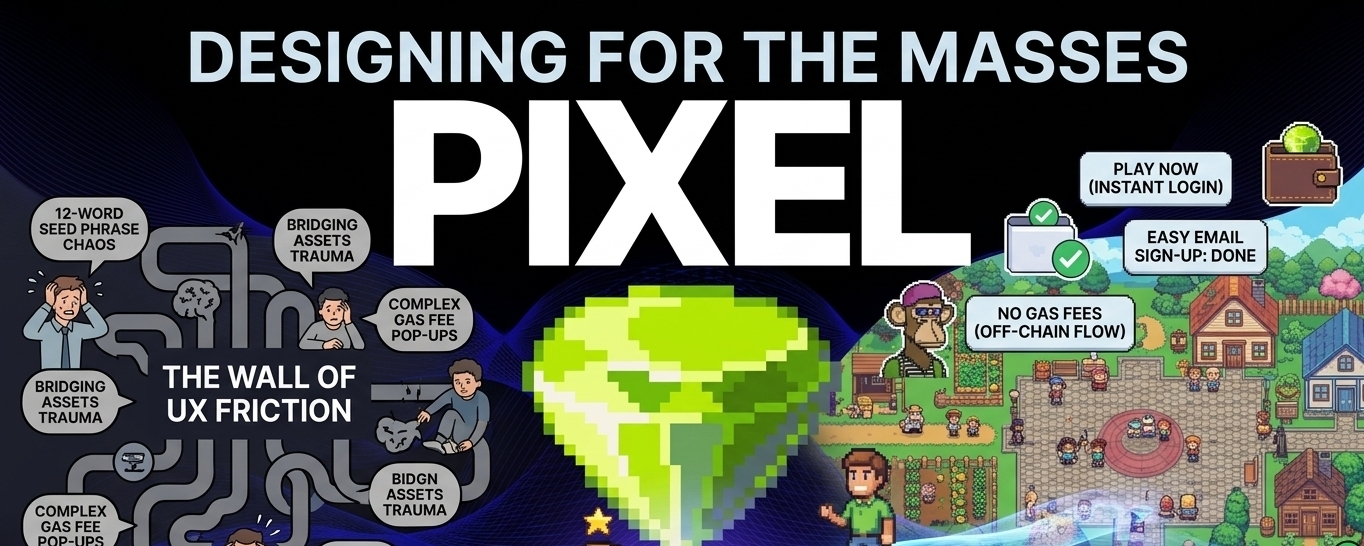
In the high-stakes world of blockchain, we often talk about "mass adoption" as if it’s a destination we can reach simply by building faster networks or cheaper gas fees. But as a Brand and Product Designer, I see it differently. Mass adoption isn’t a technical hurdle; it’s a psychological one. For years, Web3 has been a "gated community" protected by a moat of jargon, complex wallet handshakes, and a user experience that felt more like a chemistry lab than a playground.
While most projects were busy building more complex walls, @Pixels was busy building a bridge.
Today's deep dive focuses on the "Interface": the crucial touchpoint where decentralized technology meets human behavior. By stripping away the friction that has plagued the industry for years, Pixels hasn't just built a game; it has created the gold standard for how we design for the next billion users.
The "Wall of Friction": Why Web3 Felt Like a Chore
Before we can appreciate how Pixels solved the problem, we have to acknowledge the state of Web3 UX in its infancy. To "play" a typical blockchain game two years ago, a user had to:
1. Research a compatible wallet.
2. Store a 12-word seed phrase (and not lose it, or lose everything).
3. Buy a specific token on a centralized exchange.
4. Transfer that token to the wallet.
5. Bridge those tokens to a specific sidechain.
6. Sign three different "approval" transactions before even seeing a character.
By the time the average person reached the start screen, they were exhausted, confused, and hyper-aware of their financial risk. The "magic" of gaming was dead on arrival. In design terms, the Cognitive Load was so high that only the most dedicated (or the most desperate) stayed.
Step 1: The "Invisible" Blockchain
The most revolutionary thing Pixels did was make the blockchain invisible.
When you first enter the world of Pixels, you aren't greeted with a "Connect Wallet" button that blocks the entire screen. Instead, you are greeted with a world. You can start playing, exploring, and interacting with the community almost immediately. The technicality of the blockchain is pushed to the background, functioning as a silent infrastructure rather than a loud gatekeeper.
By allowing users to sign up with familiar methods, like social logins or email, Pixels removed the "Seed Phrase Anxiety" that stops 90% of mainstream users from ever trying a dApp. The blockchain only becomes visible when the user chooses to interact with it, such as when they want to withdraw their hard-earned $PIXEL or mint a unique asset.
This is Progressive Disclosure at its finest: giving the user only the information and complexity they need at the exact moment they need it.
Step 2: Aesthetics as an Onboarding Tool
As a designer, I know that aesthetics are never "just" about looking good. They are about signaling intent.
Early Web3 games tried to mimic the high-fidelity graphics of "Triple-A" titles, often failing because the blockchain isn't yet fast enough to support that level of data throughput without lag. This created a jarring experience: beautiful graphics paired with clunky, slow transactions.
Pixels took the opposite approach. By embracing a nostalgic, 2D pixel-art aesthetic, they signaled something important to the user: This is a game, not a banking app.
This visual choice immediately lowers the user's defenses. We associate pixel art with the joy of our childhood; Game Boys, SNES, and simple adventures. This "Safety Signal" is crucial in a space often characterized by scams and complexity. The art style isn't just a design choice; it’s a trust-building mechanism. It promises a "Low Friction" experience, and it delivers.
Step 3: Solving the "Gas Fee" Trauma
Nothing kills a user’s "flow" faster than a pop-up window asking for a gas fee to complete a simple action like planting a seed or talking to an NPC. In the early days of P2E, every click felt like a financial transaction.
Pixels solved this by moving the high-frequency actions off-chain or onto highly optimized sidechains like Ronin. By batching transactions and eliminating the need for constant wallet "approvals," Pixels allowed the gameplay to feel fluid.
Designers call this Flow State. In a traditional game, you want the player to lose track of time. You cannot achieve flow if the player has to check a gas tracker every five minutes. By streamlining the transaction layer, Pixels allowed players to stay immersed in the world, treating $PIXEL like a currency of the realm rather than a fluctuating commodity.
Step 4: Interoperability Without the Headache
One of the big promises of Web3 is "Interoperability", the ability to use your assets across different platforms. But in most cases, this is a technical nightmare for the user.
Pixels solved this through its Avatar System. They made it incredibly simple to "plugin" your existing NFTs from other projects (like Bored Ape Yacht Club or Mocaverse) and see them rendered as 2D pixel characters.
Instead of forcing the user to learn about "cross-chain bridges" or "metadata standards," Pixels simply asked: "Do you have this NFT in your wallet? Great, here is your character." They turned a complex technical feature into a moment of "User Delight." It’s the ultimate expression of digital identity, handled with a UX that feels as natural as changing a skin in Fortnite.
Designing Trust: The Role of the "Guide"
Finally, Pixels solved the UX friction by focusing on Onboarding Narrative. In many dApps, you are dropped into a dashboard and expected to know what to do. Pixels uses a classic quest-driven onboarding. You are introduced to characters like Barney, who guide you through the basics of the economy. You learn how to use the "faucets" and "sinks" of the world not through a whitepaper, but through play.
This narrative-driven onboarding builds trust. The user feels supported rather than exploited. By the time the user is asked to make a significant economic decision, like buying a VIP pass, they already understand the value of the world and feel confident in their ability to navigate it.
The Designer’s Verdict: UX is the Real "Moat"
In the crypto world, we talk about "moats" in terms of liquidity or technology. But I would argue that Pixels’ real moat is its User Experience. You can fork a smart contract. You can copy a tokenomics model. But it is incredibly difficult to replicate the seamless, trust-based relationship that Pixels has built with its massive user base. They didn't just design a better game; they designed a better "on-ramp" for the entire Web3 industry.
Pixels proved that "Designing for the Masses" doesn't mean dumbing down the technology. It means respecting the user’s time, lowering their cognitive load, and prioritizing their delight over the protocol's complexity.
The Future is Frictionless
Subsequently , we’ll see how this seamless UX feeds into the "Ecosystem Flywheel." Because when the friction is gone, the growth is exponential.
Pixels has set the stage. They’ve shown the world that you don't need to be a "crypto guy" to enjoy the benefits of a decentralized economy. You just need a world that’s fun to inhabit and an interface that stays out of your way.
The era of "clunky crypto" is over. The era of the frictionless digital nation has begun.