
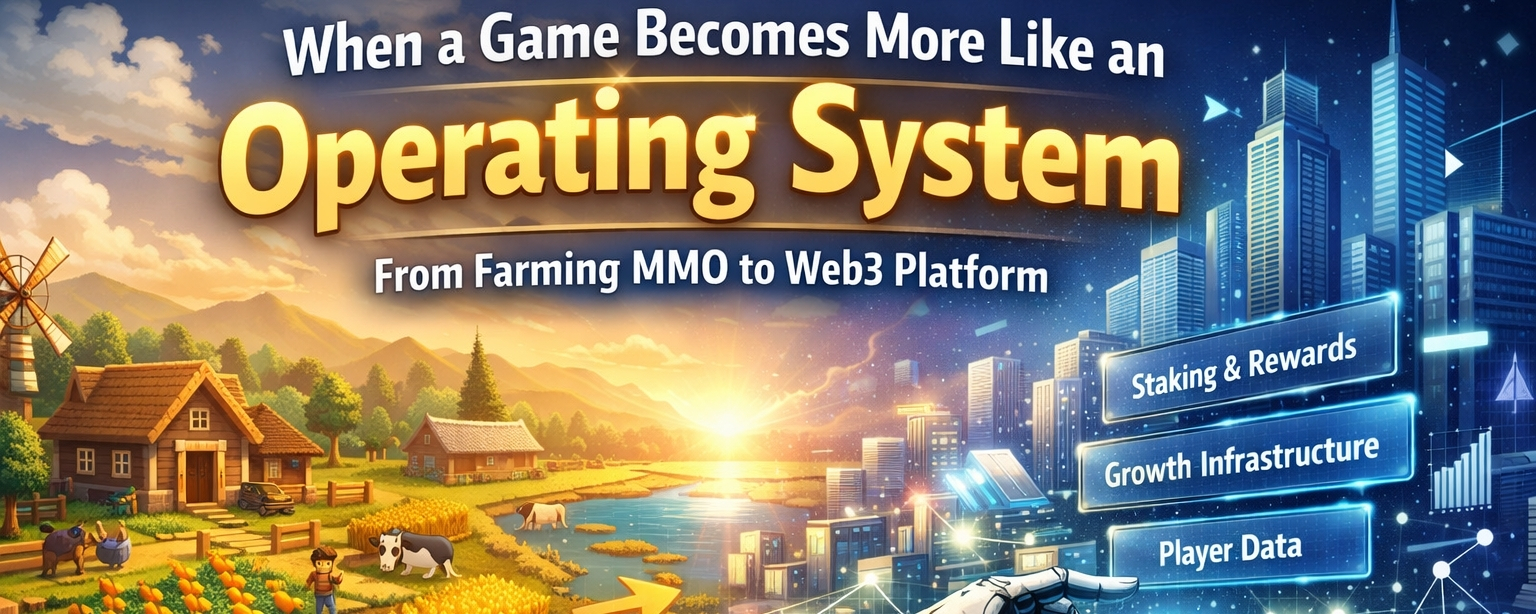
People still tend to describe Pixels in the old, familiar way: a farming game, a token, a Web3 audience, the usual rush of attention. That description is not completely wrong. It just feels too limited now.
What makes Pixels worth watching today is that the story may be bigger than the game people first noticed. A lot of projects get trapped inside the first label the market gives them. Even when they change, people keep talking about them the same way. Pixels feels like one of those cases. Many still look at it and ask the standard questions: can the game keep people interested, can the token remain relevant, can Web3 gaming become attractive again? Those questions are fair, but they no longer feel like the most important ones.
The more interesting possibility is that Pixels may have been using the game as a testing ground for something larger.
That difference matters. A game can attract attention for all kinds of surface-level reasons. Sometimes it is novelty. Sometimes it is speculation. Sometimes it is community momentum. Sometimes people simply show up because there is money moving through the system. None of that really proves the design is strong enough to last. But when a team keeps building through different market conditions, keeps adjusting the economy, keeps learning from player behavior, and then starts shaping those lessons into something other projects might use, the thing in front of you may no longer be just a game. It may be the first version of a product that happened to grow inside one.
That is where Pixels starts to feel different.
What gives that shift real weight is not just branding. Plenty of teams start calling themselves platforms the moment they want to sound bigger than they are. The difference here is that Pixels has been testing its ideas in live conditions. There is a kind of understanding you only get when a game economy runs into scale, repetition, abuse, boredom, habit, and all the messy behavior that never looks neat in a whitepaper. Reward systems almost always sound smart before real people get involved. Then the wrong users learn how to exploit them, the intended users lose interest, and the system starts revealing what it was actually built to reward.
That is the part people usually move past too quickly.
The broader play-to-earn era trained the market to pay attention to the wrong things. Big user numbers were treated like proof of health. High emissions were taken as a sign of activity. Token movement often received more serious discussion than player motivation. The category became very good at confusing motion with durability. It kept asking whether rewards were attractive enough, frequent enough, large enough. It asked much less often whether those incentives were bringing the right kind of behavior into the game or simply making extraction easier.
That older model did not fail because players dislike rewards. It failed because rewards were distributed too blindly. A system that cannot tell the difference between someone building genuine attachment and someone showing up to drain value is not generous. It is careless. And sooner or later, that carelessness shows up everywhere: in retention, in culture, and in the economy itself.
Pixels seems to have reached that understanding by going through it, not by theorizing about it. That is why the recent direction matters more than another headline about a token feature or a new mechanic. The real change is in how the team seems to think about incentives. Not as decoration. Not as a cheap way to inflate activity. But as a serious part of design. Something that should be measured. Something that should justify its cost. Something that can be tuned with the same seriousness as game balance or product decisions.
That is already a more grounded approach than most of Web3 gaming ever managed.
From that angle, the discussion around staking and rewards becomes more interesting. The obvious reading is simple: another project trying to make its token feel more useful, more central, more structured. But there seems to be a deeper logic underneath. In this case, staking can also be understood as a way of collecting preference signals. Not just who wants yield, but where players place attention, where they see value, where support and future rewards might be directed. That makes the mechanism feel less like a passive financial layer and more like a feedback tool.
And once that logic expands, Pixels begins to look less like a single game and more like infrastructure.
That word gets thrown around too easily, so it helps to be careful with it. Infrastructure is not just what a team calls itself when it wants to sound important. It becomes real when other people can build on the system and get actual practical value from it. If Pixels is moving in that direction, then the real ambition is no longer limited to whether its own game stays compelling. The bigger question is whether the methods it developed inside Pixels can work as a growth, reward, and monetization layer for other games as well.
That is where the story becomes more demanding.
A live game can survive a surprising amount of mess. Communities often tolerate awkward systems when they still feel momentum. Players will work around friction if the overall experience gives them enough reason to stay. But a reusable external layer has to clear a much higher bar. It has to work outside the habits of the ecosystem that produced it. It has to make sense to other studios, other players, other economies. The language around targeting, attribution, pricing, intent, and bot resistance sounds strong, but strong language on its own is never enough. Internal tools often look brilliant until they have to prove themselves somewhere else.
So yes, the market may still be underestimating Pixels. But it may also be underestimating how difficult the next stage really is.
That is why this is not some simple bullish story. There is something genuinely promising in the idea that rewarded play could mature into a more disciplined operating layer for online games. At the same time, this is exactly where easy narratives become dangerous. If the company gets this right, it could end up occupying a more durable place than most token-driven games ever reach. If it gets it wrong, the failure will not look like the old kind of failure. It will not just be about fading attention or weak emissions. It will be about something harder: whether internal lessons can actually become external product value.
That difference changes what people should be watching.
The old checklist was predictable: player numbers, token price, update cadence, hype, partnerships, market mood. Those things still matter, but they do not fully explain what is being tested now. The better questions are less flashy. Can Pixels make reward design clear and usable enough that outside developers actually want it? Can it improve monetization without quietly rebuilding the same extractive habits that damaged the broader category? Can the system stay genuinely better for players while becoming more efficient for operators? And can the token keep a real coordinating role without slipping into the usual fate of becoming symbolic rather than necessary?
Those are more difficult questions than asking whether the game is still growing. But they are also much more useful.
What makes Pixels interesting now is not that uncertainty has disappeared. It has not. It is that the uncertainty now sits in a more important place. The project seems to be moving away from the fragile identity of a game with an attached economy and toward something more ambitious: a company trying to turn the messy reality of live virtual worlds into reusable systems.
That is a harder business. It requires restraint in a space that usually prefers excitement. It requires evidence in a market that often settles for narrative. And it requires a willingness to accept that rewards are not some magic layer placed on top of a game. They are part of the structure. They can deepen an experience, or they can quietly empty it out.
Pixels is interesting now because it seems to understand that distinction.
And once a team starts thinking at that level, it is no longer just building a game. It is trying to understand what games become when incentives stop acting like a headline and start becoming part of the underlying design.