
I’ve been watching Pixels closely, and honestly, the more I look at it, the less it feels like a simple game.
At first glance, it’s easy to label it: farming, quests, NFTs, token rewards. Another GameFi project trying to survive the cycle.
But that surface-level view misses what’s actually happening underneath.
What Pixels is really trying to do is much more ambitious — and much more dangerous.
It’s trying to turn itself into a creator-driven platform, where the value doesn’t just come from playing… but from building inside it.
And that’s where things get complicated.
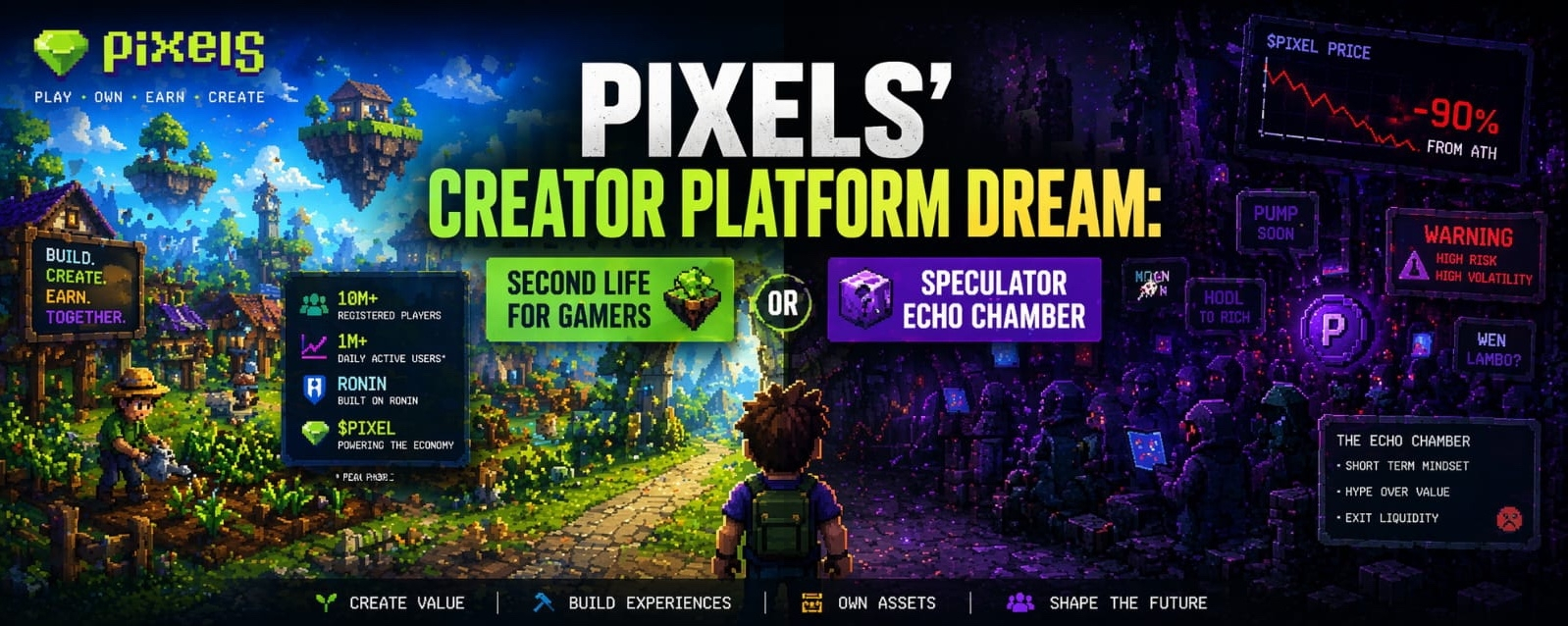
Because this idea can evolve into something powerful — a digital world where creators build economies and players live inside them — or it can collapse into something we’ve seen too many times in crypto: a system where everyone is just extracting value from each other.
From the outside, the numbers look impressive. Millions of registered users, consistent activity, regular updates, a growing ecosystem. On paper, it looks like one of the few GameFi projects that actually survived.
But numbers alone don’t tell the full story.
What matters is why people are there.
That’s the first question I keep coming back to.
Are people logging in because they enjoy the experience?
Or because there’s still something to earn?
That distinction decides everything.
Pixels has already started shifting its model. It moved away from pure inflationary rewards and began introducing more structured token usage — things like gated access, in-game spending, staking, and controlled emissions. The idea is clear: reduce constant selling pressure and push users toward participation instead of extraction.
On paper, that’s exactly what GameFi needed.
But here’s the uncomfortable part.
When you reduce easy rewards, you also remove the main reason a large portion of users showed up in the first place.
So now Pixels is balancing on a very thin line.
If it leans too much into incentives, it risks becoming unsustainable.
If it leans too much into utility, it risks losing users who were only there for rewards.
And right now, it’s trying to solve both at the same time.
What makes this even more interesting is the direction it’s heading next.
Pixels is no longer acting like a single game. It’s slowly positioning itself as an ecosystem — a place where multiple experiences can exist, potentially built by different creators, all connected through the same economy.
That changes everything.
Because now the success of Pixels doesn’t depend on one gameplay loop anymore. It depends on whether it can attract and support creators who build things people actually want to engage with.
And that’s a completely different challenge.
In traditional games, developers control everything. In this model, control starts to spread out. Creators come in with their own ideas, their own incentives, and their own expectations of profit.
That sounds powerful, but it introduces a new risk.
When money becomes the core layer of a creative platform, the focus can quietly shift.
Instead of asking, “Is this fun?”
Creators start asking, “Does this generate returns?”
And when that happens at scale, quality usually takes a hit.
We’ve seen this pattern before. Platforms open up, incentives attract builders, content explodes, but most of it lacks depth. Users get overwhelmed, engagement drops, and the entire system starts to feel hollow.
That’s how ecosystems turn into echo chambers.
Everyone is active. Everyone is participating. But the value isn’t actually expanding — it’s just circulating.
And this is where Pixels faces its biggest test.
Because a creator economy only works if it produces real demand. Not just internal activity, but genuine reasons for people to stay, spend, and engage without constantly thinking about exits.
Right now, the signals are mixed.
On one side, you have strong user numbers, consistent updates, and a clear attempt to fix the economic flaws that killed earlier GameFi projects.
On the other side, you still have a token that hasn’t fully recovered, a market that remains cautious, and a system that hasn’t yet proven it can sustain itself without relying on incentives.
That gap matters.
Because it tells me the market is still waiting for confirmation.
Not hype. Not announcements. But proof.
Proof that creators can build experiences that attract real players.
Proof that players stay even when rewards aren’t the main driver.
Proof that value is being created, not just moved around.
Until that happens, Pixels sits in an interesting position.
It’s not failing.
But it hasn’t fully succeeded either.
It’s in that rare phase where the idea is ahead of its validation.
And honestly, that’s what makes it worth paying attention to.
Most projects either die quickly or explode fast. Pixels is doing neither. It’s evolving slowly, adjusting its economy, experimenting with structure, and trying to build something that actually lasts.
That process doesn’t look exciting from the outside.
But it’s usually where the real foundations are built.
The outcome of this experiment matters more than most people realize.
If Pixels manages to align creators, players, and its economy in a way that generates real, sustainable demand, it won’t just succeed as a game.
It will become a model for how Web3 platforms should be designed.
But if it fails to balance those forces, it risks becoming something much smaller than its vision.
A system where activity exists, but meaning doesn’t.
Where users participate, but don’t truly engage.
Where value moves, but isn’t actually created.
That’s the line it’s walking right now.
And from where I’m standing, it’s still unclear which side it’s going to land on.
That uncertainty is exactly why I’m watching it this closely.