
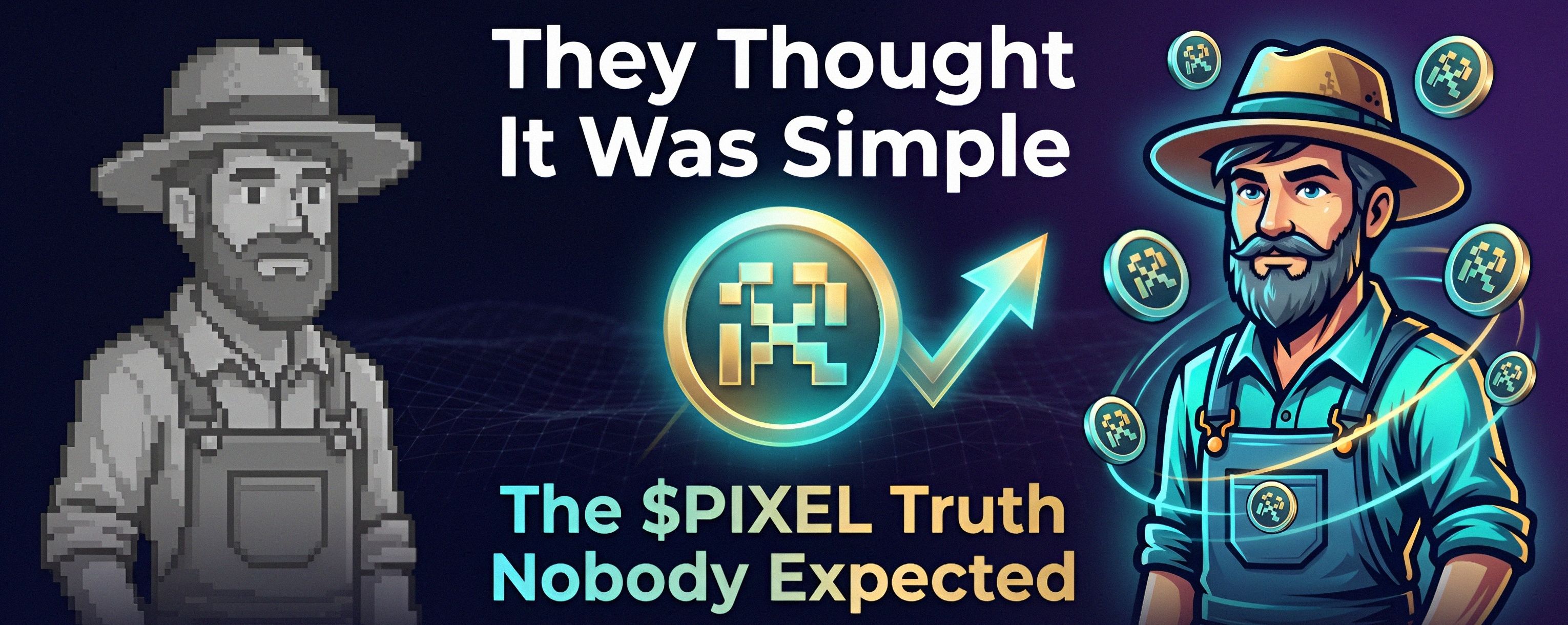
I went into Pixels expecting the usual pattern I've seen countless times before in Web3 gaming. A quick burst of hype, aggressive rewards, and then that slow fade once the excitement cools off. But what caught me off guard was how none of that really showed up the way I expected. It didn't try to overwhelm me or convince me right away that it was something massive. If anything, it felt quiet—almost too simple at first. And normally that would've been a reason to leave early, but this time it had the opposite effect. I stayed longer, not because I was chasing something, but because nothing was forcing me to chase. It felt like the game was comfortable letting me take my time, and that subtle difference changed how I experienced everything that followed.
The Strength of Simplicity
When you break it down, Pixels is built on mechanics we've all seen before. Farming, gathering, moving around, interacting with others—none of that is groundbreaking on its own. But the way it all comes together feels fundamentally different. It doesn't constantly remind you that you're inside a blockchain game, and that's probably one of the smartest design decisions behind it. In most Web3 games, you're aware of the "earning" aspect almost immediately. It's right in front of you, shaping every move you make, every decision you take. Here, that layer exists, but it stays in the background where it belongs. You end up focusing more on what you're doing instead of what you're getting out of it every single second.
That shift in perspective, even though it sounds small on paper, actually changes your mindset in a profound way. You stop thinking like a short-term participant optimizing for quick gains and start behaving more like someone who's just... there, genuinely part of the world. That's when things get interesting. That's when $PIXEL stops being just a token and becomes something that feels natural to hold—because the experience itself makes you want to stay.
The Pacing That Builds Loyalty
Nothing in Pixels feels rushed. There's no constant pressure to optimize every action or squeeze value out of every minute you're online. At first, that can feel unfamiliar, especially if you're used to fast cycles where rewards come quickly and frequently. But over time, that slower rhythm starts to make sense. It creates a kind of balance that keeps you engaged without exhausting you—a luxury most games can't afford.
You're not logging in with a checklist of things you have to do. You log in because it feels easy to continue from where you left off. That kind of consistency doesn't create hype. Hype is flashy and short-lived. But this builds something more stable—something that compounds over time. It gives the game a quiet pull, something that doesn't demand attention but still manages to keep it. That's the foundation for long-term token appreciation and community strength.
The Economics: Patience Over Pressure
At the same time, it's not like the economic layer isn't there. It absolutely is, and it still influences how people play. The difference is that it doesn't dominate the experience from the start. Rewards are tied to activity, which makes sense in theory, but we've all seen how tricky that balance can be. Too much accessibility can lead to inflation and token devaluation. Too little can push people away. That's not a problem you solve once and forget—it's something that needs constant, intelligent adjustment.
Pixels seems to understand this. It's building its foundation around the experience first, letting $PIXEL's value emerge naturally through sustained utility and demand, rather than relying entirely on incentive structures to carry it. That's a refreshing approach in a space where so many projects burn out after their initial reward phase.
Why Timing Matters Now
The market isn't the same anymore. People aren't jumping into every new project just because there's a token attached to it. Attention is harder to capture, and even harder to keep. That means games can't just rely on rewards to hold players—they actually have to feel worth returning to, day after day, week after week.
Pixels seems to understand that fundamental shift. It's not trying to win people over instantly with massive APY or flashy events. It's trying to hold them over time, and that's a much more difficult thing to get right. Because once the initial curiosity fades—and it always does—the only thing that matters is whether people still want to come back. That's when token holders make real decisions about whether their investment was sound.
The Real Test Ahead
There's still a question that lingers, though, and it's probably the most important one moving forward: If you took away the earning aspect completely, would the game still stand on its own?
Right now, it feels like it sits somewhere in the middle. The simplicity makes it approachable and genuinely relaxing, but it also leaves room for something deeper. Some players will appreciate that balance perfectly. Others might eventually look for more complexity, more depth, more reasons to keep pushing forward. The challenge will be expanding the experience without losing what makes it easy and inviting to get into in the first place. That's not an easy line to walk, especially in a space where things tend to swing too far in one direction or the other.
The Social Layer That Compounds
Even small, repetitive actions start to feel different when they're shared with a real community. Visiting other players, trading, interacting casually—it all adds a sense of presence that turns routine into something a bit more alive. It doesn't feel forced or overly structured, which makes it more natural. But that also means it needs to grow carefully to keep people engaged over time. Still, it's one of those elements that quietly strengthens the overall experience without demanding attention or creating pressure.
The Bigger Picture
When I step back and look at everything together, Pixels doesn't feel like it's trying to dominate the space through noise or hype. It feels more like a deliberate, long-term experiment—a slow, thoughtful attempt to see if a Web3 game can hold attention and build real community without constantly reminding players about rewards or token mechanics.
And honestly? That's a much harder challenge than just attracting users in the first place. There are still risks, of course. Market conditions can shift, token dynamics can influence behavior unpredictably, and external factors always play a role. But beyond all of that, the real question is beautifully simple:
Will people keep coming back when nothing is pushing them to?
If the answer turns out to be yes, then Pixels might not just be another project that came and went. It might be one of the few that actually figured out how to make people stay. And if people stay, if they build real lives and communities in that world, then $PIXEL stops being a speculative bet and becomes something with genuine, sustainable value.
That's the story worth following.
#Pixels @Pixels #Web3Gaming #Binance #AltcoinRecoverySignals? #TokenEconomics #Binance