

I was half-asleep, mindlessly refreshing charts and doomscrolling through the same recycled takes, when Pixels popped up again. Not even trending, not even being aggressively shilled — just there, existing quietly while everything else tried way too hard to be the next big thing. And for some reason, that alone made me pause. Maybe I’m just tired of loud projects pretending to be meaningful.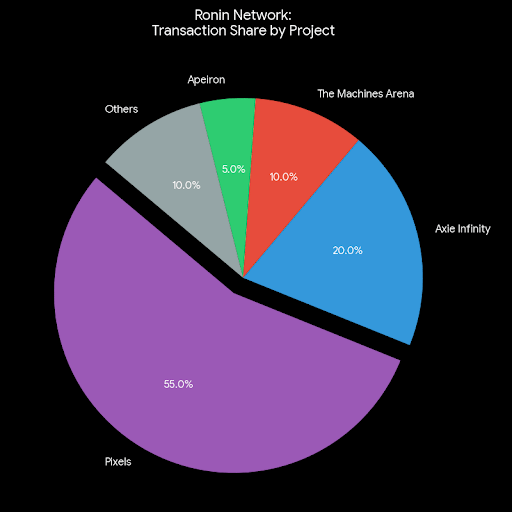
So yeah, Pixels (PIXEL)… I didn’t open it with excitement. I opened it with that familiar mix of curiosity and skepticism that comes from being in this space too long.
Because if you’ve been around long enough, you start seeing through the patterns. Same ideas, new packaging. Same promises, slightly upgraded vocabulary. Every cycle, we convince ourselves we’re building something revolutionary, but most of the time it’s just a slightly different version of what didn’t work before.
Play-to-earn didn’t die, it just rebranded itself into something more subtle. Now it’s “engagement layers” and “player-owned economies.” Sounds smarter. Feels the same underneath.
And that’s the mindset I had going into Pixels.
It runs on Ronin Network, which already puts it in a different lane than most of the random chains popping up with unrealistic performance claims. Ronin has been through actual stress. It’s been exploited, rebuilt, questioned, and still survived. That history matters more than any TPS number on a website.
Pixels itself doesn’t try to overwhelm you. Farming, exploration, crafting — that’s it. No overcomplicated DeFi mechanics pretending to be gameplay. No forced financial loops in every action. It feels… simple.
Almost suspiciously simple.
But maybe that’s where it gets interesting.
Because somewhere along the way, crypto forgot that simplicity is actually hard. We keep building systems that look impressive on paper but feel exhausting in practice. Layers on layers, features on features, until using the product feels like doing homework.
Pixels doesn’t do that. At least not on the surface.
But the deeper you go, the same old tension starts showing up.
Because no matter how clean the design is, it still exists inside a market that has trained people to think in one way: extract value, move on.
And you can see that in the numbers.
There have been spikes in activity. Moments where the game actually felt alive, where people were logging in, interacting, building something. The PIXEL token had its run — listings, liquidity, attention. For a while, it felt like one of those rare cases where a Web3 game actually got traction beyond just hype tweets.
But then the questions start creeping in.
Are people here because they like the game, or because they’re optimizing rewards?
What happens when incentives slow down?
Do they stay, or does everything quietly empty out?
It’s not even a criticism of Pixels specifically. It’s just how this space works.
We’ve created an environment where even games are treated like financial instruments. Players behave like traders. Efficiency matters more than enjoyment. And once that mindset sets in, it’s hard to reverse.
Pixels tries to balance that. You can feel the effort. The world isn’t aggressively pushing token mechanics at every step. There’s an attempt to make it feel like an actual place rather than a reward machine.
But incentives still shape behavior in the background. They always do.
And then there’s the infrastructure reality, which most people ignore until something breaks.
Ronin has improved a lot — smoother transactions, better onboarding, a clearer focus on gaming rather than trying to be everything at once. That’s a strong foundation. But scaling isn’t just about handling transactions. It’s about handling people.
When real users show up, systems get tested in ways whitepapers never account for. Lag, sync issues, backend stress — these things matter more than theoretical decentralization when you’re trying to run a live game.
And let’s be honest, most “on-chain games” aren’t fully on-chain anyway. They’re hybrids. Part traditional game infrastructure, part blockchain layer stitched together.
That’s not a flaw. It’s reality.
But it also means the real challenge isn’t innovation. It’s execution under pressure.
Pixels is in that phase right now. Not just building, but being tested.
There have been steady updates — adjustments to land systems, resource balancing, social mechanics, attempts to deepen the gameplay loop beyond just farming rewards. It doesn’t feel abandoned, which already puts it ahead of a lot of projects that disappear after their token launch.
There’s also a noticeable push to make the world feel more persistent, less tied to short-term incentives. That’s important. Because if everything revolves around rewards, the moment rewards slow down, so does the entire ecosystem.
And that’s where the bigger problem shows up.
Not technology. Not even design.
Attention.
The crypto environment right now is fragmented. AI narratives, meme coins, new chains, restaking, whatever trend decides to dominate the timeline for a week. Everything is competing for attention, and nothing holds it for long.
Gaming sits in an awkward position. Everyone agrees it’s important, but very few actually commit to it.
And the ones who do? Half of them are there for profit, not experience.
So Pixels isn’t just competing with other games. It’s competing with the entire attention economy of crypto.
And that’s a brutal fight.
Because attention here isn’t loyal. It moves fast. It follows incentives. It disappears the moment something shinier shows up.
You can build a solid, enjoyable game, but if users don’t feel a reason to stay beyond earnings, the system starts feeling empty surprisingly quickly.
Still… I wouldn’t say I’m bearish on it.
There’s something about Pixels that feels grounded in a way most projects aren’t. It’s not trying to sound smarter than it is. It’s not drowning itself in buzzwords. It’s just… building.
And maybe that’s enough. Or maybe it isn’t.
Because there’s another layer people don’t like talking about — user behavior.
Most people are lazy. Not in a bad way, just realistically. They don’t want friction. They don’t want complexity. They don’t want to think too much before jumping into something.
Web2 games already struggle with retention, and they don’t have wallet setups, gas fees, or token mechanics to deal with.
So expecting Web3 games to outperform them just because of “ownership” feels like a stretch.
Pixels gets closer than most, but it’s still fighting that same uphill battle.
And I think that’s why I keep checking in on it.
Not because I’m convinced it’s the future.
But because it feels like an honest attempt in a space full of forced narratives.
It’s not perfect. It’s not revolutionary. But it’s trying to exist as a game first, not just a financial loop disguised as one.
Whether that’s enough… I genuinely don’t know.
Maybe it slowly evolves into something people actually care about.
Maybe it fades once the rewards stop making sense.
Maybe it survives quietly while louder projects burn out chasing hype.
Or maybe none of it matters if users never fully shift their mindset.
I’ve seen too many cycles to be confident either way.
But I’ve also learned not to completely dismiss things that don’t fit the usual pattern.
So yeah, I’ll keep watching Pixels.
Not with excitement. Not with conviction.
Just with that same tired curiosity that keeps pulling me back into this space.
It might turn into something real.
Or it might just be another moment we thought would matter more than it actually did.
And maybe that’s the part nobody wants to admit — it’s not about whether Pixels is good enough.
It’s about whether we are.
Because one day, the rewards will slow, the noise will fade, and whatever’s left will be the truth.
Either a world people chose to stay in… or just another empty map with ghosts of wallets that moved on.
I’ll probably still be here, refreshing, watching it breathe or slowly disappear.
Not knowing if I’m witnessing the start of something real… or just another quiet ending nobody tweets about.