
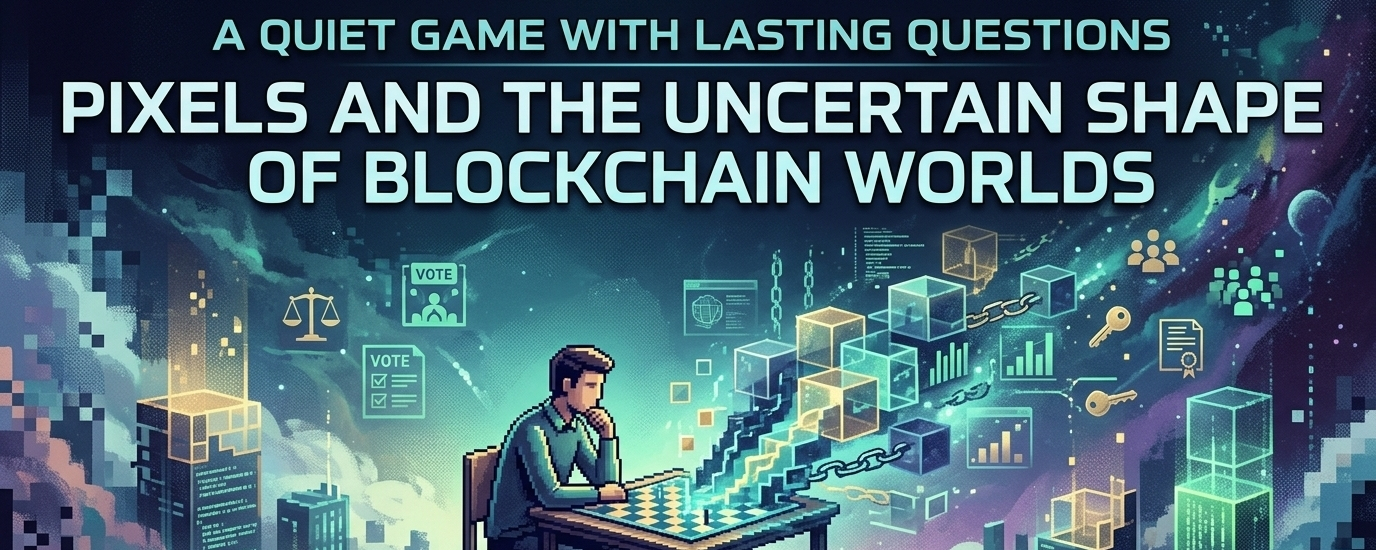

I keep coming back to the same question whenever I spend time in blockchain-based games: what exactly are we trying to make permanent here? It’s an odd thing if you think about it. Games have always been fleeting spaces servers shut down, economies collapse items disappear into forgotten inventories. And yet projects like Pixels running on the Ronin Network seem to suggest that maybe some parts of these worlds are meant to stick around a little longer than usual.
Pixels, on the surface doesn’t feel like it’s trying to answer that question directly. It looks more like a quiet experiment disguised as a farming game. You plant crops wander around interact with other players. It’s slow almost deliberately so. There’s no urgency in the design no sense that you’re racing toward something. That alone already sets it apart from a lot of blockchain projects where everything tends to feel accelerated prices attention expectations.
But underneath that simplicity is a different kind of structure. The game leans on blockchain infrastructure not to dazzle but to persist. Ownership of items progression even parts of the in-game economy exist in a way that isn’t entirely tied to a single server or company. At least that’s the idea. And it sounds compelling until you start wondering how much of that persistence actually matters to the average player.
Because most players if they’re honest don’t really think about infrastructure. They think about whether a game feels good to play. Whether it’s worth coming back to. Whether the time they spend there has some kind of meaning even if it’s just personal. Blockchain doesn’t automatically solve that. If anything it complicates it.
Ronin, as a network is an interesting choice here. It was built with gaming in mind, shaped by the needs of projects that require high transaction throughput without making every action feel like a financial decision. That’s important. One of the quiet frictions in earlier Web3 games was the constant awareness of cost every move every interaction carrying a tiny but noticeable weight. Ronin tries to remove that feeling, or at least soften it which makes a game like Pixels possible in the first place.
Still, there’s a tension that never fully goes away. When a game introduces real ownership even in a casual setting it subtly changes how people behave. Farming a plot of land isn’t just about passing time anymore. It might be about optimizing yield managing assets or thinking ahead in terms of value. The line between playing and managing starts to blur.
Sometimes that’s interesting. Sometimes it’s exhausting.
What Pixels seems to be testing whether intentionally or not is whether you can build a social space where blockchain exists in the background rather than the foreground. A place where people gather trade explore and create but don’t constantly feel like they’re inside a financial system. It’s a delicate balance. Lean too far into the economic side, and the world starts to feel transactional. Pull too far away, and you’re left wondering why the blockchain is there at all.
There’s also the question of durability. Blockchain promises persistence but games are living things. They evolve they shift they sometimes break. If a game changes significantly over time, what happens to the assets tied to its earlier versions? Do they retain meaning or do they become artifacts of a world that no longer exists in the same way?
I don’t think Pixels answers that yet. It might not need to. Right now it feels more like a space where these questions are being quietly played out rather than explicitly addressed.
And maybe that’s the more interesting part. Not whether it succeeds or fails in the traditional sense but how it reshapes expectations over time. If players start to feel that their time in a game carries some form of continuity beyond the game itself that’s a shift. A small one maybe but noticeable.
Or maybe nothing changes at all and people just enjoy tending virtual crops for a while before moving on like they always have.
It’s hard to tell which direction things are leaning. And I suppose that uncertainty is part of why projects like this are worth paying attention to not because they promise a clear future but because they sit somewhere in between quietly testing what a game can be when infrastructure stops being invisible but doesn’t quite take center stage either.
