What appears most visible in digital systems is often the least complete. Clarity, in these environments, is rarely a function of what is shown—it is a consequence of what is structured, verified, and connected beneath the surface. Yet most users continue to equate visibility with truth, treating fragments of information as if they represent the whole.
This is the quiet distortion of the digital age: we are surrounded by signals, but disconnected from the systems that give those signals meaning.
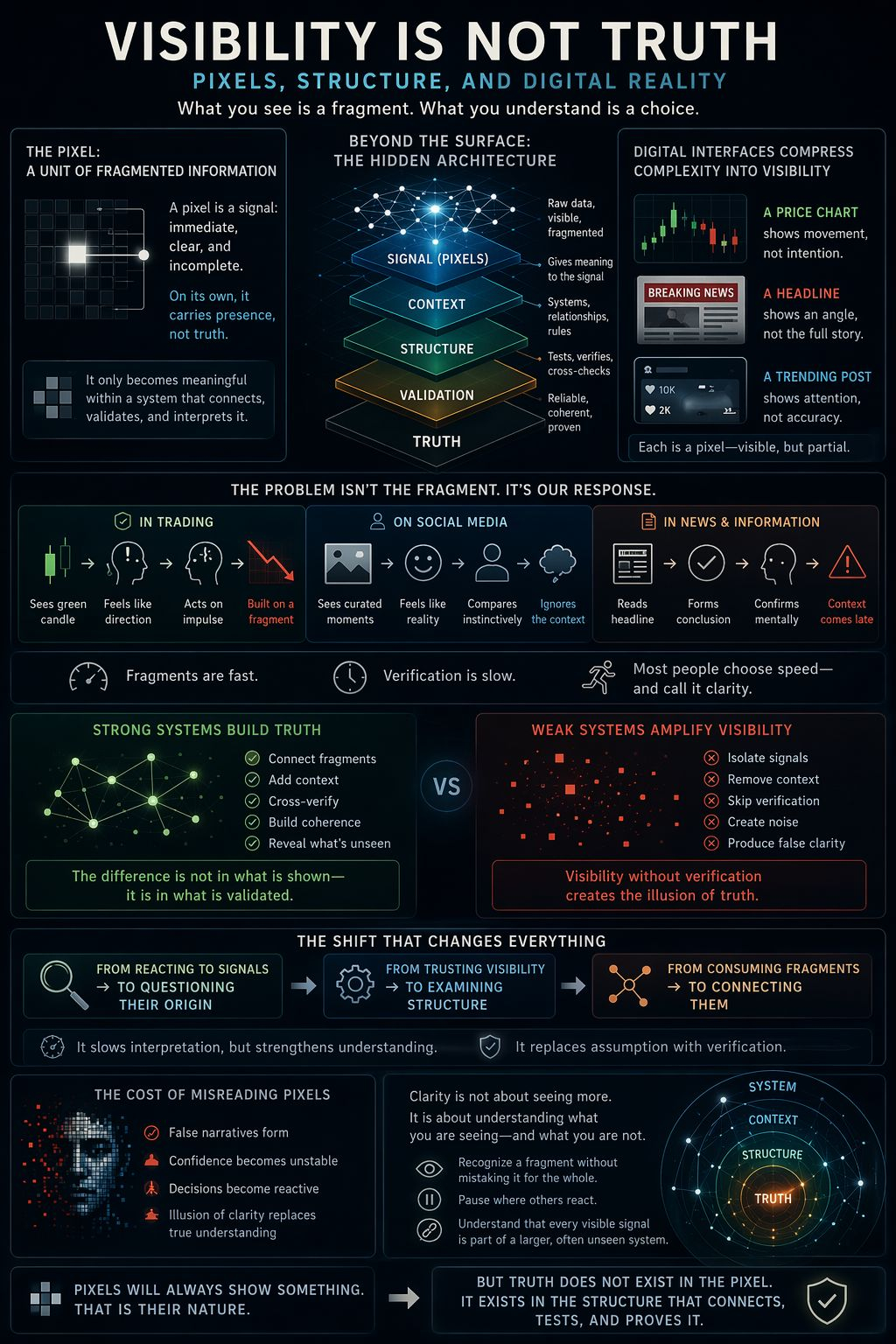
At the center of this lies the idea of a pixel—not just a visual dot, but a unit of fragmented information. A pixel is a signal: immediate, clear, and incomplete. On its own, it carries presence, not truth. It only becomes meaningful when placed within a system that connects, validates, and interprets it.
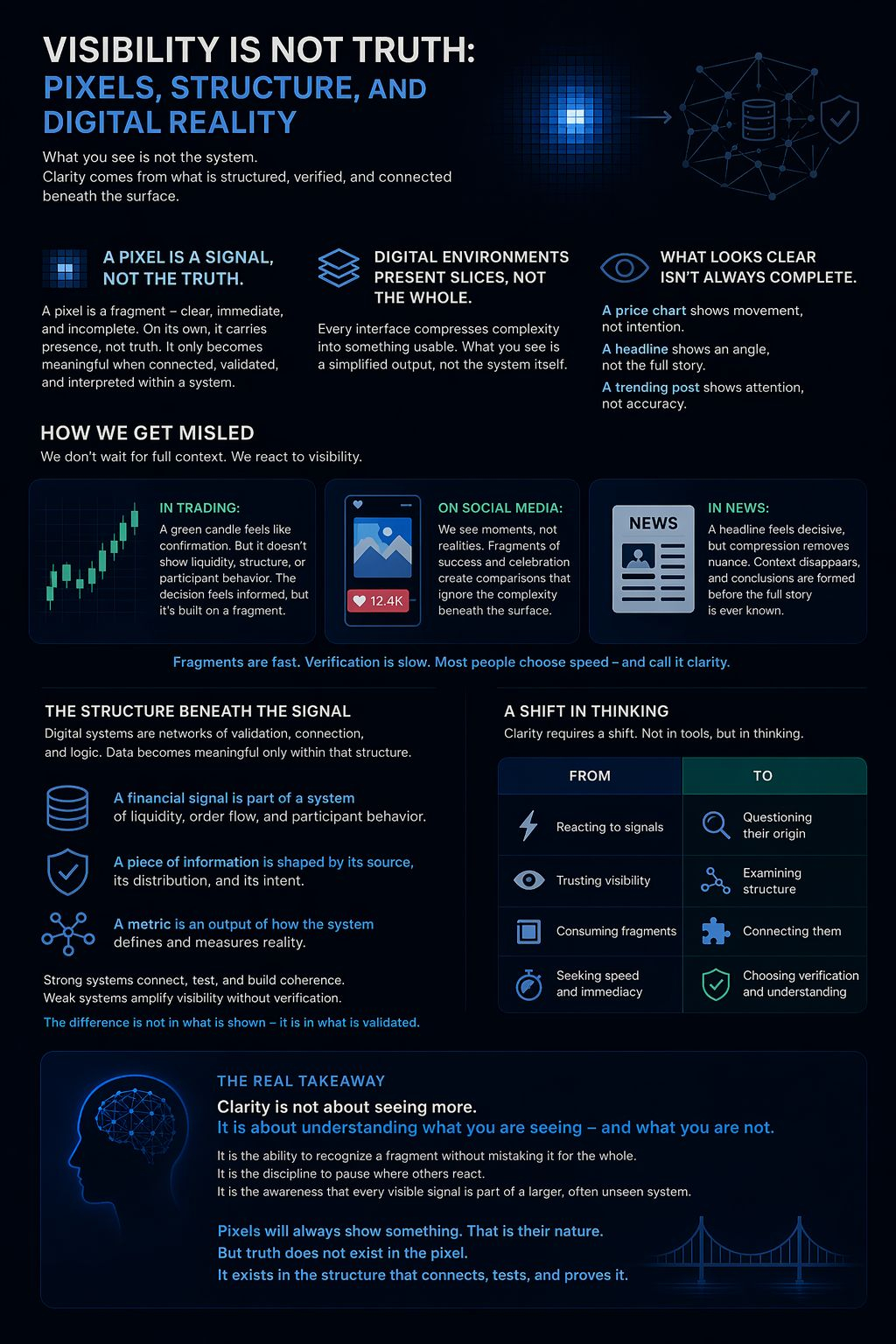
Digital environments are built on such fragments. Every interface you interact with—charts, feeds, notifications—presents reality in slices. Not because it intends to mislead, but because it must compress complexity into something usable. What you see is not the system itself, but a simplified output of it.
Each is a pixel—visible, but partial.The problem does not begin with these fragments. It begins with how we respond to them.A trader opens a chart and sees a sudden green candle. In that moment, it feels like direction—like confirmation. The instinct is to act quickly, to align with what appears to be momentum. But the candle is only a surface signal. It does not reveal liquidity conditions, broader market structure, or the forces shaping that movement. The decision feels informed, but it is built on a fragment.Scroll through a social feed, and the pattern repeats. You see moments—celebrations, success, curated experiences. Over time, these fragments begin to feel like a complete picture of someone’s life. Comparison follows naturally, even though the underlying reality is far more complex and uneven. The feed is not lying—it is selecting.Open a news app, and a headline delivers a complete story in a single line. It feels efficient, decisive. But compression removes nuance. Context disappears. By the time the full article is read—if it is read—the conclusion has already been formed.In each case, the structure is the same: a fragment is presented, and the mind completes it.We do this instinctively. We do not wait for full context—we react to visibility. We do not verify the system—we trust the signal. The speed of digital environments rewards immediacy, and our cognition follows. Fragments become conclusions before they are ever tested.
Fragments are fast.
Verification is slow.
Most people choose speed—and call it clarity.But beneath every visible signal lies a deeper architecture—one that determines whether a fragment is reliable or misleading. Digital systems are not just collections of data; they are networks of validation, connection, and logic. Data points gain meaning only when they are contextualized within these structures.A financial signal is not just a movement—it is part of a system of liquidity, order flow, and participant behavior.A piece of information is not just content—it is shaped by source credibility, distribution mechanisms, and intent.A metric is not truth—it is an output of how the system defines and measures reality.
Strong systems acknowledge this. They do not rely on isolated signals. They connect fragments, test them, and build coherence over time. Weak systems, by contrast, amplify visibility without verification, allowing fragments to create false clarity.
The difference is not in what is shown—it is in what is validated.Understanding this requires a shift. Not in tools, but in thinking.From reacting to signals → to questioning their origin
From trusting visibility → to examining structure
From consuming fragments → to connecting them
This shift is subtle, but it changes everything. It slows interpretation, but strengthens understanding. It replaces assumption with verification.Because the cost of misreading pixels is not always immediate—but it is cumulative.False narratives begin to form, built on partial information. Confidence becomes unstable, rising and falling with each new signal. Decisions become reactive, shaped by what is visible rather than what is true. Over time, this creates an illusion of clarity—where everything feels understandable, but nothing is deeply verified.And that illusion is difficult to detect, because it feels like knowledge.But clarity, in its true form, is not about seeing more. It is about understanding what you are seeing—and what you are not.It is the ability to recognize a fragment without mistaking it for the whole.
It is the discipline to pause where others react.It is the awareness that every visible signal is part of a larger, often unseen system.Pixels will always show something. That is their nature.
But truth does not exist in the pixel.
It exists in the structure that connects, tests, and proves it.


#pixel #Market_Update #campaigns #TrendingTopic