I still remember watching someone play Pixels for the first time and feeling a bit confused by how calm everything seemed.
Nothing felt urgent. No flashing pressure, no aggressive prompts pushing decisions, no obvious mechanics forcing you to act quickly or risk losing out. On the surface, it didn’t look like a system trying to extract attention at all. It almost felt neutral, like the game didn’t care how you played it.
But that impression didn’t last.
After spending more time observing it, something subtle started to stand out. Not in any specific feature or update, but in the way certain players moved through the system. Some weren’t necessarily playing faster. They just seemed better positioned. Their actions felt like they were compounding in a way that wasn’t immediately visible, but still clearly mattered.
That’s where my understanding of Pixels started to shift.
Because what looked like a calm GameFi experience on the surface might actually be something more interesting underneath. A system that doesn’t just reward activity, but gradually selects for certain types of behavior.
Most GameFi economies we’ve seen over the past few cycles follow a very simple logic. You play more and you earn more. You grind longer and you extract more value. You optimize repetition and you maximize returns. It is a volume-based system, and on paper it feels fair because everyone is rewarded for participation.
But in practice, it creates something very predictable. Players stop thinking about what they are doing and focus only on how much they can repeat. The system doesn’t care about the quality of behavior. It only measures output. And once every action is treated equally in reward terms, players naturally move toward the easiest and most repeatable loops. Not because they want to, but because that is what the system teaches them to optimize.
That is usually where these economies start to break. Because when everything is rewarded equally, behavior becomes shallow. The game stops shaping how people play and starts being shaped by how efficiently people can extract from it.
Pixels feels like it is moving away from that logic, even if it does not announce it directly.
At first glance, it still looks like a familiar loop-based economy. You farm, you upgrade, you progress. But the longer you observe it, the more you notice small differences in how progression behaves. Some actions feel like they flatten out quickly, while others seem to open up additional layers over time. Not in a loud or obvious way, but in a slow compounding structure that becomes clearer with time.
It is not just about doing more. It starts to feel like it is about doing what the system naturally expands.
That is where the idea of behavior selection becomes important.
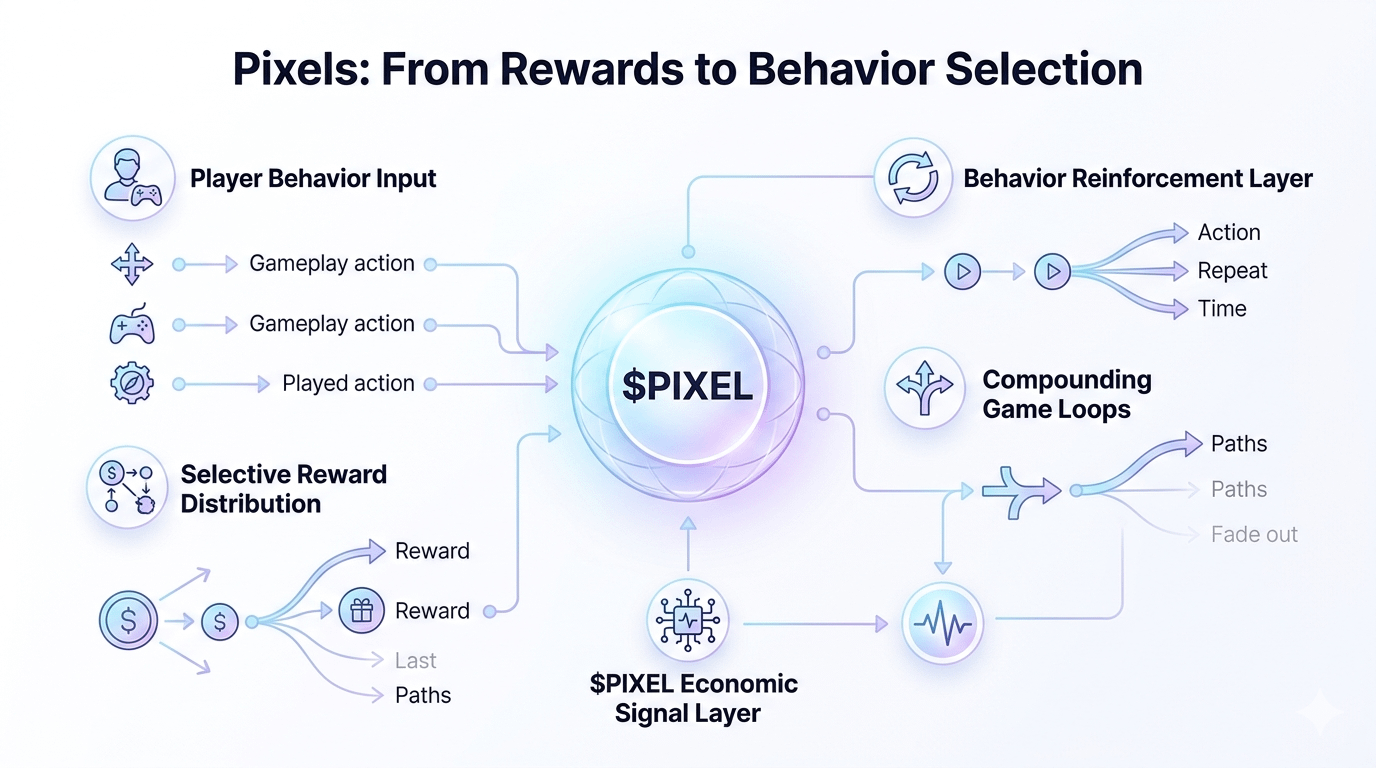
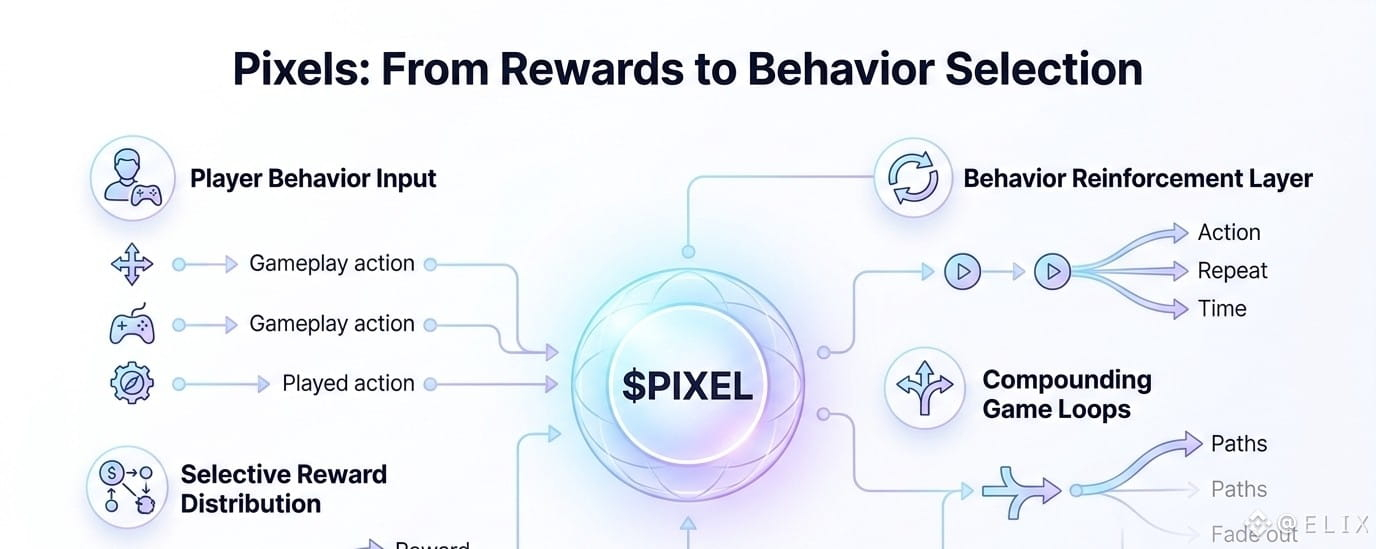
Pixels does not just measure what players do. It seems to reinforce certain patterns more than others, even if that reinforcement is not explicitly visible in the moment. This creates a very different structure compared to traditional GameFi design.
Instead of a simple loop that says do more and earn more, it starts to resemble a system that says certain actions matter more over time, and those actions begin to compound in ways others do not.
The result is subtle but powerful. Some behaviors start to grow in importance as they are repeated, while others remain stuck in loops that do not scale beyond a point. Over time, this creates an invisible sorting effect inside the economy where not all playstyles evolve equally.
In this structure, $PIXEL stops feeling like just a reward token. It starts to behave more like a signal layer between player behavior and system response. Not in an obvious or centralized way, but as an outcome of how incentives and progression interact.
It begins to influence which actions feel worth repeating, which loops expand over time, and which behaviors quietly lose momentum. That turns $PIXEL into something more structural than transactional. It is no longer just flowing through the system as a currency. It is helping define which parts of the system gain strength and which parts fade.
This becomes easier to understand when compared to how modern content platforms work. On platforms like TikTok or YouTube, effort does not guarantee success. The algorithm does not reward time spent creating. It rewards what it can amplify. Over time, creators adapt without fully understanding why certain things work and others do not.
The platform never explicitly tells anyone what to do. It just reinforces certain outcomes until behavior adjusts naturally.
Pixels feels like a slower version of that same principle, except instead of content being selected, it is behavior being shaped through economic feedback. Instead of an algorithm deciding what gets visibility, the economy itself starts to decide what gets reinforced.
The risk in systems like this is not immediate failure. The risk is optimization.
Players are extremely good at figuring out what actually gets rewarded, even when the system is not fully transparent. If certain behaviors consistently lead to better outcomes, players will eventually converge on them. And once that happens, exploration starts to disappear.
The system becomes predictable again, just in a different form.
That is what has broken many previous GameFi models. Not because they were unclear, but because they eventually became too understandable. Once players decode the structure, they stop exploring and start extracting.
The deeper question here is not whether the rewards are strong or sustainable. It is whether players can still experience genuine exploration while the system continuously shapes which behaviors scale and which do not.
Because once behavior selection becomes part of the core design, gameplay is no longer just interaction. It becomes alignment with a system that is evolving underneath you.
Players stop asking what they should do to earn more and start asking what kind of behavior the system is currently favoring. That shift changes the entire psychological layer of the experience.
Maybe the most important shift is not technical at all. It is conceptual.
If a game economy begins to decide which behaviors deserve to grow over time, then gameplay stops being purely about participation. It becomes about adapting to a system that is shaping itself while also shaping you in return.
And that leaves a quiet but uncomfortable question in the background. At what point does playing the game stop feeling like exploration, and start feeling like trying to stay aligned with something you can sense, but never fully see.