
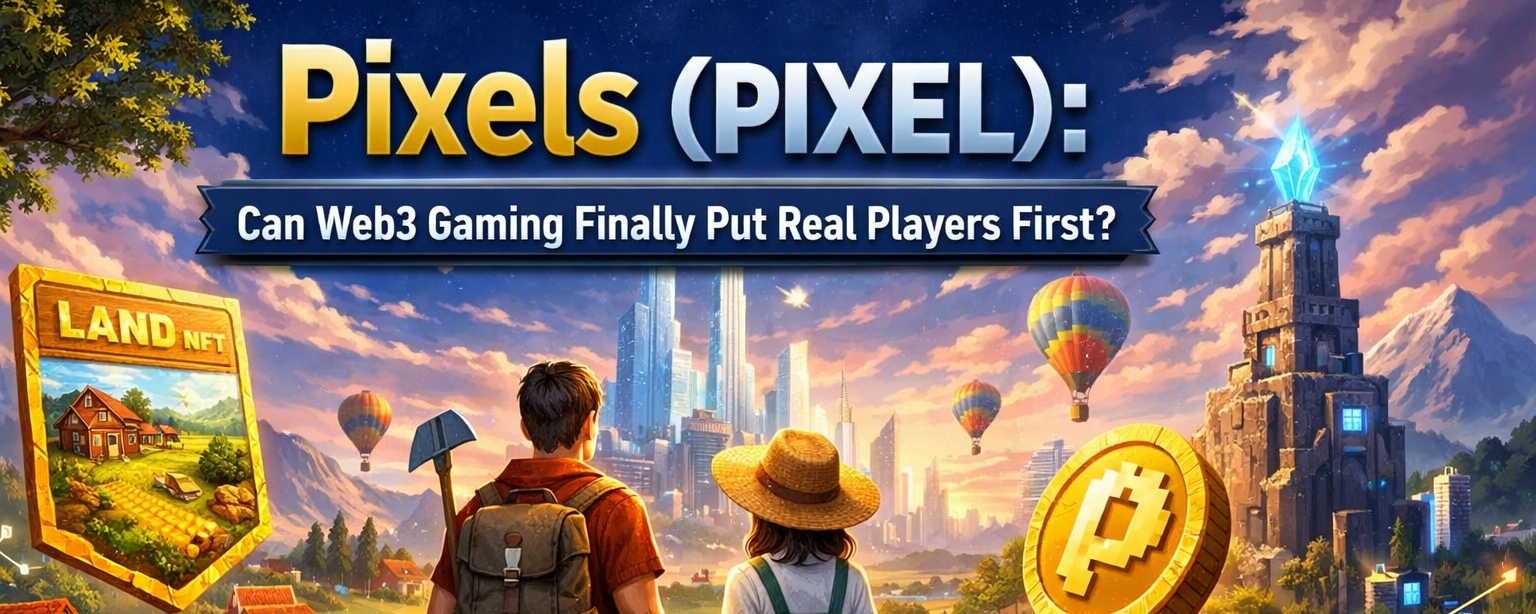
What are people really looking for when they spend time in an online game, because it is rarely just about rewards, and it is never only about ownership, and it is certainly not about a token alone, but about the feeling that their time means something and that the world still remembers them when they log off for the day. That is the larger issue that Pixels points to, and it is exactly why the project deserves a calm, serious reading instead of easy praise or hype. Pixels is a social casual Web3 game built on the Ronin Network, focused on farming, exploration, progression, and player-owned assets, while its native token, PIXEL, is designed to work as a utility layer inside that broader game economy instead of standing on its own as the whole story.
Before projects like this started gaining attention, blockchain gaming had a trust problem that was difficult to ignore. Many earlier play-to-earn systems were built around extraction first and enjoyment second, which meant people often joined because of rewards and left the moment those rewards became weaker. The outcome was a fragile cycle where new users were constantly needed to support old expectations, while the actual gameplay often felt thin, repetitive, and emotionally empty. Pixels’ own whitepaper says clearly that it was created to “solve play-to-earn,” and it explains its revised model through three main ideas: fun first, smarter reward targeting, and a publishing flywheel shaped by data. That wording matters, because it shows the team understood that the older problem was not simply a lack of tokens, but poor incentive design and weak alignment between players and the long-term health of the game.
This is also the reason earlier solutions kept falling short. A lot of Web3 games talked about ownership, but ownership without meaningful use can feel decorative rather than meaningful. A token can exist, but when there is little real reason to use it inside the game, it starts to feel like an outside object instead of a living part of the experience. Pixels’ lite paper makes that argument in a very direct way by focusing on utility, demand through fun, and the importance of money velocity inside a closed system. In simple language, they are saying that a game economy works better when the currency is actually being used for real in-game decisions, not simply held while everyone waits for the next person to arrive. Their documents also emphasize that the health of the ecosystem depends on holders who actually play, not people who only watch from the outside.
Pixels enters that history as one possible answer, not as a perfect solution. The game itself begins with familiar mechanics because farming is the first skill and crops are connected to progression, crafting, resource cultivation, and access to other goods. Public and private land both matter, and land NFTs add another layer through customizable farms, different utility traits, and upgrades that affect how land is used. That design choice was likely very intentional, because familiar actions like planting, watering, harvesting, and upgrading are easier for a broad audience to understand than abstract DeFi systems hidden behind the label of gameplay. I’m struck by how often Pixels returns to accessibility and easier onboarding in its roadmap, because that suggests the team understands that complexity is one of the biggest reasons mainstream users walk away from Web3 games.
The token sits on top of that structure. Binance Research described PIXEL as the native utility and governance token of the ecosystem, with stated uses that include in-game currency, NFT minting, VIP battle passes, guild participation, premium quality-of-life features, and eventually governance over a community treasury. That is a more restrained structure than the old model where everything was expected to reward everyone all the time, and it helps explain why the team chose to separate broad gameplay from premium utility. They’re trying to give the token clear places where it matters without forcing every single player action to feel financial. On the infrastructure side, Ronin was a logical choice because it was built for gaming and player-owned economies, and Pixels’ growth story as presented by Binance Research ties much of its expansion to the move onto Ronin.
When we ask what metrics really matter here, the answer is not only token supply or holder counts, even though those still matter. Pixels’ own documents highlight daily active users, the percentage of owners who are actually playing, and time spent per user as key signals of whether the system is healthy. Binance Research reported roughly 166,000 daily active addresses and more than one million unique users around February 2024, while the current Ronin app page for the token shows hundreds of thousands of holders and an on-chain total supply figure above 2.59 billion PIXEL on Ronin, compared with the project’s originally disclosed maximum supply of 5 billion. Those numbers do not tell the whole story, but together they show what analysts should really watch: active participation, user retention, real in-game usage, holder distribution, token release over time, and whether new features actually deepen gameplay or only create temporary bursts of attention. We’re seeing a project that understands engagement metrics matter just as much as blockchain metrics, and that already makes it a healthier starting point than many older models had.
Still, the risks are real, and they should not be softened. A data-driven reward system may sound efficient, but it can also become difficult to understand if players are not fully clear about why certain actions are rewarded and others are ignored. Land ownership may strengthen long-term commitment for some players, but it can also create layered advantages that make newcomers or lower-budget users feel secondary. Governance is often promised long before it becomes meaningful, and premium utility can slowly drift into social separation if the core game loses strength. There is also the familiar token risk of emissions, vesting pressure, and reward expectations growing faster than the game’s natural ability to create real demand. If it becomes too dependent on token-centered motivation, Pixels could end up repeating the same history it says it wants to move beyond.
Who benefits most from Pixels today is also something worth asking carefully. Players who enjoy relaxed progression, light social coordination, farming loops, and steady account-building may benefit because the design is intentionally more approachable than many blockchain-native experiences. Ronin users and existing digital asset holders may also benefit because entering the ecosystem is more direct for them. But some people may still be left out, especially those who dislike wallet-based systems, those who do not want any exposure to token structures, or those who feel that asset-linked game layers quietly turn leisure into strategic labor. Accessibility is clearly a goal in the project’s roadmap, but accessibility promised is not always the same as accessibility delivered.
The future case for Pixels is neither fantasy nor certainty. In the strongest version, it becomes a better example of how Web3 gaming can borrow the emotional logic of traditional games, where players come back because the world feels alive, the progression feels fair, and the economy supports the experience instead of swallowing it. In the weaker version, it remains interesting but limited, with token mechanics always slightly louder than the game itself. Somewhere between those outcomes lies the real test, and perhaps that is exactly why Pixels is still worth watching with both curiosity and restraint, because beneath the crops, quests, and guild systems there is a more human question about the internet itself: can a game built around ownership still protect wonder, patience, and belonging, or are we still learning how to build worlds that remember people without asking them to become investors first?