
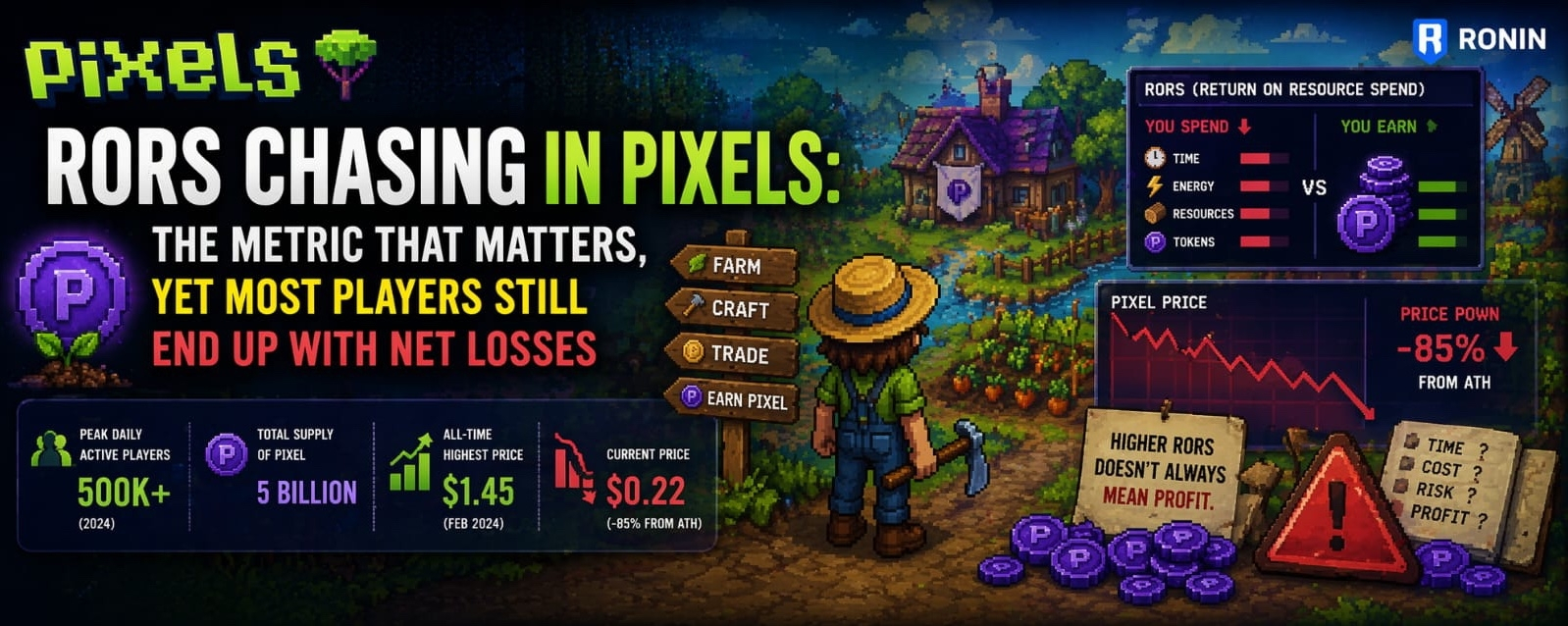
I’ve spent a lot of time inside Pixels, not just playing but quietly observing how people move, how they think, and more importantly how they calculate their returns.
And the more I watch, the clearer one pattern becomes.
Everyone is chasing efficiency. Everyone is optimizing. Everyone believes they’ve found a better loop than the average player.
But somehow… most of them still end up with less than they expected.
That contradiction is what pulled me deeper into understanding what’s really happening.
At the center of it all is RORS, the idea of maximizing return on every resource spent. It sounds logical. If you spend less and earn more, you win. That’s how most players approach Pixels. They optimize crops, energy usage, crafting paths, even movement inside the map. I’ve seen players build detailed spreadsheets, tracking every action just to squeeze out a slightly better return.
And on paper, it works.
You can clearly see which strategies produce higher output. You can measure efficiency. You can compare loops and pick the “best” one.
But here’s where things start to break.
RORS only measures your position inside the system. It doesn’t measure the health of the system itself.
That distinction is everything.
Because Pixels runs on PIXEL, and that means your returns are not just determined by what you do, but by what everyone else is doing at the same time.
The moment a high-efficiency strategy appears, it doesn’t stay exclusive for long. It spreads fast. Within days, sometimes even hours, thousands of players are following the exact same path. The same crops, the same loops, the same optimizations.
What looked like an edge becomes the norm.
And when everyone is efficient, no one really is.
Returns start compressing. Margins shrink. The advantage disappears without most people even noticing.
At the same time, the system keeps producing rewards. As Pixels expanded on Ronin Network, it attracted a massive wave of players. At peak periods, the game reached hundreds of thousands of daily active users, something very few Web3 games have ever achieved.
But that growth came with a hidden cost.
More players farming means more tokens entering circulation. More tokens in circulation means more pressure on value. So even if your in-game numbers look consistent, the real-world value behind those numbers can quietly decline.
This is where many players get confused.
They see stable or even improving RORS, but their actual outcomes don’t match the expectation. The missing piece is that RORS doesn’t account for market dynamics. It doesn’t reflect demand. It doesn’t capture selling pressure.
And then there’s the cost almost nobody talks about.
Time.
I’ve seen players spend hours every single day inside Pixels. Optimizing routes, managing resources, adjusting strategies, constantly trying to stay ahead. Three hours, four hours, sometimes more.
But that time is rarely included in their calculations.
If the end result is minimal profit or even a loss, then the question becomes uncomfortable. Was the system efficient, or did it just feel efficient?
From what I’ve seen, Pixels sits in a very delicate balance between a circulating economy and an extractive one.
There are players who reinvest, upgrade, and stay engaged long-term. But there are also many who follow a simple cycle. Earn, convert, exit. When that behavior becomes dominant, the system starts to leak value instead of retaining it.
And no level of personal optimization can fully counter that.
This is why I’ve stopped looking at RORS as the ultimate metric.
It’s useful, but incomplete.
It tells you how well you are playing the game, not whether the game itself is rewarding in a sustainable way.
What makes this even more interesting is that Pixels is still one of the few projects that has managed to create real engagement. People are not just clicking for rewards. They are actually playing, interacting, building routines. That alone makes it stand out in a space where most projects struggle to hold attention for more than a few weeks.
So this isn’t a dismissal.
It’s a shift in perspective.
Instead of asking how to maximize returns inside the system, I’ve started asking a different question.
What happens when growth slows down?
Because that’s where the real answers usually appear.
When fewer new players enter, when rewards feel smaller, when the excitement fades, that’s when you see whether the economy can stand on its own or not.
Until then, chasing RORS will continue to feel like progress. It will feel like control. It will feel like you’re getting closer to winning.
But from everything I’ve observed so far, the reality is more complex.
You can optimize perfectly, follow every proven strategy, and still not get the outcome you expected.
Not because you made a mistake.
But because the system you’re operating in is still evolving, still unstable, and still heavily influenced by forces far beyond individual efficiency.
And that’s the part most players haven’t fully understood yet.