
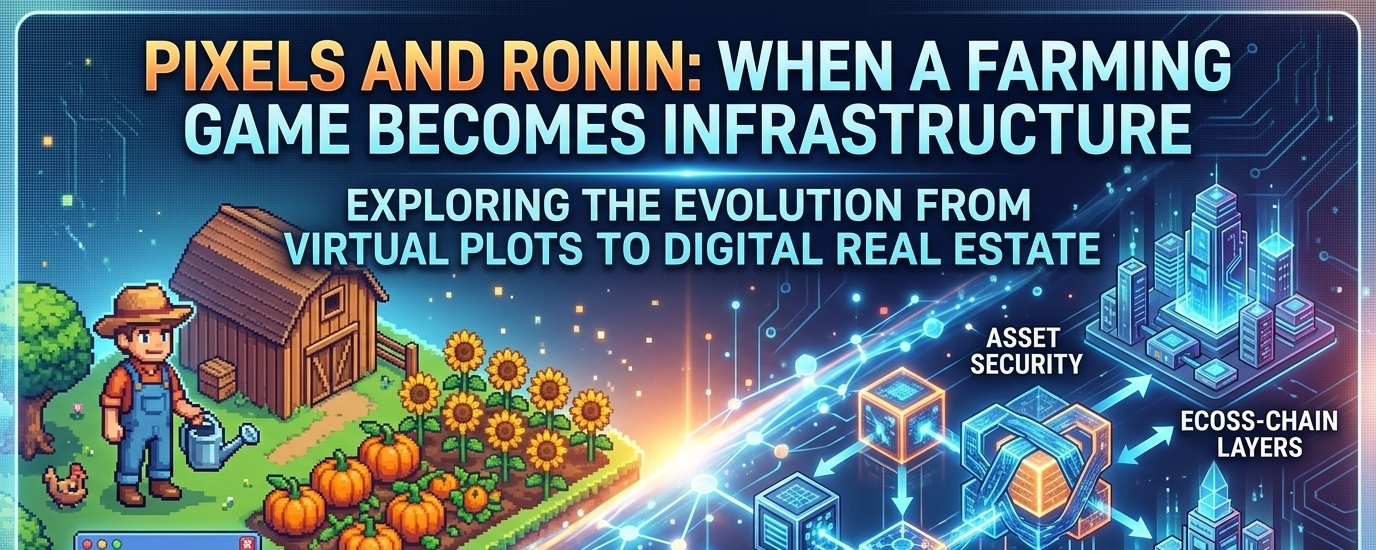

There’s something quietly strange about tending a digital farm that lives on a blockchain. Not strange in a loud dystopian way, but in a softer almost philosophical sense. You log in water crops maybe trade a few items wander around a pixelated landscape and somewhere beneath all that simplicity there’s an entire infrastructure trying to prove that ownership progress and even play itself can exist differently online.
That’s roughly where a game like Pixels sits. On the surface it feels familiar. Farming mechanics resource gathering a bit of exploration it doesn’t demand much explanation. But the moment you step back and ask what makes it Web3 things get more layered. The game isn’t just running on a centralized server where progress is stored in a database controlled by a company. Instead parts of it lean on blockchain systems where assets and actions are meant to be more persistent more portable or at least less dependent on a single authority.
The Ronin Network which powers Pixels, plays a big role here. It’s designed to handle the kind of throughput games need—fast, cheap interactions that wouldn’t make sense on more congested chains. That alone says something about how blockchain gaming has evolved. Early experiments tried to squeeze gameplay into environments that clearly weren’t built for it. Now, the infrastructure is being shaped around games instead of the other way around.
Still, there’s a quiet tension in all of this. A farming game is usually about routine and repetition. You plant, you wait you harvest. It’s almost meditative. But when you add blockchain elements the question shifts slightly: what does it mean to own a crop or a piece of land or an in-game tool? Is that ownership meaningful because it exists on-chain, or is it only meaningful as long as the game itself remains active and engaging?
It’s easy to say that blockchain makes assets transferable or tradable outside the game but in practice that value often loops back into the game’s own ecosystem. A plot of land or a rare item doesn’t carry much weight if there’s no one interested in using it or if the game loses its player base. So the infrastructure might be decentralized but the experience is still deeply tied to community attention which is fragile in its own way.
What’s interesting about Pixels is that it doesn’t try too hard to foreground the blockchain aspect. At least not in the way earlier Web3 projects did where every action felt like a transaction and every item came with a subtle expectation of financial value. Here, the mechanics feel closer to traditional games. You can spend time just playing, without constantly thinking about tokens or markets. That shift might seem small but it hints at a broader change in how Web3 systems are being integrated—less as the main attraction more as background infrastructure.
But even then questions linger. If the blockchain layer fades into the background, does it still matter to the player? Or does it become something that only developers and a subset of users care about? There’s a possibility that over time, the distinction between Web2 and Web3 games becomes less visible not because the technology failed but because it stopped needing to announce itself.
At the same time there’s a kind of fragility in relying on a specific network like Ronin. It’s optimized yes but it’s also specialized. If something shifts—whether it’s user interest technical direction or even security concerns the entire ecosystem around it can feel that impact. This isn’t unique to Pixels of course, but games tend to magnify these dependencies because they rely so heavily on consistent uninterrupted experiences.
I find myself wondering who these systems are really for. Is it for players who want deeper ownership and more control over their in-game lives? Or is it for developers experimenting with new economic models and infrastructure? Maybe it’s both, but the balance isn’t always clear. Sometimes the technology feels like it’s solving problems that players weren’t actively thinking about, while at other times it quietly enables things that would have been difficult otherwise.
There’s also the question of time. Farming games by nature stretch out over days, weeks even months. They reward patience. Blockchain systems on the other hand often move in cycles of rapid change—new protocols new tokens shifting attention. Putting those two rhythms together creates an odd contrast. A slow, steady game built on top of a fast-moving, sometimes unpredictable technological layer.
And yet, maybe that’s part of the appeal. There’s something grounding about logging into a simple world where progress is incremental even if the underlying systems are anything but stable. It’s like building a small routine on top of a much larger noisier experiment.
I don’t think Pixels or games like it fully answer what Web3 gaming is supposed to become. If anything they highlight how unfinished the idea still feels. The infrastructure is getting better the design is becoming more thoughtful but the core question why this needs to exist on a blockchain in the first place doesn’t always have a clear or consistent answer.
Maybe that’s okay for now. Maybe the point isn’t to have a definitive answer yet but to keep exploring these edges where familiar experiences meet unfamiliar systems. A quiet farming game running on a specialized network might not seem like a big deal at first glance. But it does make you pause just for a moment and wonder what parts of the internet we’re slowly trying to rewire and whether we’ll even notice when it starts to feel normal.
