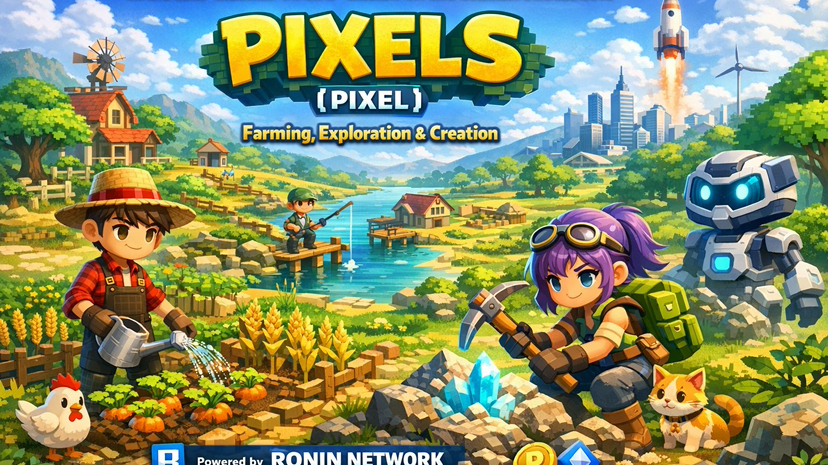
Pixels is often perceived as a simple farming simulator wrapped in a tokenized economy, but that interpretation quickly falls apart under closer inspection. What appears to be a straightforward gameplay loop—plant, harvest, craft, sell—actually conceals a far more intricate system driven by economic balancing, behavioral incentives, and infrastructure design. At its core, Pixels is less about farming and more about maintaining equilibrium between multiple competing forces.The illusion of simplicity comes from the accessibility of its primary actions. Players can easily generate resources, and this abundance creates the impression of a generous, open system. However, scarcity emerges not at the resource level, but at the level of processed goods and utility-driven items. This layered scarcity is intentional. Raw materials are plentiful to encourage engagement, while crafted goods carry value because they require time, coordination, or strategic planning. The result is a system where effort is transformed into assets—but not all assets are equally meaningful.This raises a fundamental question: are players creating value, or are they simply feeding a system that requires constant input to sustain itself? The distinction matters. In a healthy in-game economy, value should emerge organically from player interaction, not just from repetitive production. Without sufficient mechanisms to absorb output—commonly referred to as “sinks”—the system risks becoming saturated. When that happens, items lose value, and player motivation shifts away from gameplay toward liquidation. Instead of enjoying the loop, players begin looking for exits.Sinks, therefore, are not optional features; they are essential stabilizers. Whether through upgrades, access fees, cosmetic customization, or convenience features, players need meaningful ways to reinvest their earnings back into the system. But designing sinks is a delicate process. If they are too weak, inflation accelerates. If they are too aggressive, the experience starts to feel extractive, as though the system is constantly pulling value away from the player. The challenge lies in making these sinks feel natural—integrated into the gameplay rather than imposed upon it.Complicating this balance further is the role of token economics. When in-game actions generate tokens faster than they are consumed, the resulting inflation can destabilize the entire ecosystem. Early growth phases often mask this issue because new players continuously inject fresh demand. As long as the user base expands, the system appears healthy. But growth is not infinite. Eventually, the rate of new participants slows, and the economy must rely on retention rather than expansion. This is where many systems falter.Infrastructure plays a crucial but often overlooked role in this equation. Smooth, low-cost transactions enable frequent interactions, which are vital for maintaining an active economy. If trading, claiming rewards, or transferring assets becomes cumbersome or expensive, friction builds up, discouraging participation. A seamless backend allows the economic loop to function fluidly—but it also amplifies both strengths and weaknesses. Efficient systems can accelerate growth, but they can just as easily accelerate imbalance if the underlying design is flawed.Against this backdrop, the introduction of adaptive systems like AI-driven economic balancing adds a new layer of complexity. The idea of dynamically adjusting rewards based on player behavior is compelling. In theory, it allows the system to respond in real time, optimizing engagement and stabilizing the economy. However, such systems are only as good as the data they are trained on. If the initial dataset is narrow—focused on a specific type of player or environment—the model may struggle when applied to different contexts.This creates an interesting paradox. The more specialized the data, the more accurate the system becomes within its original environment—but the less transferable it may be elsewhere. Adaptation requires continuous retraining, which introduces its own challenges. If updates are too slow, the system lags behind player behavior. If they are too frequent or unstable, the experience becomes inconsistent. For developers, this means walking yet another tightrope: leveraging automation without sacrificing predictability.Ultimately, Pixels is experimenting with two unresolved questions. The first is economic: can a game sustain a circular economy once the initial growth phase ends? The second is technological: can behavioral patterns learned in one ecosystem be effectively applied to others? Both questions are critical not just for Pixels, but for the broader future of tokenized gaming.What makes this experiment particularly compelling is that it doesn’t offer easy answers. Instead, it highlights the inherent tension between value creation and value extraction. A successful system must do both—generate meaningful rewards while ensuring long-term sustainability. Lean too far in either direction, and the balance breaks.In the end, Pixels is not just a game. It is a live test of whether complex digital economies can remain stable, engaging, and fair over time. And while the surface may look calm, the underlying system is constantly in motion, adjusting, reacting, and searching for equilibrium.@Pixels $PIXEL #pixel

Artículo
Pixels: The Hidden Economics Behind a Farming Game That Isn’t One
--
Aviso legal: Contiene opiniones de terceros. Esto no constituye asesoramiento financiero. Es posible que incluya contenido patrocinado. Consultar Términos y condiciones.