
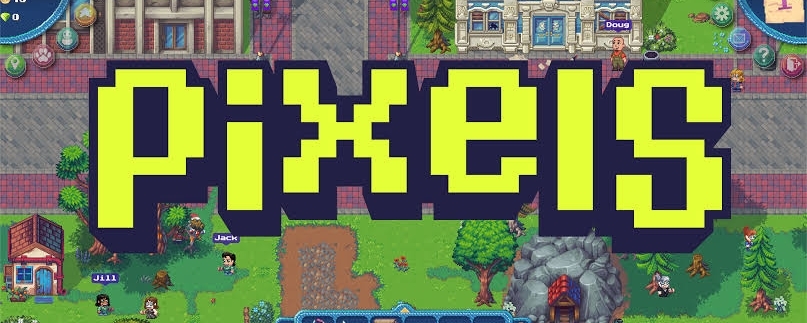
Let’s face facts. If you were active in the crypto space during the last major bull run, you probably have a little bit of PTSD from Web3 gaming. We all remember the hype. We all remember staying up till 3:00 AM, grinding on clunky games just to earn a few tokens, only to wake up the next morning and see the token price had dumped by 40%. Wahala for who didn't take profit early, right?
The old "Play-to-Earn" (P2E) model was a trap. It was an extractive economy. Players came in, stripped the game of its tokens, and rushed to the nearest exchange to dump them for stablecoins. Nobody was actually playing for fun; everybody was playing to pay rent. And when your entire ecosystem is built on people looking for an exit liquidity door, the collapse is inevitable.
But then, @Pixels entered the chat and completely flipped the script.
If you are wondering why PIXEL has managed to capture the attention of the masses and maintain a thriving, active daily user base while other Web3 games are turning into digital ghost towns, you need to look under the hood. It is not just about farming digital carrots. It is about a masterclass in tokenomics, friction-less UX, and a massive transition to the "Fun-First" model.
We need to shine our eyes and understand the real economic engine driving this project. Stop grinding blindly. Here is the deep breakdown of how the Pixels ecosystem actually works, and why it is built to survive the test of time.
The Death of the "Dump Economy"
To understand why PIXEL is winning, you have to understand why the others lost. In traditional P2E games, there was usually a single token. You did a task, the game printed the token out of thin air and gave it to you. That is hyper-inflation.
The developers at Pixels realized this was a suicide mission. So, they did something brilliant: they decoupled the core gameplay from the premium token. In the Pixels universe, the day-to-day currency you earn for farming, crafting, and doing basic tasks is an off-chain currency called "Coins."
You cannot simply bot your way into a fortune of $PIXEL. The on-chain token, $PIXEL, is treated like digital gold. It is difficult to get, and it is handed out through a highly calculated reward system that favors real, active, and contributing members of the community. By heavily restricting the emission of the main token and relying on off-chain coins for basic game loops, Pixels effectively killed the hyper-inflation death spiral. They protected the bag.
Token Sinks: Why Do People Actually Buy $PIXEL?
Here is where the deep thinking comes in. A token only holds value if people actually want to buy it and use it, not just sell it. This is called a "token sink." And my people, Pixels has built some of the most attractive token sinks in the entire Web3 space.
When a player finally gets their hands on $PIXEL, what do they do? They don't just rush to Binance to sell. They use it.
VIP Memberships: Players spend $PIXEL to buy VIP status, which gives them massive in-game perks, extra inventory space, and exclusive access.
Guilds and Social Status: The game is heavily reliant on social coordination. You need $PIXEL to join high-level Guilds, buy shards, and participate in the massive social economy of the game.
Minting and Upgrades: Want a digital pet? Want to speed up your crafting time because you are impatient? You need PIXEL.
The game is so genuinely fun and addictive that players voluntarily spend their hard-earned tokens back into the ecosystem to flex on their friends, build their empires, and rank higher on the leaderboards. It is a circular economy. Value stays trapped inside the ecosystem because the utility of the token is directly tied to the enjoyment of the game.
Erasing UX Friction: Designing for the Masses
We cannot talk about the success of @Pixels without talking about the user experience. Let's be real, crypto is complicated. The average person on the street does not want to write down a 12-word seed phrase, figure out how to bridge Ethereum to a Layer 2 network, and pay $15 in gas fees just to plant a digital potato. That friction is why Web3 gaming struggled to go mainstream.
Pixels cracked the code. By integrating with the Ronin network, they made the onboarding process smoother than butter. You can literally log in with an email or a Discord account and start playing within seconds. The blockchain mechanics are hidden quietly in the background.
You do not need to be a DeFi expert to play Pixels. You just need a browser. By lowering the barrier to entry, they opened the floodgates to retail players who just want to relax, farm, and chat with their friends. This mass adoption is the true underlying fundamental that gives the ecosystem its strength. When you build for the masses, the liquidity naturally follows.
The Collective Intelligence of Guilds
Another massive factor driving the Pixels economy is the transition from single-player grinding to collective intelligence. The introduction of Guilds completely changed the market structure of the game.
You are no longer a lone wolf trying to survive in the wilderness. You are part of a digital cooperative. Guilds pool resources, strategize together, and compete for the highest tier of rewards. This creates a powerful social lock-in. When your friends and your digital business partners are relying on you to log in and contribute to the Guild's treasury, you do not just quit. This social layer ensures high daily active user retention, which is the exact metric that institutional investors and big exchanges look at when evaluating a token's long-term viability.
The Bottom Line
The Web3 gaming space is maturing. We are graduating from the era of unsustainable ponzinomics and moving into an era of genuine digital economies. @Pixels is currently the tip of the spear in this revolution.
They figured out how to balance the delicate scale of supply and demand. They created a game that is actually fun to play, integrated seamless UX that your grandmother could understand, and built a tokenomics structure that rewards community building over value extraction.
So, if you are still out there treating Pixels like a 2021 clicker game, trying to aggressively farm and dump, you are playing the wrong game. The real alpha is in understanding the ecosystem, joining a strong Guild, utilizing your assets to build in-game infrastructure, and positioning yourself for the long-term growth of the Ronin and Pixels ecosystem.
Honestly speaking, the future of Web3 gaming is looking very bright, and it is heavily pixelated.
Over to you guys: Are you currently part of a Pixels Guild, or are you still playing solo? What has been your biggest challenge in adapting to this new "Fun-First" economy? Drop your thoughts in the comments below, let’s discuss the real alpha! 👇🏾