
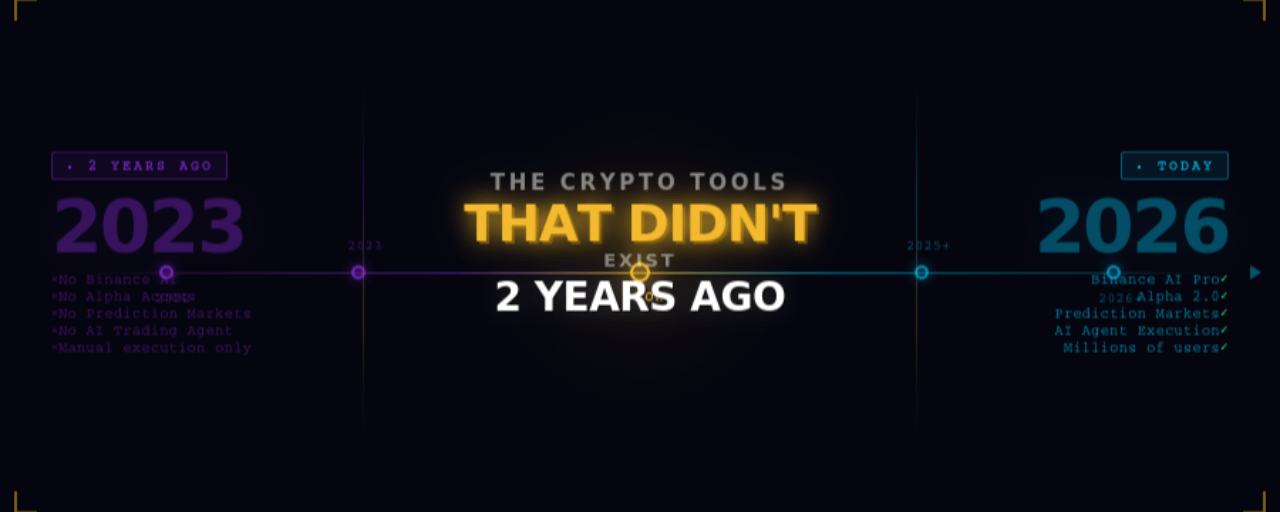

Think back to early 2023. If you were a retail crypto trader on Binance, your toolkit looked something like this: a spot trading interface, some basic charting, Launchpool for passive yield, and maybe a grid bot if you were technically inclined. You analyzed markets manually, relied on Twitter threads for alpha, and waited patiently for a token to get listed before you could access it. The infrastructure was solid — but the intelligence was yours to supply.
Fast forward to today, and that picture has changed more dramatically than most people have paused to acknowledge. The tools that now exist for an ordinary retail user on Binance would have sounded like speculative roadmap items two years ago. Some of them barely existed anywhere, at any price, for anyone.
This is not just a product story. It's a signal about where crypto is heading — and how fast.
Before and After: What Retail Access Actually Looked Like
In 2023, the divide between retail and institutional traders in crypto was wide and structural. Institutions had proprietary data feeds, algorithmic execution infrastructure, early access to token launches, and research desks to synthesize it all. Retail traders had price charts and group chats.
The gap wasn't just about capital — it was about information, timing, and tooling. A hedge fund could run an automated strategy that reacted to on-chain flows in real time. A retail trader was watching the same candlestick charts that have existed since the 1990s and making gut calls.
That asymmetry has begun to close — not perfectly, not completely, but meaningfully. Three products in particular tell that story well.
Case Study 1: Binance Alpha — Early Access, Democratized
Binance Alpha launched on December 17, 2024 as a price discovery engine designed to spotlight early-stage crypto projects with high growth potential, blending centralized exchange accessibility with decentralized innovation. Medium
Before Alpha existed, the path for a retail trader hoping to get early exposure to a promising project was fragmented and high-friction: find the project on a DEX, navigate wallet setup, manage gas fees, accept high slippage, and hope you weren't buying into a rug. The information edge belonged entirely to those already plugged into insider networks.
Alpha gives users an early look at tokens that may eventually list on Binance Spot, serving as a discovery hub for early-access assets. Its Token Generation Events operate under an oversubscribed model, with the average fully diluted valuation at launch sitting at just $16.7 million — and the average buy price coming in nearly eight times lower than the day-one closing price. Ainvest
In March 2025, Binance introduced Alpha 2.0, integrating Binance Alpha directly into the Binance Exchange and eliminating the need for external wallets — making the feature accessible to anyone already on the platform, not just experienced Web3 users. Coinbureau
The result: retail traders now have a structured, curated, low-friction pathway to early-stage projects that would previously have required being the right person in the right Telegram group at the right time.
Case Study 2: Prediction Markets — A New Asset Class in Your Pocket
Two years ago, prediction markets were a niche product used by a small community of forecasters and political junkies. Platforms like Polymarket existed but occupied a corner of the crypto ecosystem largely disconnected from mainstream trading.
Today, that corner has become a major intersection. Prediction markets have surpassed $20 billion in monthly trading volume, up from $1.2 billion in early 2025. In March 2026, Kalshi saw roughly $10.98 billion in volume while Polymarket recorded $10.04 billion. The Block
Binance has now entered the space directly. Binance partnered with Predict.fun, the leading on-chain prediction market provider on BNB Smart Chain, allowing participants to take positions on the outcomes of real-world events — from sports to economics to geopolitics. Each possible outcome is represented by a share priced between $0.01 and $0.99, with the price reflecting the collective assessment of market participants regarding the probability of that outcome. Trending Topics
The integration offers one-click, fee-free access with no complex onboarding required — built directly into the Binance app using existing account balances. Finovate
This matters beyond the product itself. Prediction markets represent a fundamentally different kind of financial instrument — one that puts a price on information and collective belief rather than just asset supply and demand. Making them accessible through a familiar interface to millions of existing users is a meaningful expansion of what "crypto trading" even means.
Case Study 3: Binance AI Pro — From Chatbot to Execution Agent
Of the three developments, this one carries the most weight in terms of what it signals about the direction of the industry.
In 2023, AI in crypto was largely cosmetic. Chatbots could answer questions about tokenomics. Screeners could flag momentum breakouts. Sentiment tools could scrape Twitter. But the actual work — reading the market, forming a view, executing a strategy — still sat entirely with the human.
For years, crypto trading tools promised to make markets easier to navigate. Most ended up as smarter dashboards or chatbots that explain what's happening. Binance AI Pro is trying something different — handing over the ability for AI to actually execute trades on behalf of the user. Not suggest. Not guide. Execute. IntInsight
Building on the existing Binance AI chatbot, the beta version evolves it into a full workflow assistant, integrating top-tier models like ChatGPT, Claude, Qwen, and Kimi via the OpenClaw framework — powering everything from spot and futures orders to on-chain portfolio tracking. CryptoLenz
The security design matters too. The system automatically creates an isolated AI sub-account with a dedicated API key that carries no withdrawal or transfer permissions, ensuring fund segregation between the main account and the AI's operating environment. The AI acts within a defined sandbox — not with unconstrained access.
The broader shift among exchanges is moving toward AI and automation as competitive differentiators. Binance's approach of exposing agent skills at the infrastructure layer — rather than purely as a consumer-facing chatbot — suggests an intent to position itself as a base layer for third-party AI trading tools, mirroring how exchanges once integrated with payment networks to capture transactional flows. Crypto News
What the Pattern Tells Us
Taken individually, each of these three products is notable. Taken together, they describe a coherent trajectory: the systematic reduction of barriers between retail users and the kinds of tools that have historically only been available to sophisticated or well-connected market participants.
Early token access. Event-based trading instruments. AI-native execution. Two years ago, none of these existed in accessible, retail-ready form on a major exchange. Today, they are live, integrated, and being used by millions of people.
This is what crypto maturation actually looks like in practice — not just higher market caps or institutional adoption headlines, but a genuine expansion in the surface area of what an ordinary person can do from their phone on a Tuesday afternoon.
The pace of this change also matters. The gap between "this is a promising concept" and "this is a live product with millions of users" has compressed dramatically. What took traditional financial infrastructure decades to develop — accessible derivatives, algorithmic execution, early-stage deal flow — crypto is iterating through in product cycles measured in months.
Looking Forward
The natural question is: what exists two years from now that doesn't exist today?
If the last two years are any guide, the answer will likely include things that currently feel like roadmap speculation: fully autonomous AI portfolio managers operating on behalf of retail users; on-chain reputation systems that give AI agents verifiable track records; prediction markets that price not just events but probabilities across interconnected real-world systems.
Some of that infrastructure is already being built. What changes is when it becomes accessible — when it stops being a feature used by early adopters and becomes a default part of the trading experience.
The crypto tools that didn't exist two years ago are already changing how people interact with financial markets. The ones being built right now will likely do the same — at a pace that continues to accelerate.
Disclaimer: This article is for educational purposes only and does not constitute financial advice. All trading activities involve risk. Please conduct your own research before making any decisions.