
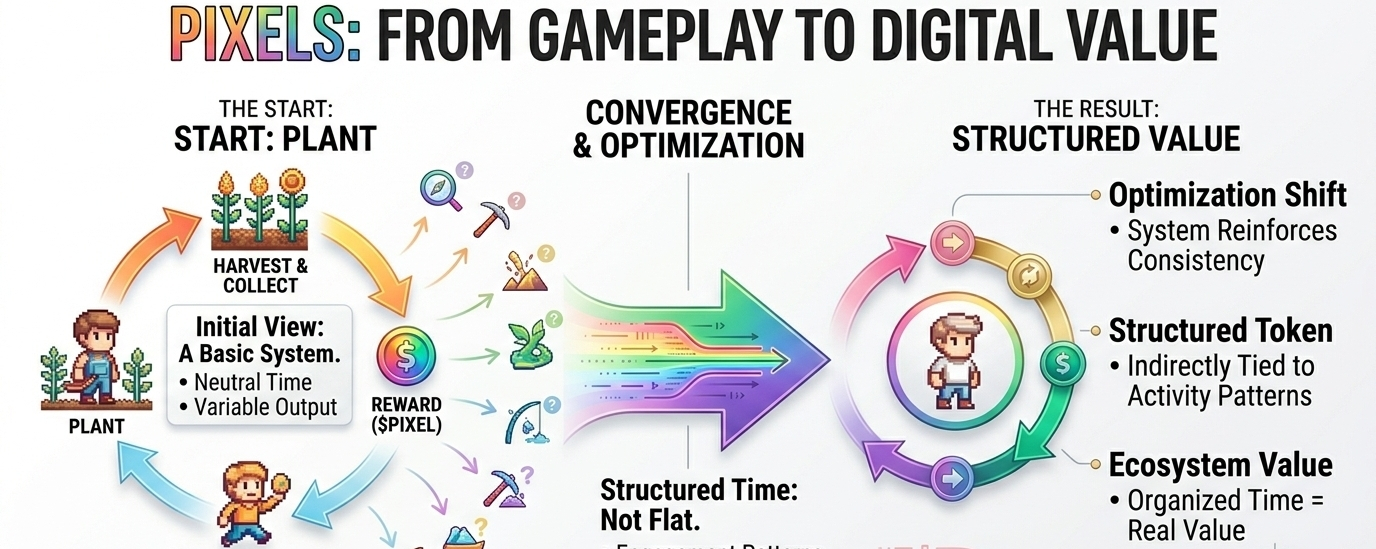
Initially, Pixels doesn’t seem complicated. You enter the game, follow routine farming activities, collect your rewards, and continue the same loop. It gives the impression of a standard progression system, similar to many other farming-style games where repeated actions steadily translate into visible growth over time.
But the longer you stay inside the system, the more it starts to feel slightly less uniform than it initially appears. Nothing obviously breaks or signals an issue, yet outcomes don’t always align in a simple, predictable way. Two players can spend a similar amount of time in the same environment and still end up with noticeably different progression paths.
And that raises a subtle but important question about what the system is actually responding to beneath the surface.
We usually assume time in games is neutral. One hour is one hour, and any difference in outcome is attributed to skill, efficiency, or decision-making. But in systems like Pixels, time begins to behave less like a flat resource and more like something that changes depending on how it is used. It is not just about how long you play, but how that time is structured through repeated actions and behavioral patterns.
Over time, a shift becomes visible, even if it is not immediately easy to define. Some players begin to experience smoother progression. Not because rewards suddenly increase, but because variability decreases. The experience becomes less chaotic and more consistent, as if the system is gradually responding better to certain forms of engagement.
This is where the idea of behavior starts to matter more than raw activity. In the early stages, players experiment freely. They try different strategies, explore mechanics, and test possibilities without a fixed direction. But as familiarity increases, behavior naturally begins to converge toward what feels most efficient. Players repeat actions that appear to work, reduce unnecessary exploration, and begin following patterns that the wider community recognizes as optimal.
At this point, gameplay slowly shifts from exploration to optimization. That change is subtle, but it fundamentally alters how time is spent inside the system. It is no longer random engagement; it becomes structured repetition. And structured repetition is easier for any system to recognize, process, and reinforce.
This is where $PIXEL starts to take on a more layered role. On the surface, it functions as a typical in-game reward token. Actions lead to rewards, and engagement translates into measurable value. But in systems where behavior becomes structured over time, the token does more than just reward activity. It begins to sit inside the feedback loop that defines which patterns are reinforced and which ones fade away.
The important shift here is not obvious at first. The token does not change its definition, but the context around it changes. As certain behaviors consistently produce smoother or more efficient outcomes, the system naturally begins to favor those behaviors. Over time, the token becomes indirectly tied to how structured a player’s activity is, not just how active they are.
This leads to a broader observation that appears in many digital systems. Once behavior becomes predictable, it becomes usable. Systems do not need to understand identity in a human sense. They only need stable patterns. When those patterns emerge, they can be reinforced, balanced, or deprioritized depending on how they interact with the overall ecosystem.
In that sense, time inside Pixels stops behaving like a simple input and starts resembling something closer to a structured profile. Not in terms of personal identity, but in terms of behavioral consistency. The system does not need to know who a player is; it only needs to understand how they behave over time.
From this perspective, $PIXEL exists somewhere between currency and structure. It is still a tradable reward, but it is also part of how the system translates repeated actions into progression. It helps define how behavior is converted into outcomes, even if that process is not explicitly visible to the player.
The result is a subtle shift in how engagement evolves. Players begin to optimize not only for enjoyment or exploration, but for what appears to produce the most stable progress. Over time, this can naturally reduce experimentation, as predictable patterns tend to outperform irregular ones in systems that reward consistency.
This is not necessarily intentional in a strict sense. Many systems develop these behaviors simply through scale, as large numbers of users interact with the same underlying mechanics. What feels like design can often emerge from interaction patterns rather than explicit rules.
Still, the outcome remains interesting. What initially looks like a simple farming loop may actually be a system that gradually organizes time into structured behavior patterns. And once that structure exists, the value generated inside the ecosystem is no longer just about activity. It is also about how that activity is shaped, repeated, and stabilized over time.
In that framing, Pixels is not only processing gameplay. It may also be processing structure itself, where $PIXEL plays a role in translating repeated human behavior into a form the system can recognize and reinforce. And if that holds true, then what players are really producing is not just tokens, but organized time that carries its own internal value within the ecosystem.
