
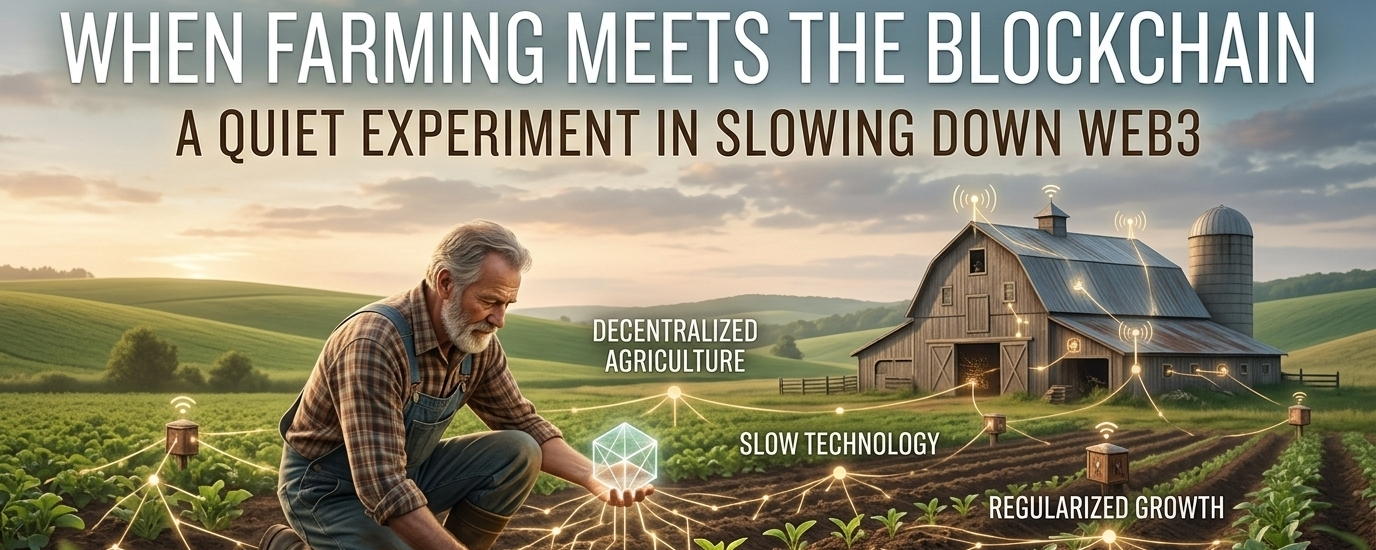

I didn’t expect to feel anything about a farming game on a blockchain but that’s more or less what happened the first time I watched someone wander through Pixels. It wasn’t the crops or the pixel art itself that caught my attention. It was the strange overlap of two worlds that don’t always sit comfortably together: the slow, repetitive calm of casual gaming and the restless, speculative energy of Web3.
There’s something almost contradictory about it. Farming games at their core, are about patience. You plant something, you wait you come back later. Progress unfolds gradually almost stubbornly so. Web3 on the other hand has often been defined by speed price movements, hype cycles sudden shifts in attention. Pixels tries to sit somewhere in between those rhythms and I can’t quite decide if that tension is its biggest strength or something it will always struggle with.
Running on the Ronin Network gives it a particular kind of context. Ronin itself has been closely tied to gaming for a while, especially after proving that people will actually stick around in a blockchain-based ecosystem if the experience feels smooth enough. Transactions that don’t feel like friction assets that move without much thought that’s the promise at least. In Pixels this shows up in small almost invisible ways. You collect resources you trade, you build, and somewhere underneath all of that, there’s a ledger keeping track. But most of the time you’re not really thinking about it.
That might be the point.
A lot of earlier Web3 games felt like they wanted you to constantly remember that you were interacting with a blockchain. Wallet prompts transaction confirmations token balances it was all very present, sometimes overwhelmingly so. Pixels seems more interested in fading that layer into the background. You still own things, in a technical sense. Your land your items your progress they have a kind of permanence that traditional games don’t usually offer. But the game doesn’t insist that you dwell on it.
Still it raises a quiet question: if players aren’t actively aware of the blockchain, does it actually matter to them?
I’ve noticed that for many players, what matters is not the infrastructure but the feeling of continuity. The idea that what they’re building won’t just disappear if a server shuts down or a publisher loses interest. Blockchain offers one version of that promise though not a perfect one. Ownership on paper doesn’t automatically translate to meaningful control. If the game itself fades away what exactly are you left with? A token a record maybe an asset that no longer has a world to exist in.
Pixels doesn’t solve that problem, but it does make it easier to ignore, at least while you’re playing.
There’s also the social layer which feels more organic than I expected. Open-world design helps, of course. You run into other players you trade, you collaborate in small, unstructured ways. It reminds me less of competitive online games and more of older virtual worlds where the goal wasn’t always clear and that ambiguity was part of the appeal. In that sense Pixels leans into something that Web3 has been circling for a while: the idea of shared digital spaces that feel a bit more persistent a bit more owned by the people inside them.
But even here, there’s a subtle tension. When assets have real-world value or at least the potential for it interactions can shift. A friendly exchange can start to feel transactional. Exploration can turn into optimization. You begin to wonder whether you’re playing the game or managing a set of resources with fluctuating value. Pixels doesn’t entirely escape that gravity. It just softens it wraps it in a more relaxed aesthetic.
What I find interesting is how it handles progression. In many blockchain-based systems, progress is tightly linked to economic activity. Earn more own more advance faster. Pixels seems to dilute that a bit. Yes there are economic layers but they’re not always front and center. You can spend time just tending crops, wandering around, figuring things out at your own pace. It feels closer to a traditional game loop, even if the underlying systems are more complex.
That balance might be fragile though. If the economic side becomes too dominant the experience could tilt back into something more extractive, more about maximizing returns than enjoying the process. On the other hand if the economic incentives are too weak, you start to question why the blockchain layer is there at all. It’s a narrow path to walk and it’s not clear yet how sustainable it is.
I keep coming back to the idea that Pixels isn’t really trying to prove anything in a loud way. It’s not making grand claims about the future of gaming or decentralization. It just exists quietly blending familiar mechanics with a different kind of infrastructure. Maybe that’s why it feels more approachable. It doesn’t demand that you believe in Web3. It just lets you experience a version of it.
And maybe that’s enough at least for now.
There’s still a lot unresolved. Questions about long-term value, about true ownership, about whether players actually care about the underlying technology once the novelty fades. But watching Pixels evolve it feels less like a finished answer and more like an ongoing experiment one that’s trying to figure out in small incremental ways, what happens when you take something slow and human like a farming game and place it on top of something as abstract and restless as a blockchain.
I’m not sure where that leads. But it’s interesting to watch it grow.
