
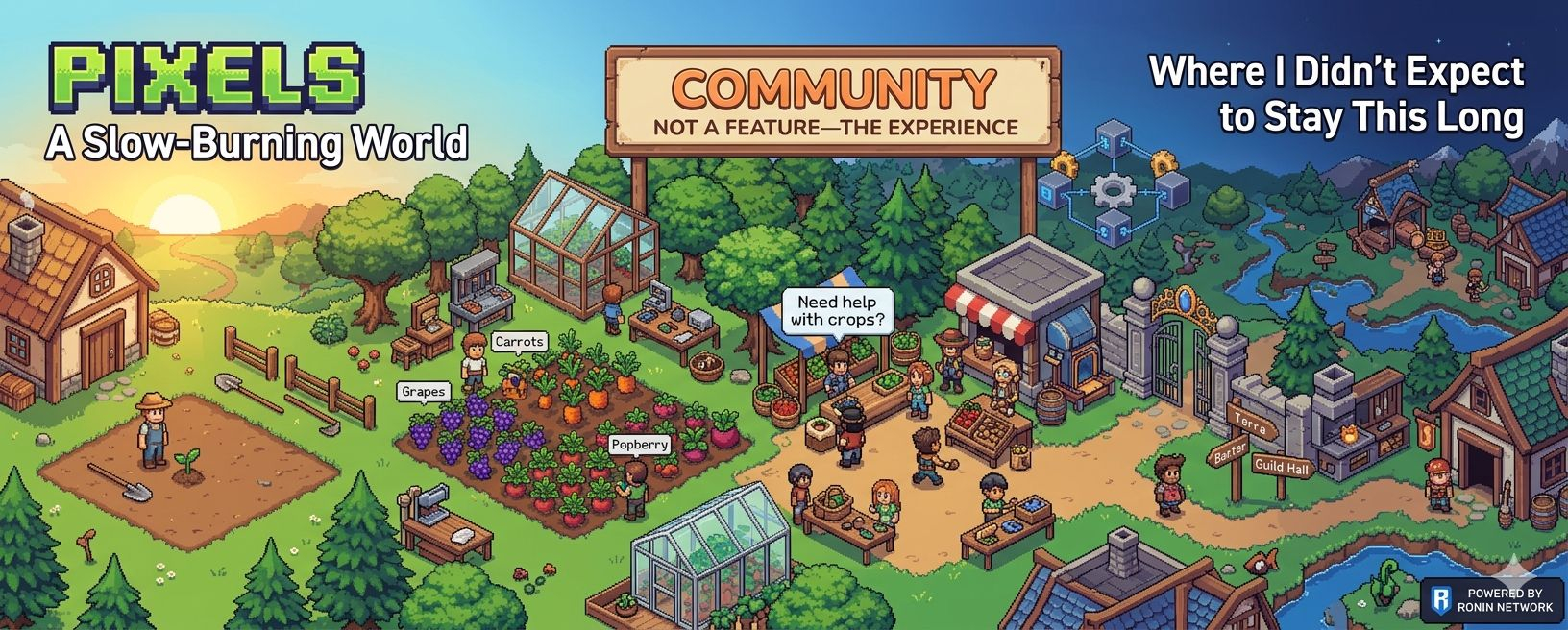
I remember opening Pixels (video game) without any real expectations. I’ve seen a lot of Web3 games promise big things and then lose me within minutes. But this one didn’t rush me. I spawned into a simple pixel world, got a small piece of land, and just started planting. No complicated setup, no pressure to understand tokens or systems right away. It felt oddly calm, almost like the game was giving me space to figure things out on my own.
At first, I thought it was just another farming loop. Plant, wait, harvest, repeat. But the more I played, the more I noticed how everything connects beneath that simplicity. Farming isn’t isolated it feeds into crafting, which opens up upgrades, which then pushes you to explore. I found myself slowly building routines without even realizing it. One moment I was growing basic crops, and the next I was thinking about efficiency, timing, and how to make better use of my land. It never felt forced. It just evolved naturally.
What really caught me off guard was how alive the world felt. I’ve played games that claim to be social, but interactions usually feel optional or artificial. Here, I noticed players actually helping each other, trading, talking, sharing small discoveries. I remember needing a resource I couldn’t find, and instead of searching a guide, I asked someone nearby. That simple interaction made the experience feel more real than any system-driven feature ever could. It reminded me of older online games where community wasn’t a feature it was the experience.
As I spent more time in the world, I started to appreciate the role of ownership. Because Pixels runs on the Ronin Network, what you build and collect isn’t just temporary progress. I think that subtly changes your mindset. I wasn’t just playing to pass time anymore I was building something that had continuity. But what I liked most is that the game never forced that idea on me. The blockchain side stays in the background, supporting the experience instead of interrupting it.
Exploration became another unexpected highlight for me. I’d leave my farm just to wander, without any clear objective, and somehow always find something useful or interesting. New areas, different resources, other players doing their own thing it all made the world feel open in a way that isn’t common in casual games. I think the lack of constant instructions is what makes it work. You move because you’re curious, not because the game is pushing you.
The economy is there too, but it doesn’t overwhelm the experience like it does in many Web3 projects. I’ve seen games where everything revolves around tokens, where every action feels like part of a financial strategy. Pixels doesn’t do that. You can engage deeply with trading and optimization if you want, or you can ignore most of it and just enjoy the loop of farming and exploring. I found that balance refreshing. It respects both types of players without forcing either approach.
Over time, I realized why the game was holding my attention. It doesn’t try to impress you instantly. It grows on you. The systems reveal themselves slowly, the world opens up step by step, and your connection to it builds without pressure. I’ve played games that felt bigger, louder, and more complex but they didn’t stick like this.
I think Pixels works because it focuses on being a good game first. Everything else ownership, economy, blockchain comes after that. And because of that, it feels less like a product and more like a place you return to, not out of obligation, but because you actually want to see what happens next.