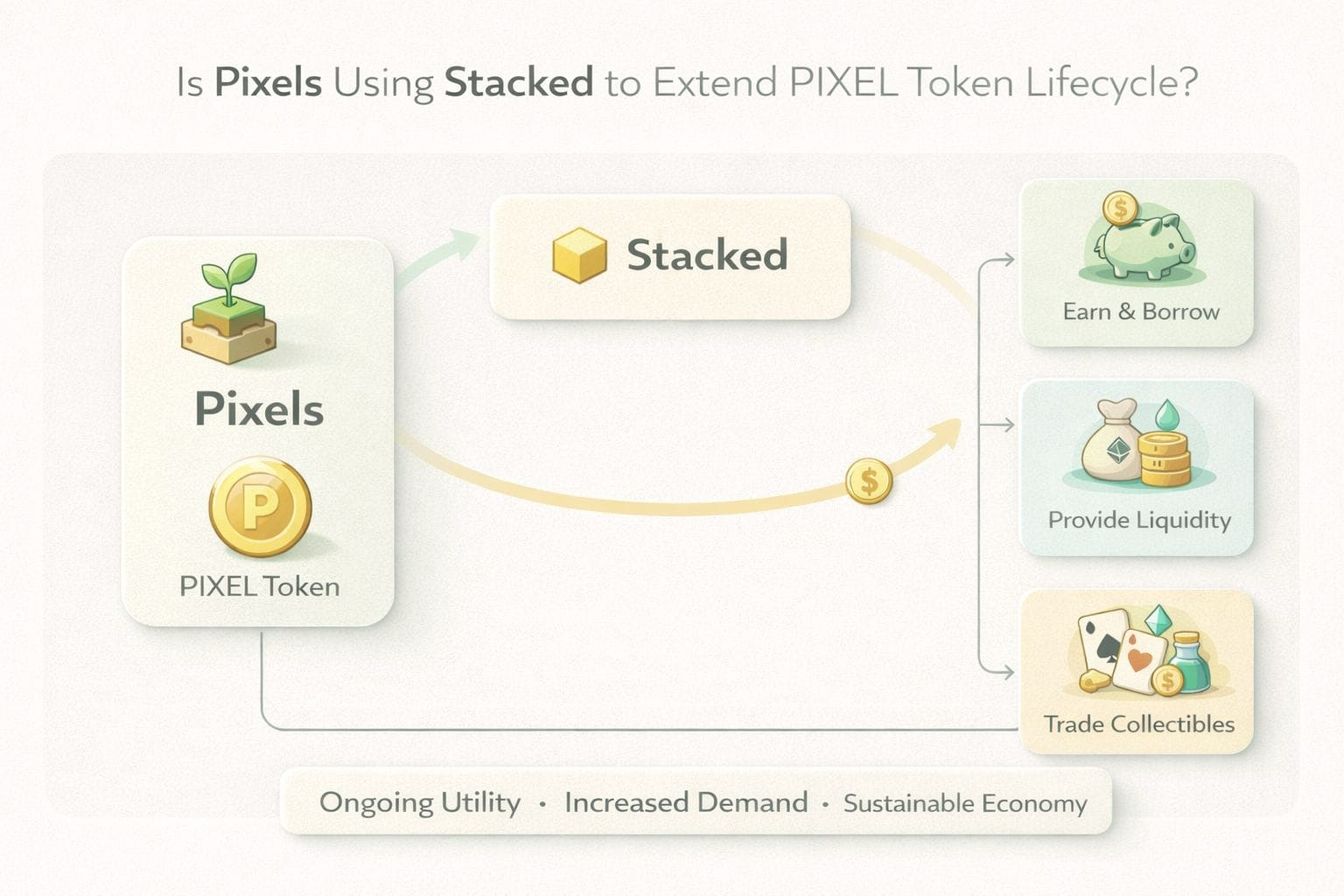
Looking at how Pixels applies Stacked, I’ve started to view the PIXEL token differently—not simply as an in-game token, but as part of a larger value flow that is being redesigned.
The question I keep asking is: is Stacked being used to extend the lifespan of the PIXEL token?
In my opinion, the answer is yes—but not in a direct “token-saving” way.
The real impact comes from how Stacked changes the movement of value inside the ecosystem.
A common problem in many Web3 games is that token lifecycles are very short. Tokens are distributed as rewards, players claim them, sell immediately, supply pressure rises, prices fall, and the system is forced to depend on constant new user inflows just to stay alive.
We have seen this pattern many times.
And it is one of the main reasons why many gaming tokens struggle to hold value over time.
What Stacked seems to do is intervene at the most important point: distribution.
It does not stop token emissions, but it improves how rewards are allocated.
Instead of rewarding everyone equally, incentives are optimized based on behavior. Players who contribute more, stay active longer, and create stronger value for the ecosystem are rewarded more meaningfully.
That sounds simple, but the economic effect is significant.
Because when rewards are distributed with more precision, sell pressure becomes less concentrated among short-term users who are only there to extract value.
Another important point is that Stacked changes the role of the token itself.
PIXEL stops being just a reward and starts becoming a functional economic tool.
When incentives are connected to long-term participation, users are more likely to keep the token instead of instantly selling it.
Not because they are forced to hold—but because holding becomes the smarter economic decision.
To me, this is a far stronger way to extend token life than artificial locking or simply reducing emissions.
One detail that stands out is that systems powered by Stacked have reportedly contributed over $25 million in revenue to Pixels.
That matters because it means value is not coming only from token issuance—it is also coming from real economic activity inside the ecosystem.
This reduces the burden placed on the token.
In many projects, the token is expected to do everything: incentivize users, maintain price stability, provide liquidity, and support growth.
That is often too much pressure for one asset.
Stacked helps reduce that pressure by allowing the broader economy to carry more of the weight.
I also find it interesting that by improving retention and increasing LTV, Stacked raises the value of each player.
This allows the system to generate stronger revenue without depending entirely on aggressive user growth.
And when a project does not rely only on constant new users, the token becomes less vulnerable to the “run faster” problem where fresh capital is always needed to support the economy.
That, in my view, is another form of extending token lifespan.
Not through tokenomics tricks—but by improving the health of the economy underneath it.
I also notice that Stacked does not focus on making the token instantly scarcer through heavy burns or hard locks.
Instead, it works by slowing down how quickly value exits the system.
That may sound simple, but it is extremely powerful.
Because in any economy, velocity matters just as much as supply.
If tokens move too fast and constantly leave the ecosystem, maintaining long-term value becomes difficult.
But if value stays inside longer, the system has more time to generate real economic depth.
In my opinion, Stacked is targeting the right variable.
Of course, it is important to stay realistic.
Stacked alone cannot save the PIXEL token if gameplay is weak or if the game itself fails to generate meaningful value.
It is an optimization layer—not a miracle solution.
If the core product is weak, even the best reward system will eventually struggle.
But if the foundation is strong, Stacked can help extend token sustainability in a much more natural way.
No artificial hype.
No dramatic tokenomics redesign.
Just better economic flow.
If I had to summarize it simply, I would say Pixels is not using Stacked to directly “protect” the PIXEL token.
They are using it to improve how value moves through the ecosystem.
And that gives the token a much better chance to survive longer.
To me, that is the smarter strategy.
Don’t try to fix the token first.
Fix the economy around it.
Because when the system becomes healthier, the token’s lifecycle improves naturally.