
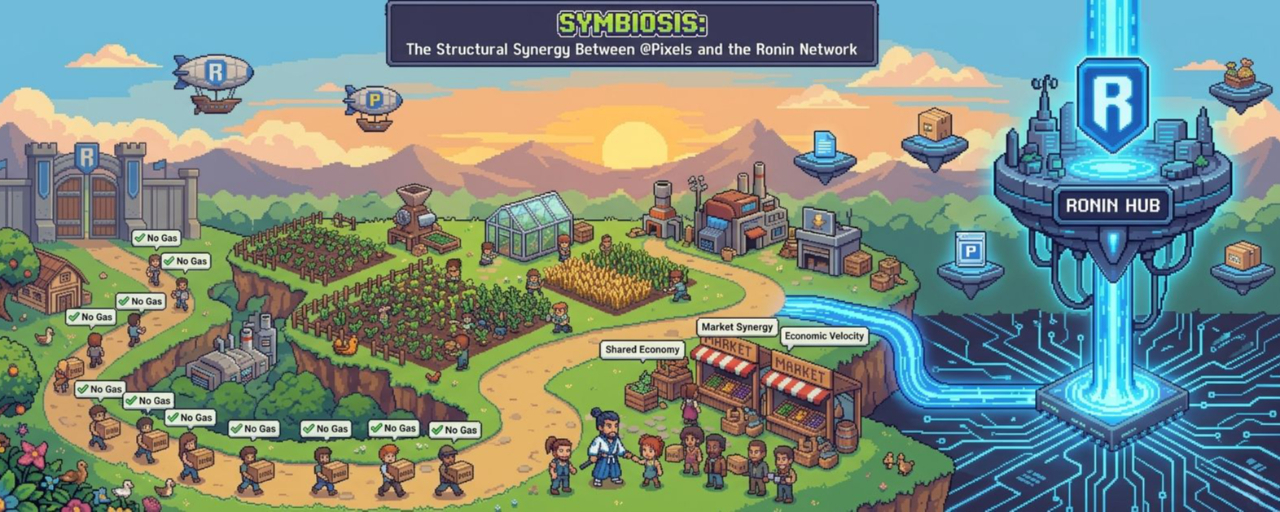
In the high-stakes world of Web3 gaming, infrastructure is destiny. A project’s choice of blockchain dictates its user experience, its economic ceiling, and its long-term survivability. For @Pixels, the strategic migration to the Ronin Network has proven to be a masterclass in alignment creating a symbiosis where the game and the network feed into each other’s growth.
1. Economic Velocity and the Frictionless UX
The hallmark of a truly great gaming chain is that the user eventually forgets the blockchain even exists. Ronin’s high throughput is what allows Pixels to implement high-frequency interactions like harvesting crops, crafting specialized items, and refreshing the task board that would be prohibitively expensive on almost any other Layer 1 or Layer 2.
This "velocity" is what keeps the PIXEL economy dynamic. If every single in-game action cost $0.10 or even $0.05 in gas, the "micro-earning" and "micro-spending" models would instantly collapse under their own weight. On Ronin, the friction is minimized to near-zero, allowing the "digital production layer" of the game to function at a massive scale without punishing the player for being active.
2. The Mavis Hub & The Network Effect
Being part of the Ronin ecosystem means being plugged directly into the Sky Mavis "flywheel." The Mavis Hub serves as a centralized point of discovery in a fragmented decentralized world. This "vetted" environment provides a layer of institutional trust that "wild west" chains simply lack.
There is a powerful cross-pollination effect at play here. When a new player enters the Ronin ecosystem whether for Axie Infinity or a new "Stacked" partner the path to Pixels is seamless. This shared liquidity of attention is a defensive moat that competitors find nearly impossible to replicate. You aren't just fighting for users in a vacuum; you are part of a thriving digital city-state.
3. Staking Psychology: From Mercenary to Stakeholder
We are witnessing a fundamental shift in how players view their involvement in Web3. The synergy between $RON and $PIXEL has moved the community away from a "mercenary" mentality (farming to sell) toward a "stakeholder" mentality (owning to grow).
Staking $RON or participating in PIXEL governance isn't just about chasing a daily yield; it's about securing the "digital land" where your business and social life operate. As noted by analysts like BlueDolphinX, the "caged liquidity" of modern GameFi can be a risk, but on Ronin, it feels more like a long-term investment in a premier economic zone. Players aren't just playing; they are building equity in the infrastructure they use.
4. Resilience Through Battle-Tested Governance
Finally, the choice of Ronin provides a hedge against market volatility. The network has survived extreme conditions and come out more decentralized and robust. For @Pixels, this means they don't have to worry about the foundation crumbling beneath them while they focus on building T5 mechanics and expanding the "Stacked" vision.
Conclusion
The success of $PIXEL is inseparable from the stability and specialized focus of the Ronin Network. As Ronin continues to attract high-quality partners and further decentralize its validator set, the value proposition of every project built on top of it hardens. We aren't just looking at a successful game; we are looking at the emergence of the premier economic zone of the Web3 world.
In this ecosystem, the network isn't just a host it’s a multiplier.