
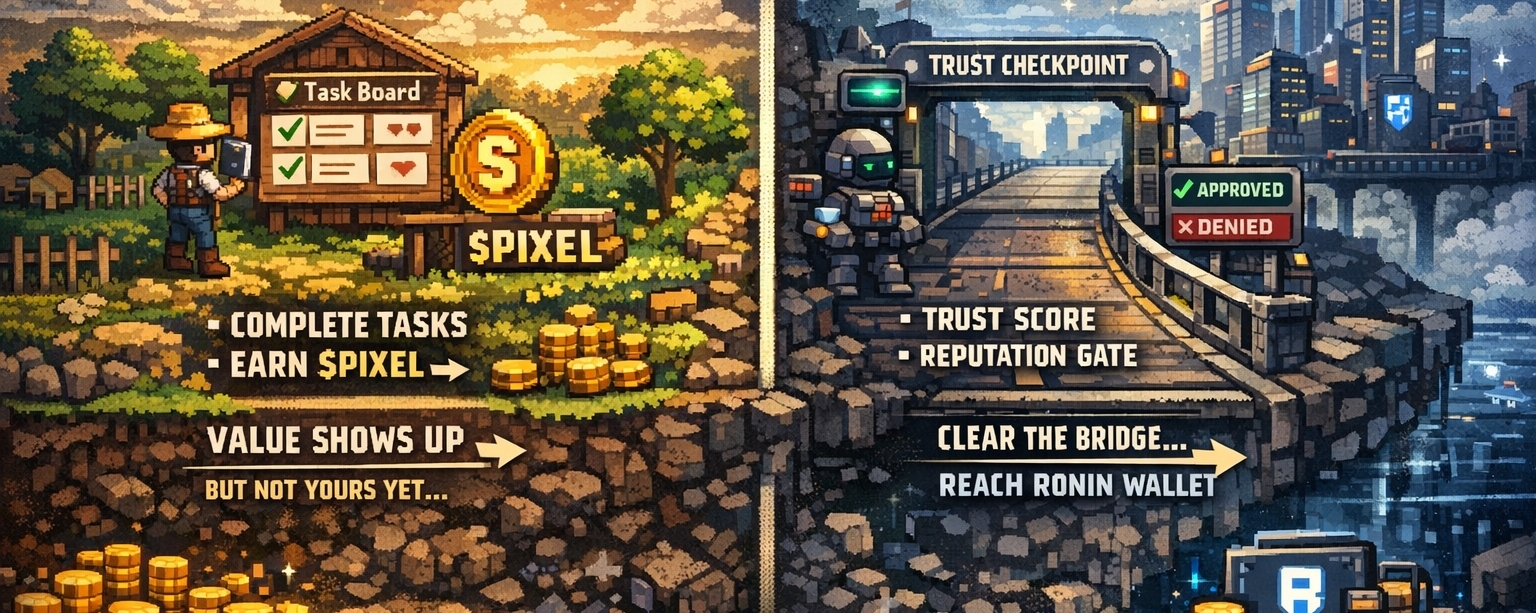
At first, that distinction is easy to miss. The loop inside Pixels feels complete: you act, you finish a task, Pixels appear. It feels immediate, resolved, yours. The system presents earning as a finished process, like the moment value shows up is the moment it belongs to you.
But there’s a second step that never quite connects to that momentexit.
Earning and leaving don’t feel like parts of the same flow. Inside the game, everything is smooth: off-chain, instant, frictionless. You move, craft, complete tasks, and value circulates naturally. It feels like a closed system that works perfectly on its own.
Then you try to move that value out and everything changes.
The transition toward Ronin doesn’t feel like a continuation. It feels like hitting the edge of a system that isn’t open, but conditional. There’s something sitting between what you earned and what you can actually take: Trust Score, reputation, behavioral signals—whatever name you give it, it acts less like a feature and more like a checkpoint.
And not everyone passes through it the same way.
Two players can complete similar tasks and still experience completely different exits. One withdraws cleanly. Another gets delayed. One settles quickly. Another lingers. It doesn’t feel random it feels like the system is building a profile over time and making decisions based on it.
Same effort. Different outcome.
That’s where the question shifts: did you actually earn it, or did you just get close to owning it?
Because if you can’t freely take it out, then earning wasn’t the final step it was just the middle of the process.
Over time, it starts to feel like earning isn’t even the main event. The system doesn’t just decide what gets rewarded it decides what gets released. And those are clearly separate decisions.
Inside the farm, value is allowed to exist freely. But the moment it tries to leave, the system becomes selective. That shift makes sense in a way that’s hard to ignore: once value exits, it’s gone. It’s no longer circulating, no longer feeding back into the loop.
It becomes final.
Coins make this even clearer. They never attempt to leave. They circulate endlessly, absorbing excess activity, acting as a buffer. Not everything is meant to exit and most activity never does. Not because it failed, but because it was never designed to cross that boundary in the first place.
So where does ownership actually happen?
Is it when Pixels appear? Or only when they settle on chain when you can move them freely, without delay or resistance?
If it’s the latter, then most of what you’re doing happens before ownership even exists.
The system never explicitly tells you this. You don’t hit a hard wall. Instead, you feel it through friction delays, evaluations, subtle resistance. It’s less “you can’t withdraw” and more “not yet.”
That’s where it stops feeling like simple anti-bot logic and starts looking like economic control.
Bots are the easy explanation. The harder question is what happens to real players who don’t align with the system’s expectations. Do they just wait longer? Does their value stay circulating inside internal loops? Are they being shaped quietly into behaviors that the system prefers?
Because over time, it starts to feel like exit isn’t just technical it’s behavioral.
You’re not just earning. You’re qualifying.
Qualifying to leave.
And that changes the entire experience. You start adjusting without realizing it staying longer, acting differently, aligning more closely with what seems to pass through smoothly. Not because the system tells you to, but because you feel that exit isn’t guaranteed.
In most systems, earning equals ownership. Here, ownership feels delayed like it exists in a pending state until the system decides it’s safe to release.
“Earning isn’t enough. You have to be acceptable.”
That idea sits uneasily, but it explains a lot.
Letting value leave has a cost. If too much exits too quickly, the system breaks. We’ve seen that before in other economies. So Pixels doesn’t just control rewards it controls outflow.
Exit becomes a throttle.
Which means the real control point isn’t the task board or the gameplay loop.
It’s the bridge.
That narrow space between off-chain activity and on-chain settlement where value isn’t just moved, but approved. Where the system decides what becomes real outside of it, and what stays inside.
Once you see that, the structure changes.
The farm is one layer. The tasks are another. But exit that’s where equality ends.
So now, when Pixels appear, they don’t fully feel like mine. They feel like something I’m holding within a system that hasn’t released them yet—something still tied to its internal flow.
Ownership doesn’t happen when you earn.
It happens when you cross.
And that crossing isn’t just about pressing withdraw it’s about whether the system is ready to let you take value with you, and how easily it’s willing to let that happen.
So the real question isn’t how much you can earn.
It’s how much of it actually makes it out.