


Pixels is often described in simple terms: a farming game with a token loop. On the surface, that description is not wrong. Players complete in-game actions, earn $PIXEL, and a significant portion of those rewards enters the market for sale. That visible cycle makes it easy to categorize the project alongside earlier GameFi experiments that struggled to sustain long-term balance.
But that surface-level framing misses what actually determines whether such systems hold or break: how value behaves after it is created.
Reward flow is the real pressure point
In many play-to-earn style economies, the core weakness is not emission itself, but what happens immediately after distribution. If most rewards are consistently sold rather than reused, the system becomes structurally dependent on new demand to absorb constant supply. This creates ongoing sell pressure that the ecosystem must continuously offset.
In that sense, the important metric is not how much is emitted, but how much is retained, reinvested, or cycled back into usage.
This is where systems like Axie Infinity became an important reference point. During its peak period, the economy was heavily driven by reward extraction, where farming activity often translated directly into selling pressure rather than long-term in-game economic participation. When external demand weakened, the imbalance between issuance and retention became difficult to sustain.
Where Pixels differs in structure
Pixels sits in a more ambiguous position. It does not fully force spending to progress, but it also does not strongly enforce holding behavior. That creates a middle state: players can meaningfully participate without reinvesting, but can also extract value without structural friction.
This type of design leads to a predictable behavioral outcome in rational market conditions: if usage is optional and selling is immediate, selling becomes the default optimization strategy for a large portion of participants.
The result is not necessarily collapse, but persistent outflow pressure unless counterbalanced by strong internal demand loops.
The missing variable: internal demand
The long-term stability of any token-based game economy depends on whether it can generate sustained internal consumption. This includes:
progression systems that require meaningful resource use
utility that creates recurring demand for the token
social or status mechanisms tied to holding or spending
economic sinks that absorb supply over time
Without these, even active ecosystems can behave like pass-through systems where value enters, circulates briefly, and exits quickly.
In that scenario, the core limitation is not user activity, but retention mechanics.
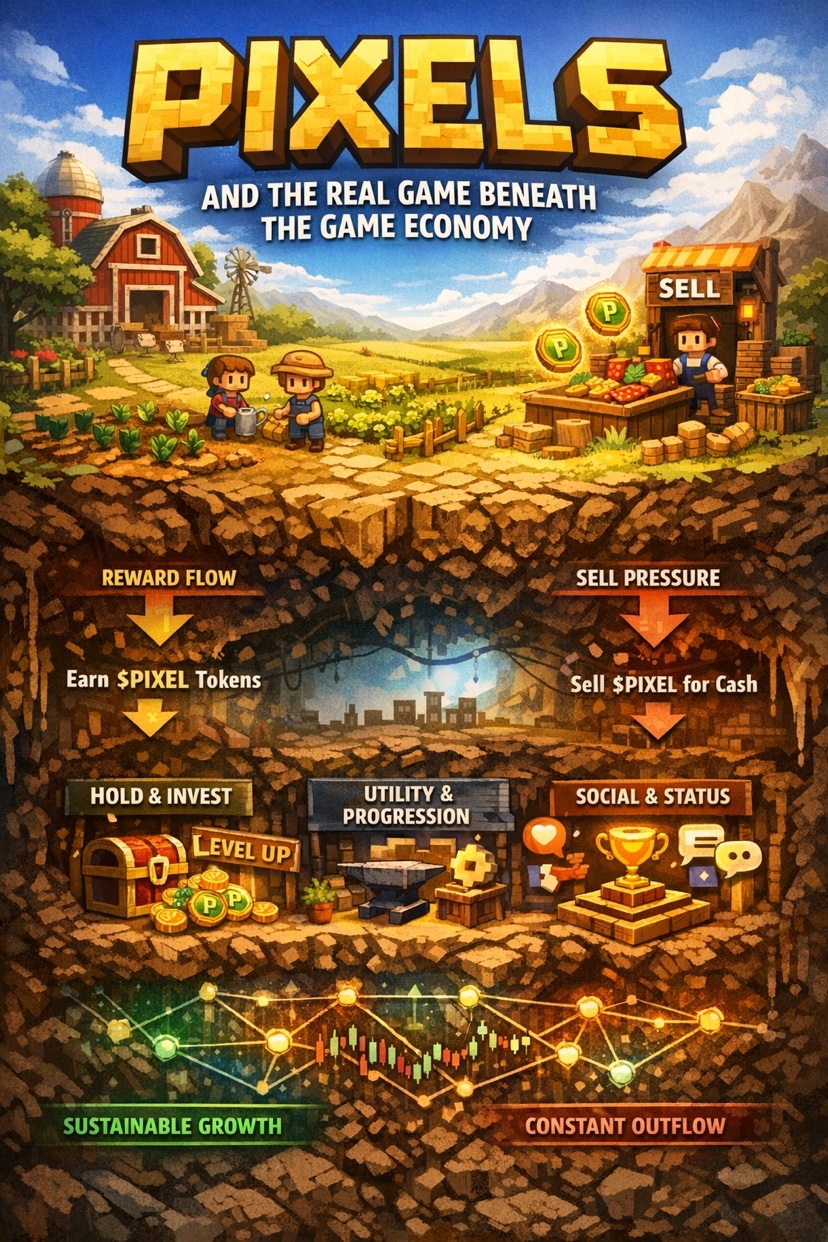
The key tension in Pixels’ design
Pixels appears to be attempting something more structured than pure reward farming. There are signals of progression systems, social layers, and in-game utility intended to deepen engagement beyond extraction behavior. However, the effectiveness of these systems depends on one critical condition: whether they make holding and using $PIXEL more rational than selling it.
If that condition is not met consistently, user behavior will naturally converge toward exit-first optimization, regardless of how engaging the gameplay feels.
Conclusion
Pixels is not accurately described as a Ponzi structure. However, like many tokenized game economies, it operates in a narrow corridor between sustainability and continuous outflow pressure.
The determining factor is not hype, emissions, or activity levels. It is whether the system can convert participation into retention.
If internal demand grows stronger than extraction incentives, the economy stabilizes. If not, it remains dependent on external inflows to balance persistent selling pressure.
That is the real mechanism worth watching—not the gameplay on the surface, but the direction value takes once it leaves the player’s hands.