
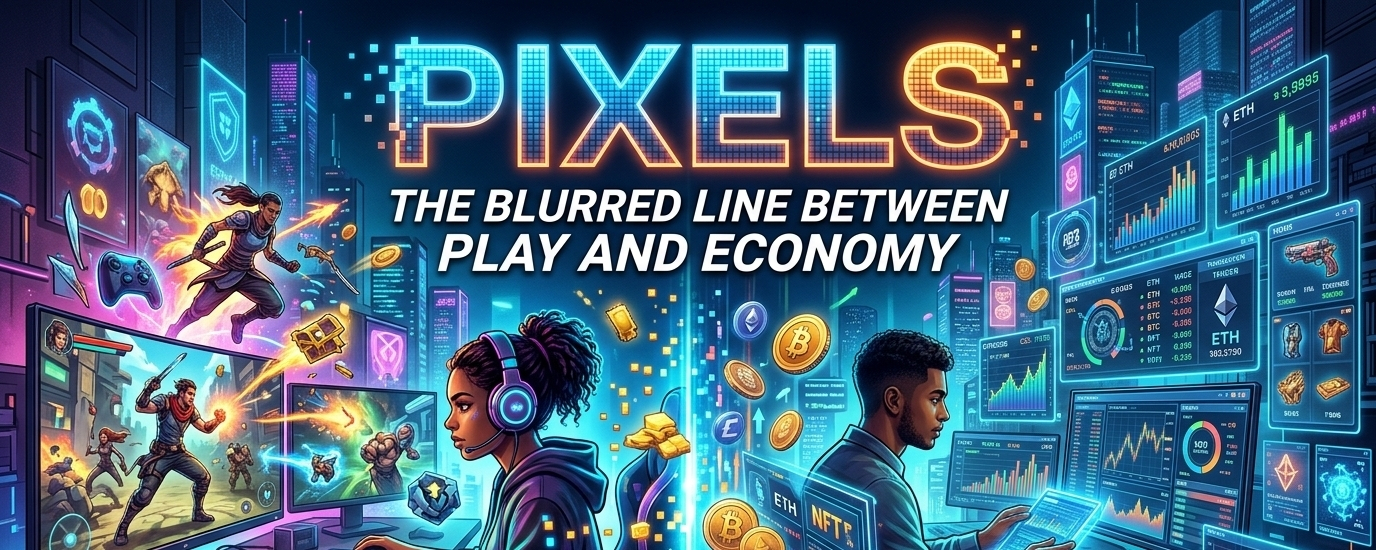

I keep coming back to the same question whenever I spend time in projects like Pixels: what actually makes a digital world feel like a place rather than just a system? It’s easy to say ownership or on-chain assets but those words don’t quite capture the texture of being there planting something waiting for it to grow noticing who your neighbors are and slowly building routines that feel oddly familiar.
Pixels sits in an interesting corner of Web3 because it doesn’t try to overwhelm you with complexity at first glance. You log in, and it feels closer to an old-school browser game than anything resembling finance or infrastructure. You farm you gather you wander. And yet under the surface it’s stitched into a blockchain network that quietly tracks what you own what you trade, and how your time translates into something persistent beyond the game session.
That layering is what makes it worth thinking about. Not because it’s revolutionary on its own but because it exposes a tension that still isn’t resolved in Web3: how much of the blockchain should the player actually feel?
In Pixels, most of the time you don’t feel it at all. And maybe that’s the point. The blockchain isn’t the experience—it’s the substrate. It’s there when you need it mostly invisible when you don’t. That’s a noticeable shift from earlier experiments where the on chain aspect was the main attraction sometimes to the detriment of everything else.
But even if the blockchain fades into the background its presence shapes behavior in subtle ways. When resources have real value outside the game loop, even a simple act like harvesting crops starts to carry a different weight. It’s no longer just about progression. it’s about extraction efficiency and timing. You start to see players optimize in ways that feel less like play and more like work even if they wouldn’t describe it that way.
That’s where things get complicated.
There’s a quiet balancing act happening in systems like this. On one hand giving players control over their assets can make the world feel more meaningful. If you spend time building something it doesn’t just disappear when the game shuts down or changes direction. On the other hand tying in real value risks turning every mechanic into an economic decision. Fun can start to blur with productivity.
Pixels doesn’t fully escape that tension but it also doesn’t lean too hard in either direction. It feels like it’s still figuring out what it wants to be. Sometimes it’s a relaxed farming sim where you log in water your crops and chat with others. Other times it feels like a network of micro-economies with players carefully calculating how to maximize returns on their time.
What’s interesting is how the underlying infrastructure shapes this without being obvious. Running on a gaming-focused blockchain means transactions are fast and cheap enough to not interrupt the flow. That matters more than people usually admit. If every action required noticeable friction the illusion of a living world would break instantly. Instead the system stays responsive almost like a traditional game which makes the economic layer easier to ignore or easier to slip into depending on how you play.
I find myself wondering whether this kind of design is actually the more realistic path forward for Web3 games. Not the ones that loudly announce themselves as blockchain-first but the ones where the technology is quietly doing its job in the background, letting the player decide how deep they want to engage with it.
At the same time there’s an unresolved question about sustainability. If a game world is partially driven by external value what happens when that value shifts? Do players stay because they enjoy the world, or because it was worth something at a particular moment? And if those motivations are mixed does that make the community stronger or more fragile?
Pixels doesn’t answer these questions but it makes them harder to ignore. It shows what happens when you embed a relatively simple almost nostalgic gameplay loop into a system where ownership and trade extend beyond the game itself. The result is neither purely a game nor purely an economy but something in between that still feels unstable in places.
Maybe that’s not a flaw. Maybe it’s just where things are right now.
There’s something oddly compelling about watching players treat a pixelated field like both a garden and a marketplace, switching between those mindsets without always noticing. It makes you realize that the real experiment isn’t just technical it’s behavioral. It’s about how people adapt when the boundaries between play ownership and value start to blur even in something as simple as planting virtual crops.
And it leaves me wondering whether the future of these systems will feel more like games that happen to use blockchains or economies that happen to look like games. Right now Pixels seems to be sitting somewhere in the middle not fully committing either way and maybe that uncertainty is exactly what makes it worth paying attention to.
