
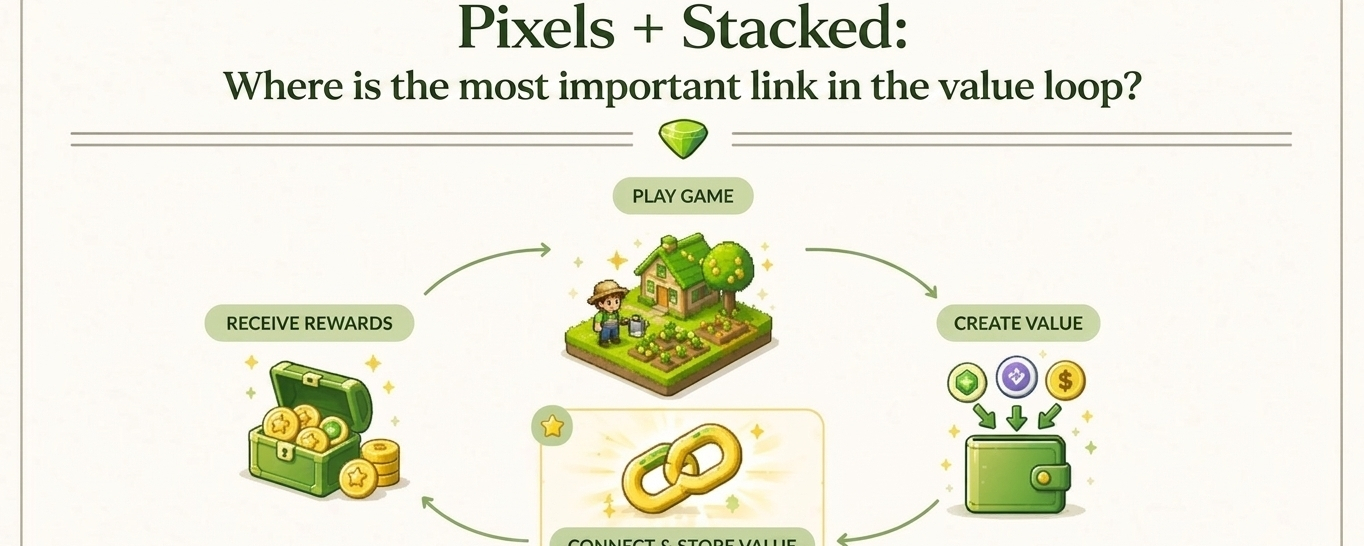
After reading how Pixels frames Stacked, one idea stood out to me and lingered: in systems like this, the real challenge is not how many rewards are issued, but how effectively those rewards are converted into long-term, sustainable value.
If I had to identify the most critical part of the Pixels + Stacked value loop, I wouldn’t point to gameplay, and I wouldn’t point to the token either.
For me, the key lies in one thing: preventing value from exiting the system too quickly after it is created by the user.
It sounds abstract, but this is the core issue.
Pixels is fairly strong at bringing users into the loop. The gameplay is simple, the progression is clear, and new players can quickly understand what to do. That’s why many initially viewed it as a reward-driven farming game.
However, attracting users is not the same as retaining value. These are fundamentally different problems.
In many earlier Web3 games, activity wasn’t the issue. There were players, and there were rewards. But the problem was that value leaked out immediately after being generated. Users would enter, farm rewards, and leave shortly after.
On the surface, these projects could still show activity and engagement, but internally the economy gradually hollowed out. To compensate, they were forced into a cycle of constantly acquiring new users just to replace those exiting.
That’s an exhausting and fragile loop.
From my perspective, Stacked matters because it targets this exact leakage point. It doesn’t create gameplay or replace the community layer. Instead, it operates between interaction and value retention—ensuring that what users generate doesn’t immediately disappear, but is instead retained, recycled, and re-used within the system more effectively.
Many observers tend to focus on the visible metrics: reward levels, TVL growth, or token performance. But those are mostly outcomes.
The real importance lies in the intermediary mechanism—what happens between user activity and actual value retention. Is there a system strong enough to process and stabilize that flow?
What makes Stacked interesting is that it treats rewards not as automatic cost, but as a precise distribution tool. Instead of simply increasing emissions, it forces deeper questions: which users should be retained, which behaviors should be incentivized, and whether each allocation improves retention, revenue, or lifetime value.
To me, this is the most important layer.
Without it, everything else tends to drift toward short-term thinking. Gameplay must constantly evolve just to keep attention. Rewards must keep increasing to maintain engagement. Tokens end up carrying too many roles at once—utility, incentive, and narrative.
Meanwhile, users become focused only on the next reward cycle.
But systems don’t usually fail because they lack activity. They fail because they cannot preserve the value created by that activity in a lasting way.
Stacked appears to address that exact gap.
One detail that stands out is that Stacked-related systems have contributed over $25 million in revenue to Pixels. This isn’t just a flattering statistic—it suggests that the mechanism is creating real economic impact, not just theoretical design.
At that scale, the intermediary layer stops looking like an add-on and starts looking like an operational core.
Another way to think about this layer is that it transforms users from short-term extractors of value into participants who remain inside the value stream. The distinction is subtle but important.
The first type accelerates short-term cycles. The second builds long-term stability.
The health of a digital economy often depends on the balance between these two groups.
Stacked, in this sense, seems designed to improve that balance. It may not trigger explosive short-term growth, but it reduces the amount of value leakage after each cycle.
And that matters more.
When this middle layer works properly, pressure is reduced across the entire system. Gameplay doesn’t need to carry retention alone. Rewards don’t need constant inflation. Tokens aren’t forced to serve every function at once.
A strong intermediary layer makes the system more stable and less strained overall.
In that sense, maturity in such ecosystems isn’t about maximum speed everywhere—it’s about reduced friction everywhere.
So if I had to summarize the most important link in the Pixels + Stacked value loop, it wouldn’t be the gameplay layer or the token layer.
It would be the retention layer—the mechanism that ensures user-generated value doesn’t evaporate too quickly, but instead becomes part of a continuing economic cycle.
Because if that layer is strong enough, Pixels + Stacked stops being a collection of separate systems.
It becomes an economy capable of holding on to the value it creates.
And in Web3, that difference is often what separates short-lived excitement from sustainable growth.