
What cooking is supposed to be
The Cooking skill in @Pixels is documented as a core progression mechanic. It has its own XP track, its own tier unlocks, its own recipes that span from basic staples at Tier 1 to complex dishes at higher levels. The whitepaper and game documentation treat it as a first-class economic skill alongside Farming, Forestry, and Mining.
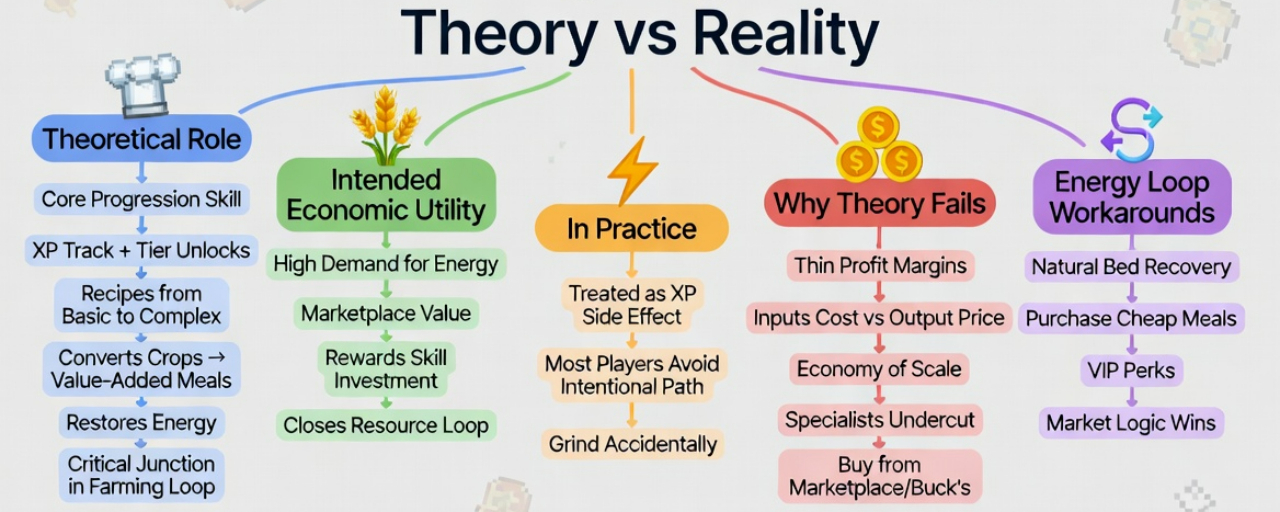
The theoretical role is clear. Cooking converts raw resources into value-added outputs. Crops go in. Meals come out. Meals restore energy. Energy powers all gathering and crafting. In the resource loop the game is designed around, cooking sits at a critical junction: the converter between the farming economy and the activity economy. Without cooking, or some equivalent energy restoration mechanic, the farming loop doesn't close.
In theory, this gives cooking irreplaceable economic utility. Players need energy. Energy requires food. Food requires cooking or purchase. The skill that produces food efficiently should be in high demand, command decent marketplace prices, and reward players who invest in leveling it.
In practice, most players treat Cooking as an XP side effect rather than a deliberate skill path.
Why the theory fails the marketplace test
The gap between what cooking should produce and what players actually do with it comes down to a simple economic signal: the margin on player-cooked meals is too thin to make intentional cooking worthwhile for most player configurations.
Here is the problem. Crafting a meal at Tier 1 or Tier 2 Cooking requires inputs, basic crops and resources, that have their own market value. The meal you produce from those inputs can be sold on the marketplace or consumed for personal energy restoration. If you sell it, the sale price should exceed the cost of inputs plus the opportunity cost of the energy and time spent cooking. If you consume it, the energy value should exceed the value of alternatives.
The issue is that alternatives exist and are often cheaper. Meals are available at Buck's Galore and from other players who have leveled Cooking specifically and are producing at scale. A player with a maxed Cooking skill producing meals on NFT land with the right industry configuration can undercut the inputs-to-outputs margin of a casual cook on a Speck. The casual player's rational response is to buy the meal rather than make it.
This is a classic economy of scale problem. The same resource that's profitable to produce at high volume with low input costs is unprofitable to produce at low volume with higher relative costs. Cooking in @Pixels rewards specialization at a level most players never reach because the game's broader structure doesn't push them toward that specialization.
The energy-cooking-farming loop that should make it inevitable
The puzzle is that Cooking is structurally unavoidable. Players need energy. Energy comes from food. Food comes from Cooking or purchase. You'd expect that structural necessity to drive more players toward the Cooking skill.
What happens instead: players time their sessions to align with natural energy recovery, using the bed in their home Speck to recharge between sessions. Or they buy meals from the marketplace or Buck's Galore at prices low enough that the purchase is cheaper than self-sufficient production at their current skill level. Or they reach for VIP membership, which comes with energy management perks that reduce the urgency of food production.
None of these workarounds are exploits. They're rational responses to a marketplace where cooking outputs are available below the cost of casual production. But they collectively mean that the Cooking skill path, despite its structural centrality to the game's energy system, is occupied by a much smaller fraction of players than the design seems to intend.
What the gap reveals about Pixels' economy
The Cooking problem is a case study in what happens when a game's designed economy and its actual economy diverge. @Pixels designed an energy-food-cooking loop that should make Cooking a primary progression path. The actual economy, shaped by specialist producers at scale, marketplace pricing dynamics, and energy-workaround options, makes Cooking a secondary skill that most players grind accidentally while doing other things.
This gap is not unique to cooking. It's visible across several game mechanics that make sense as design decisions but underperform as economic incentives. The design logic and the market logic pointed in different directions, and the market logic won.
What @Pixels has not done, in any public document or AMA I've found, is address the cooking economy specifically as a design problem to be fixed rather than a player choice to be respected. It's possible the team is satisfied with cooking as a specialist path for a small player segment. It's also possible they designed it as a universal path and haven't published an analysis of why the universality failed.
The gap between what cooking does and what it's supposed to do is the clearest available diagnostic of how the Pixels economy is actually functioning versus how the whitepaper says it functions.