
@Pixels Nothing obvious changed.
No big moment. No update that forced me to rethink how I play. If someone asked me back then, I would’ve said everything felt the same.
But it wasn’t.
Because without realizing it, I had already started playing differently.
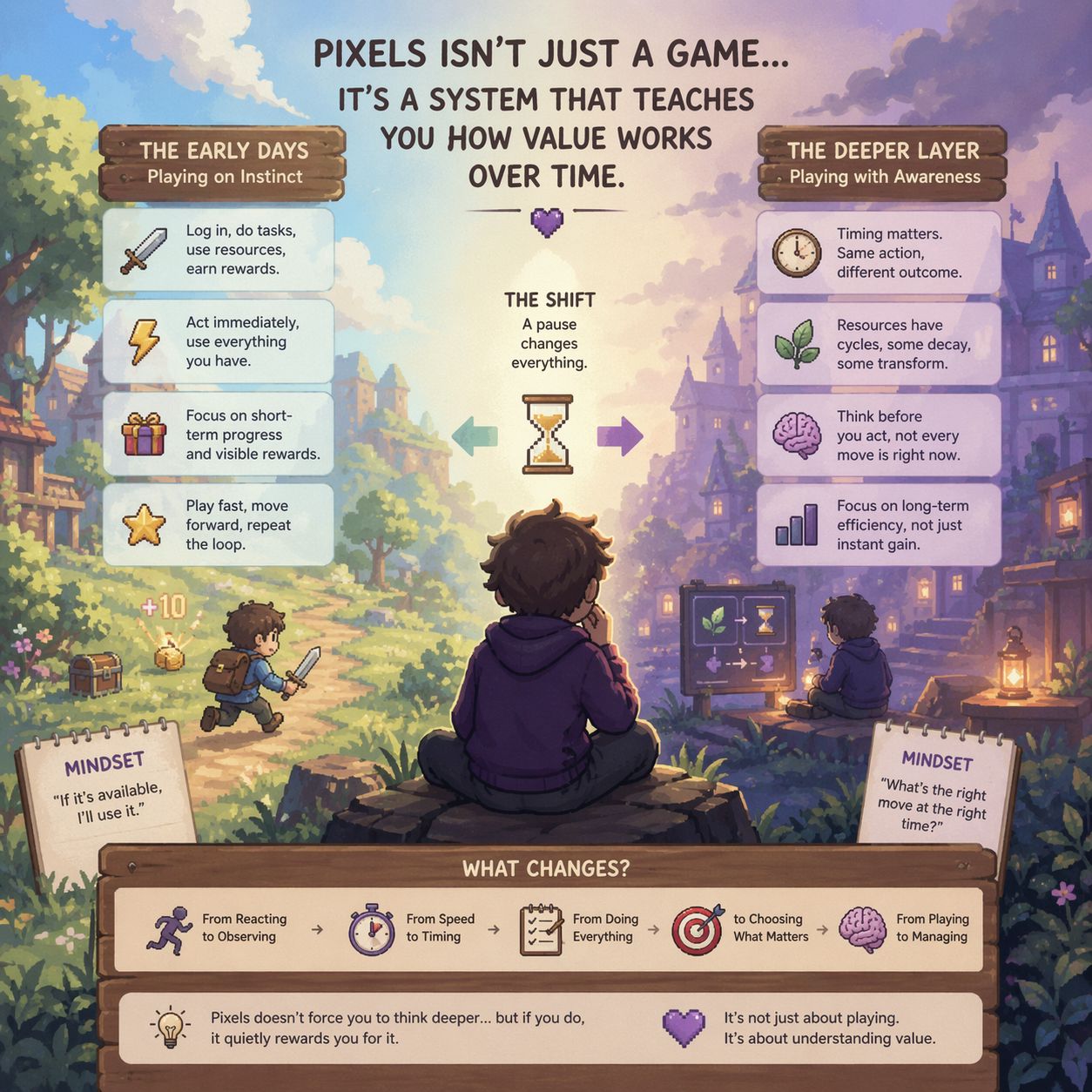
In the beginning, Pixels felt like momentum. You log in and just go. There’s always something waiting tasks to complete, resources to use, progress to make. It pulls you forward without giving you time to question anything.
And honestly, I liked that.
There’s something satisfying about constant movement. It feels like you’re doing things right just by staying active.
So that’s what I did.
I kept moving.
Until I started noticing small disconnects.
Moments where I felt like I made the “correct” move… but didn’t get the best outcome. Moments where using something immediately felt productive but didn’t really help me later.
At first, I ignored it.
I thought maybe I just needed to play more.
But those moments didn’t go away. They started stacking.
And slowly, without deciding to, I changed one small habit:
I stopped acting instantly.
That was it.
No strategy guides, no deep calculations just a pause before doing something.
And that pause changed everything.
Because when you stop reacting automatically, you start seeing things you didn’t notice before.
You start realizing that #Pixels isn’t just giving you choices it’s giving you timing problems.
The same action at different moments doesn’t carry the same weight.
That’s not something the game explains.
You feel it.
You notice it when something works better than expected or worse than it should have.
And once that idea settles in your mind, your entire approach shifts.
You stop thinking, “What can I do right now?”
And start thinking, “What should I not do yet?”
That’s a very different way to play.
It doesn’t feel fast.
It doesn’t even feel like progress sometimes.
But it feels intentional.
I started watching how other players move.
Not what they do but how they decide.
And there’s a clear difference.
Some players treat the game like a checklist. They clear everything, use everything, stay busy at all times. It looks efficient, and in a way, it is.
But others move with restraint.
They leave things unfinished. They hold onto resources. They don’t rush to act, even when they can.
At first, that looks like hesitation.
But it’s not.
It’s awareness.
They understand that value in Pixels isn’t fixed it shifts. It depends on timing, on sequence, on what you choose to delay as much as what you choose to do.
That realization made the game feel different to me.
Not more difficult.
Just less automatic.
Before, I played without friction. Every action flowed into the next. Now, there’s space between actions. Small moments where I think, reconsider, sometimes even decide to do nothing.
And weirdly, those moments feel important.
Because that’s where the real decisions are happening.
Pixels doesn’t demand that you think this way.
You can ignore all of it and still move forward.
But if you start noticing how the system behaves how resources cycle, how outcomes change, how some actions quietly reduce your future options you can’t help but adjust.
And once you adjust, the game stops feeling like something you “run through.”
It starts feeling like something you manage.
Not in a stressful or complicated way.
Just… more deliberately.
And that creates a strange balance.
On one side, the game becomes more meaningful. Your choices matter more. Progress feels earned in a different way not just through effort, but through understanding.
On the other side, it changes the freedom you felt at the start.
You’re not just playing anymore.
You’re deciding.
Sometimes that means slowing down. Sometimes that means waiting. Sometimes that means not doing something that looks obviously beneficial.
That’s not how most games work.
And that’s why this feels different.
It reminds me of how people approach real systems time, money, effort. At first, everything is reactive. You do things as they come. But once you start seeing patterns, you begin to hold back, to plan, to think ahead.
Not because you’re forced to.
But because it makes sense.
Pixels creates that same shift, quietly.
And the strange part is you don’t notice it while it’s happening.
Only after.
Only when you realize you’re no longer playing the way you used to.
So now I keep coming back to this thought:
If a game slowly replaces instinct with intention…
if it teaches you to pause instead of act…
Then maybe the real change isn’t in the game at all.
Maybe it’s in the way you’ve started thinking because of it.
